
AI Literacy for Everyone: How to Use Artificial Intelligence Safely, Creatively and Responsibly
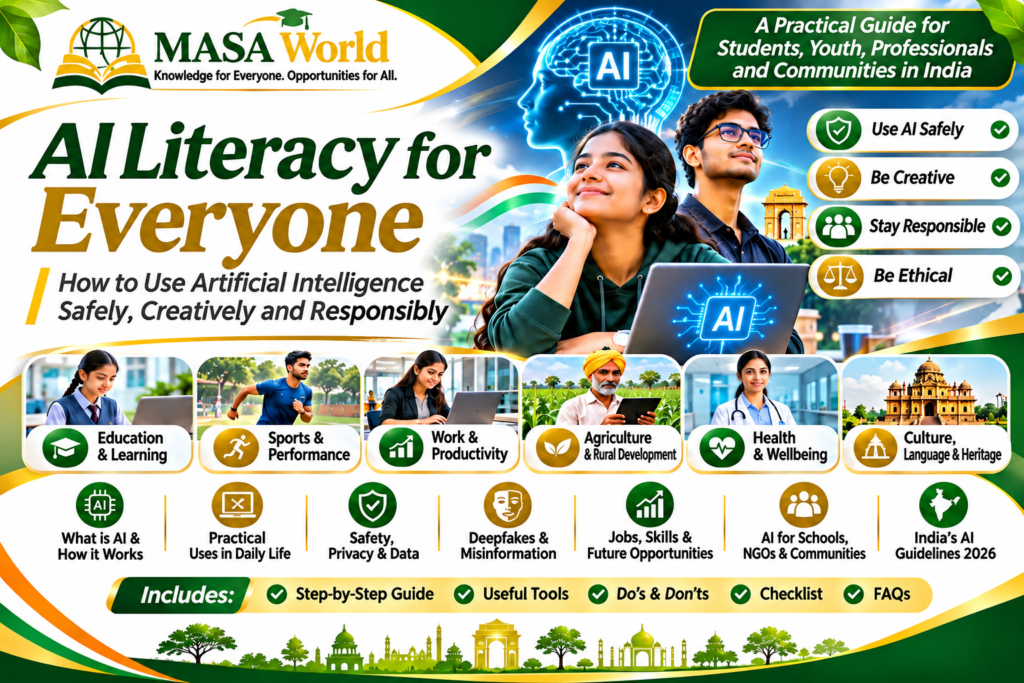
Artificial intelligence is moving into many parts of everyday life in India. Students and teachers encounter AI in education; athletes and coaches can use it to review performance; professionals use it to organise work; farmers may receive digital crop and weather advisories; health systems explore AI-supported workflows; and language technologies can help communities access information and preserve cultural knowledge. These opportunities are different in each sector, but they share one requirement: people must know how to use AI safely, verify its output and retain human responsibility.
This practical guide connects AI literacy with six real-world areas—education and learning, sports and performance, work and productivity, agriculture and rural development, health and wellbeing, and culture, language and heritage. It is written for students, parents, teachers, athletes, coaches, farmers, professionals and community organisations. You do not need to become a programmer; you need the judgement to choose suitable tasks, protect information, recognise limitations and question automated answers.
What AI Literacy Really Means
AI literacy is the ability to understand, evaluate and use artificial intelligence appropriately. It includes knowing what a system can and cannot do, recognising that outputs may be inaccurate or biased, protecting personal information, and making informed decisions about when human expertise is essential. It also includes understanding how AI affects other people and society.
UNESCO’s AI Competency Framework for Students describes learning across four connected areas: a human-centred mindset, ethics of AI, AI techniques and applications, and AI system design. It presents progression through understanding, applying and creating. The message is useful beyond schools: learn the basics, practise carefully, then use your knowledge to solve meaningful problems while keeping human agency at the centre.
How Modern AI Tools Work
Different AI systems perform different tasks. Some classify images, detect patterns, translate languages or recommend content. Generative AI systems can produce new text, images, audio, video or code in response to instructions. Many language models generate responses by predicting likely sequences based on patterns learned during training and the context supplied in a conversation.
This is why a fluent answer is not proof of truth. A model may produce a plausible explanation while misunderstanding a question, relying on outdated information or inventing a source. Some tools can search or retrieve documents; others answer mainly from learned patterns. Know which features are active in the tool you are using and check the evidence independently.
AI does not think, feel or understand the world in the same way a person does. Avoid treating a chatbot as a qualified doctor, lawyer, counsellor, teacher or financial adviser. It can help prepare questions or explain general concepts, but high-impact decisions need reliable evidence and appropriate human judgement.
Choose the Right Task
Start by deciding what you actually need. AI can be useful for brainstorming, outlining, simplifying a difficult concept, generating practice questions, translating a draft, summarising material you are allowed to share, or suggesting ways to organise a project. It may be unsuitable when the task requires confidential information, verified current facts, personal diagnosis, legal interpretation or a decision that affects someone’s rights.
Ask three questions before opening a tool: Will AI add meaningful value? Is the information safe to share? How will I check the result? If you cannot answer the last two questions, change the task or use another method.
A Simple Prompting Framework
A clear prompt gives the tool useful context without exposing private data. Try this five-part structure:
- Goal: State the outcome you want.
- Context: Give relevant background that is not sensitive.
- Audience: Explain who will use or read the result.
- Format: Specify a table, checklist, lesson plan, outline or short explanation.
- Limits: Set length, reading level, tone, sources required and anything the tool must not assume.
Example: “Explain the water cycle to a class 7 student in simple English. Use four short stages, one everyday example and five quiz questions with answers. Do not invent scientific facts; identify any point that needs checking against a textbook.”
For a complex task, work in stages. Ask for an outline first, correct it, then develop one section at a time. Ask the tool to list assumptions and uncertainties. Review the final work yourself instead of accepting the first response.
Check Accuracy Before You Trust an Answer
Fact-checking is one of the most important AI skills. Check names, dates, statistics, quotations, legal rules, medical claims and references against original sources. Open the links and confirm that they support the exact claim. A source title that looks official may be incorrect, incomplete or unrelated.
Use a simple verification routine: identify the claim, find a primary source, check its date and scope, compare with another credible source where appropriate, and record what remains uncertain. For current government schemes, use the relevant ministry or department website. For research, read the original paper or a recognised institutional summary rather than relying only on a generated summary.
Be especially careful with numbers and calculations. Recalculate important figures independently. For code, test it in a safe environment and understand what it does before running it. For images or audio, check provenance and context before sharing. A realistic-looking image or convincing voice recording can still be synthetic or manipulated.
Protect Privacy and Digital Security
Do not paste passwords, one-time passcodes, bank details, identity numbers, private addresses, medical records, student information, confidential work documents or another person’s personal data into an AI tool unless the service is approved for that purpose and you have the necessary authority. Removing a person’s name may not be enough if the remaining details identify them.
Before using a tool, review its privacy settings, data-use terms, retention controls and organisational rules. Use fictional examples or anonymised information when possible. Avoid uploading documents simply because a tool offers the option. Check permissions before connecting email, cloud storage or other accounts, and remove access you no longer need.
AI can also be used in scams. Be cautious of unexpected messages, voice clones, fake job offers, urgent payment requests and links that imitate trusted organisations. Verify unusual requests through a separate known channel. Never share an OTP or password because a caller or chatbot asks for it.
Understand Bias, Fairness and Inclusion
AI systems are shaped by their training data, design choices and the contexts in which they are used. They may perform differently across languages, accents, communities or demographic groups. A system can reproduce stereotypes, overlook local knowledge or present one viewpoint as universal.
Ask whose experiences may be missing, whether the output treats groups fairly, and whether the tool works well for the language and community concerned. Compare important recommendations with evidence and people who understand the local context. Never use an AI score or recommendation as the sole basis for high-impact decisions about education, employment, finance, health or access to services.
Use AI to Learn Without Losing Your Own Skills
Students can ask AI to explain a difficult topic in simpler language, generate practice questions, offer feedback on a draft or create a revision timetable. A strong learning method is to attempt the problem first, ask for a hint rather than a finished answer, solve it independently and then compare the reasoning.
Follow your school, college or examination rules. Some assignments may prohibit AI assistance; others may allow it with disclosure. Do not submit generated work as entirely your own when that misrepresents your effort. Keep notes of how AI was used if your institution requires them. Most importantly, make sure you can explain the final answer without the tool.
Use AI at Work, in Creativity and in Community Projects
Professionals may use approved AI tools to draft routine communications, organise non-confidential notes, brainstorm campaign ideas, or create a first outline for a report. A human should check facts, tone, calculations, permissions and the final decision. Do not upload client or employer information to an unapproved service.
Creators can use AI to explore concepts, develop storyboards or test alternative layouts. Check copyright, licences, platform terms and the rights of people whose likeness, voice or work may be involved. Do not imitate a real person’s identity deceptively or present synthetic evidence as authentic.
Community organisations can use AI to simplify public information, prepare draft learning materials or translate content for review. Local language speakers and subject experts should check meaning, cultural relevance and accessibility before publication. AI should help widen participation, not replace community voices.
AI in Six Real-World Sectors: From Learning to Community Development
AI literacy becomes meaningful when people can connect basic concepts with the work, services and communities around them. The following six areas reflect practical opportunities shown in the MASA World feature image. They are examples of possible uses, not a claim that every tool is accurate, approved or available in every location. Begin with a small, low-risk task, check the output and keep a responsible person in control.
1. Education and Learning
For learners, AI can explain a difficult idea in simpler language, generate practice questions, suggest revision plans, provide feedback on a draft and help teachers prepare differentiated learning material. Students can ask for hints, examples or alternative explanations rather than copying a complete answer. Teachers may use approved systems to prepare lesson outlines, accessible worksheets or language-support drafts, then check them against the curriculum and the learners’ age and needs.
Try this prompt: “Explain photosynthesis to a class 7 learner in simple Hindi and English. Use a familiar example, list five key terms and create five practice questions. Do not provide unsupported facts; flag anything a teacher should verify.”
Safety and quality check: Follow school and examination rules, respect age limits, protect student records and do not let automated scores replace teacher judgement. Check that examples are culturally relevant, accessible and aligned with the syllabus. The National Curriculum Framework for School Education 2023 discusses emerging technologies including AI, while UNESCO’s student and teacher frameworks emphasise human-centred learning, ethics and critical judgement.
2. Sports, Fitness and Athlete Performance
In sport, AI-enabled analysis may help organise video clips, tag events, compare movement patterns, summarise training logs or support performance review. A coach might use video-analysis software to identify recurring technical patterns; an athlete might use a permitted wearable or training application to review activity trends. In community sport, simple digital tools can help prepare practice schedules, translate safety instructions and organise non-sensitive event information.
Try this prompt: “Create a beginner-friendly four-week practice-plan template for a youth martial arts group. Include warm-up, skill practice, recovery and a coach observation column. Do not prescribe medical treatment or infer an athlete’s fitness from incomplete data.”
Safety and quality check: AI output is not a qualified coach, physiotherapist or sports doctor. Do not use unvalidated predictions to select, exclude or rank children. Obtain consent before recording athletes, especially minors; restrict access to footage and health-related data; and never upload private medical records or safeguarding reports to an unapproved service. A coach must check technique, training load, age suitability and athlete wellbeing.
3. Work, Careers and Productivity
At work, approved AI tools can help create a first draft of a routine email, structure a project plan, summarise non-confidential material, generate spreadsheet formulas, prepare interview practice questions or brainstorm customer-service responses. Jobseekers can use AI to identify skills in a vacancy and plan learning, but should never invent qualifications, experience or references. Small organisations can use it to create draft event notices, meeting agendas and public FAQs.
Try this prompt: “Turn these non-confidential task notes into a one-week project plan. Show task, owner role, dependency, deadline and completion evidence. Identify assumptions and leave unknown dates blank rather than inventing them.”
Safety and quality check: Check every figure, formula, deadline and factual statement. Do not paste client records, employee details, unpublished business plans, passwords or confidential documents into a consumer tool unless it has been formally approved for that data. A human manager remains responsible for employment, financial and operational decisions.
4. Agriculture and Rural Development
AI-supported agriculture can combine weather information, crop and soil observations, satellite imagery, pest reports and local agronomic knowledge to help identify patterns and deliver advisories. In India, government-described initiatives include the National Pest Surveillance System, Kisan e-Mitra and Bharat-VISTAAR. These illustrate how digital tools may support pest monitoring, scheme-related queries and multilingual access to agricultural information. Availability, coverage and service features can vary, so farmers should check current official information and local extension support.
Try this prompt: “Prepare a checklist of questions a farmer should ask a local agriculture extension officer after noticing unusual leaf spots on a crop. Include crop name, location, date, weather, affected area and photographs to collect. Do not diagnose the disease or recommend pesticide use.”
Safety and quality check: Never treat a chatbot response or image match as a definitive crop diagnosis. Confirm advice with a qualified agriculture officer, Krishi Vigyan Kendra or relevant agricultural institution before applying pesticides, changing irrigation or spending money. Check local conditions, crop stage, product labels and official advisories. AI advice must account for regional language, connectivity, smallholder affordability and the risk of incorrect recommendations.
5. Health and Wellbeing
AI may help health professionals organise information, support selected image-analysis or workflow tasks, and help the public find or understand general health information. For an individual, a low-risk use may be preparing questions for a doctor, translating a general health leaflet or organising a list of symptoms to discuss at an appointment. These uses do not make a general-purpose chatbot a clinician or a validated medical device.
Try this prompt: “Help me prepare for a routine doctor appointment. Give me a neutral checklist of questions about symptoms, duration, medicines and follow-up. Do not diagnose me, recommend a medicine or tell me to stop prescribed treatment.”
Safety and quality check: Do not rely on AI for emergency triage, diagnosis, prescriptions or treatment decisions. Seek qualified medical care for health concerns and emergency services for urgent symptoms. Do not upload identifiable medical records, photographs or another person’s health information to an unapproved tool. India’s ICMR ethical guidelines for AI in biomedical research and healthcare address consent, ethics review, governance and responsibilities of stakeholders; they are an important reference for organisations, researchers and developers.
6. Culture, Languages and Heritage
AI can assist with first-draft translation, subtitles, speech transcription, searchable archives, audio description and organising community-history material. In a multilingual country, language technology may help people discover information in a language they understand. India’s BHASHINI initiative aims to make digital services more accessible in Indian languages through AI-powered language technologies. Community organisations may also use approved tools to prepare draft captions or transcriptions for local review.
Try this prompt: “Create a draft bilingual Hindi-English caption for a community folk-art event using only the facts supplied below. Preserve the names of artists and the local art form exactly. Mark uncertain spellings for a community reviewer and do not invent historical claims.”
Safety and quality check: Translation is not cultural verification. Ask fluent speakers, artists, historians or community representatives to review names, meanings and context. Obtain informed consent before recording or digitising oral histories, songs, performances or identifiable people. Respect copyright, performers’ rights, sacred or restricted knowledge and community control over how heritage material is stored, described and shared. Do not use AI-generated images or voices to misrepresent a real tradition or person.
One Responsible Method Across All Six Sectors
- Define the task: identify the specific problem and the person who benefits.
- Choose a suitable tool: check whether it is approved, accessible and appropriate for the data and task.
- Minimise information: share only what is necessary; remove personal or confidential details wherever possible.
- Ask for a bounded output: state the audience, format, source requirements and limits.
- Verify independently: check evidence, local context, calculations, language and possible bias.
- Keep human responsibility: a qualified or authorised person reviews the result before it affects a learner, athlete, worker, farmer, patient or community member.
- Learn from errors: provide a way to correct mistakes, report harm and stop using a tool that is not fit for purpose.
For MASA World, these examples can become practical AI-literacy activities across education, sports development, youth employability, community awareness, rural outreach and cultural documentation. Programmes should teach people not only how to operate a tool, but also how to question it, protect one another and decide when not to use it.
Be Transparent and Respect Rights
When AI materially contributes to a public-facing report, image, application or educational assignment, follow the disclosure rules of the relevant institution, client or platform. Keep a record of the tool and the type of assistance used when appropriate. Do not invent human testimonials, research results, qualifications or endorsements.
Respect privacy, copyright, consent and intellectual property. Having access to a photograph, document or voice recording does not automatically give permission to upload it, transform it or publish an AI-generated derivative. Check the rights and terms that apply before using material commercially or publicly.
Guidance for Parents, Teachers and Organisations
Parents and caregivers: talk with children about what AI tools do, age restrictions, privacy and online manipulation. Encourage children to question answers and tell a trusted adult when a tool asks for personal details or makes them uncomfortable. Keep use age-appropriate and balanced with reading, play, conversation and real-world activities.
Teachers and schools: set clear rules for permitted and prohibited uses, protect student records, choose age-appropriate tools and teach source checking. Assessment can include oral explanation, drafts, practical work and reflection so that learners demonstrate their own understanding. UNESCO’s guidance for generative AI in education and research emphasises human-centred use, privacy, inclusion and institutional responsibility.
Organisations: create an AI-use policy that identifies approved tools, data that must never be entered, review responsibilities, record-keeping and escalation routes for errors or incidents. Train staff and revisit the policy as tools and risks change.
Five Practical Projects to Build AI Literacy
- Compare explanations: ask an AI tool and a textbook to explain one topic. Identify what is consistent, what differs and which source provides evidence.
- Build a quiz: create ten practice questions, answer them yourself and verify every answer using trusted learning material.
- Improve a draft: ask for feedback on a paragraph you wrote. Decide which suggestions improve clarity and explain which you reject.
- Test a translation: compare a short public information message in two languages and ask a fluent speaker to check accuracy and tone.
- Audit a claim: choose a viral AI-related claim, trace it to an original source and write a short evidence-based conclusion.
A Four-Week Learning Plan
Week 1 – Understand: learn basic AI terms, identify everyday examples and understand the difference between predictive and generative systems.
Week 2 – Practise: write clear prompts for low-risk tasks. Change one instruction at a time and compare how the output changes.
Week 3 – Verify: complete a small project and check factual claims, sources, calculations, privacy and possible bias.
Week 4 – Reflect: record where AI helped, where it failed, what human judgement added and what rules you will follow next time.
At the end, explain the project to another person without relying on the tool. If you can describe the process, identify its limitations and justify your decisions, you are developing practical AI literacy.
AI Literacy in India: Governance, Rights and Responsible Use
AI literacy in India should include awareness of the country’s evolving policy and legal environment. The Government of India’s India AI Governance Guidelines, published in February 2026, set out a principle-based approach to safe, trusted and inclusive AI. The framework discusses seven guiding sutras and governance mechanisms intended to support innovation while addressing risks such as privacy, bias, misinformation, cybersecurity and accountability. These guidelines are a policy framework; they should not be mistaken for a single new law that replaces existing legislation.
People and organisations should also understand that existing laws may apply to the way AI is used. These can include data protection, information technology, consumer protection, intellectual property, criminal law and sector-specific rules. The Digital Personal Data Protection Act, 2023 and its applicable rules, commencement notifications and official guidance should be checked on the Ministry of Electronics and Information Technology website before an organisation designs a data-processing workflow. Legal requirements can change, and this article is not legal advice.
For everyday users, the practical lesson is simple: obtain appropriate permission before using personal data, collect only what is needed, protect it, explain relevant uses, and provide a way for people to raise concerns. Organisations should identify who is accountable for an AI-supported decision and how an error can be reviewed or corrected.
Deepfakes, Synthetic Media and Misinformation
Generative tools can create or alter photographs, voices, videos and documents. Some uses are harmless or creative when clearly labelled and consensual. Others can impersonate a person, fabricate evidence, spread false claims, enable financial fraud or cause serious reputational harm. A familiar face or voice is no longer sufficient proof that a message is genuine.
Before forwarding a surprising video, voice note or urgent request, pause and verify it through another channel. Check the original source, publication date, context and whether reputable outlets or the relevant organisation confirm it. Look for inconsistencies, but do not rely only on visual glitches: high-quality synthetic media may have none, while genuine media can look unusual after compression or editing.
If someone appears to be asking for money, confidential information or urgent action, contact them using a phone number or channel you already trust. Do not use the contact details supplied in the suspicious message. Preserve relevant links, screenshots and message details if reporting is necessary. Report impersonation or harmful content to the platform and use the appropriate official cybercrime or law-enforcement channel. Do not download, create or redistribute intimate synthetic imagery of a person without consent.
Indian Languages, Accessibility and the Digital Divide
AI can make information easier to access through translation, speech-to-text, text-to-speech, captions and simplified explanations. These possibilities matter in a multilingual country where people may prefer to learn in Hindi, Bengali, Tamil, Telugu, Marathi, Urdu, Nepali or another language. Assistive tools can also help some people with disabilities participate in education, work and public services.
However, quality is uneven. A translation may change legal meaning, omit a cultural reference or mishandle a local expression. Speech systems may struggle with accents, background noise or dialects. Automated captions can misrepresent names and technical terms. Always ask a fluent speaker or relevant subject expert to review important public information, especially health, safety, legal and government-service content.
Access is also unequal. Devices, connectivity, digital skills, disability access, language support and affordability influence who benefits. A responsible AI programme should offer non-digital alternatives where needed, use accessible formats, avoid assuming every learner has a personal device and ensure that human help remains available.
AI, Work and Skills for the Future
AI may automate parts of a task without eliminating the need for the people who understand its purpose, context and consequences. The impact differs by occupation, sector and organisation. Rather than relying on dramatic predictions about which jobs will disappear, examine the tasks in a role: which are repetitive, which require trust and physical presence, and which depend on judgement, creativity, negotiation or accountability?
Useful transferable skills include communication, critical thinking, subject knowledge, data awareness, problem-solving, collaboration, digital security and the ability to learn new tools. Technical pathways may include data analysis, software development, cybersecurity, AI evaluation, design, robotics and responsible AI governance. Non-technical roles also need AI literacy: teachers, coaches, administrators, entrepreneurs, journalists and community workers all need to judge when AI assistance is appropriate.
Students and jobseekers can build evidence of capability through small projects: a verified research brief, a carefully tested spreadsheet, an accessible multilingual information resource or a documented workflow that protects personal data. Explain what you did yourself, which tools assisted you, how you checked the output and what limitations remain.
A Practical AI Checklist for Schools, NGOs and Small Organisations
Before introducing an AI tool, an organisation should answer the following questions and document its decisions:
- Purpose: What real problem will the tool solve, and is AI necessary?
- Approval: Who has authority to approve the tool and its intended use?
- Data: What information will be entered, where will it go, and is it appropriate to share?
- People: Could the output affect a child’s safety, a person’s rights, access to a service or an important opportunity?
- Verification: Who checks factual accuracy, bias, accessibility and cultural context?
- Transparency: When should participants, readers or clients be told that AI was used?
- Security: Who can access the account, files and connected services, and how is access removed?
- Incident response: What happens if the system exposes data, generates harmful content or makes a consequential error?
- Review: When will the organisation reassess whether the tool remains useful and safe?
For MASA World and community sports or education programmes, low-risk uses may include drafting a first version of a public event notice, generating practice quiz questions, translating a non-sensitive announcement for human review, or organising publicly available information. Do not upload children’s attendance records, photographs, medical details, safeguarding reports, identity documents or private contact lists to unapproved AI services. Coaches and programme leaders must remain responsible for athlete welfare, selection, safeguarding and disciplinary decisions.
A Human Review Workflow Before Publishing AI-Assisted Work
- Draft: Use AI only for an approved, clearly defined part of the task.
- Separate facts from suggestions: Mark claims, numbers, quotations, recommendations and creative ideas that need different kinds of review.
- Verify: Check factual claims against primary sources and test calculations, links, code or translations.
- Review people and rights: Check privacy, consent, bias, copyright, accessibility and possible harm.
- Approve: A named person with appropriate subject knowledge accepts responsibility for the final version.
- Disclose and retain: Record material AI assistance when relevant and keep only the records that are necessary under the organisation’s policy.
This workflow is especially important for content that gives health, financial, legal, safety or public-service guidance. A disclaimer alone does not make an inaccurate or unsafe output acceptable.
Frequently Asked Questions
Do I need coding skills to become AI literate?
No. Coding can be useful for technical work, but everyday AI literacy starts with understanding capabilities, writing clear instructions, checking outputs, protecting information and making responsible choices.
Can AI answers be wrong even when they sound confident?
Yes. AI tools can produce plausible but inaccurate information, invented citations or outdated details. Verify important claims using original and trusted sources.
Is it safe to upload personal documents?
Not automatically. Check the tool’s privacy terms, settings and your organisation’s rules. Do not upload sensitive or confidential information unless the service is approved and you are authorised to share it.
Should students use AI for homework?
Only in ways permitted by their school or institution. It can support practice and explanation, but students should do their own thinking, disclose assistance when required and understand the work they submit.
Will AI replace human judgement?
AI can automate or support some tasks, but people remain responsible for decisions, fairness, context, relationships and accountability. Keep a human review step, especially for high-impact uses.
Final Thoughts
AI literacy is not about using the newest tool for every task. It is about knowing when a tool is useful, when it is unreliable, what information must remain private and when a person with relevant expertise should take over. Start with a low-risk project, check every important claim, respect other people’s rights and keep learning.
Used thoughtfully, AI can support curiosity, creativity and access to knowledge. The goal is not to surrender judgement to technology, but to become more capable of making informed choices in a world where AI is increasingly present.
Editorial note: This is general educational information. Follow applicable laws, institutional policies and the terms of the AI service you use.
Trusted Resources and Further Reading
- UNESCO – AI Competency Framework for Students (2024)
- Ministry of Education – National Curriculum Framework for School Education 2023 (AI and emerging technology section)
- ICMR – Ethical Guidelines for AI in Biomedical Research and Healthcare (2023)
- BHASHINI – AI-powered Indian language and multilingual access platform
- PIB – Artificial Intelligence Transforming Indian Agriculture (14 February 2026)
- ICAR – Bharat-VISTAAR multilingual AI agricultural advisory initiative (17 February 2026)
- Ministry of Agriculture – Promotion of AI Use in Agriculture and Impact Assessment (24 July 2026)
- UNESCO – Guidance for Generative AI in Education and Research
- UNESCO – AI Competency Framework for Teachers
- NIST – AI Risk Management Framework
- Ministry of Electronics and Information Technology, Government of India
- Government of India – India AI Governance Guidelines (15 February 2026)
- MeitY – Digital Personal Data Protection framework and official updates
- PIB / MeitY – Government information on safeguards against AI-generated deepfakes (30 July 2026)
- UNESCO–MeitY – India AI Readiness Assessment Report (2026)
Explore More from MASA
Continue building digital awareness, critical thinking and everyday learning skills with these related guides.



Pingback: Artificial Intelligence (AI): What It Is, How It Works, Uses, Benefits and Risks – MASA WORLD