SARAS Food Festival 2026: Delhi’s Celebration of Regional Food, Women’s Enterprise and Rural Crafts
Updated: 19 November 2026 | Category: Festivals & Culture
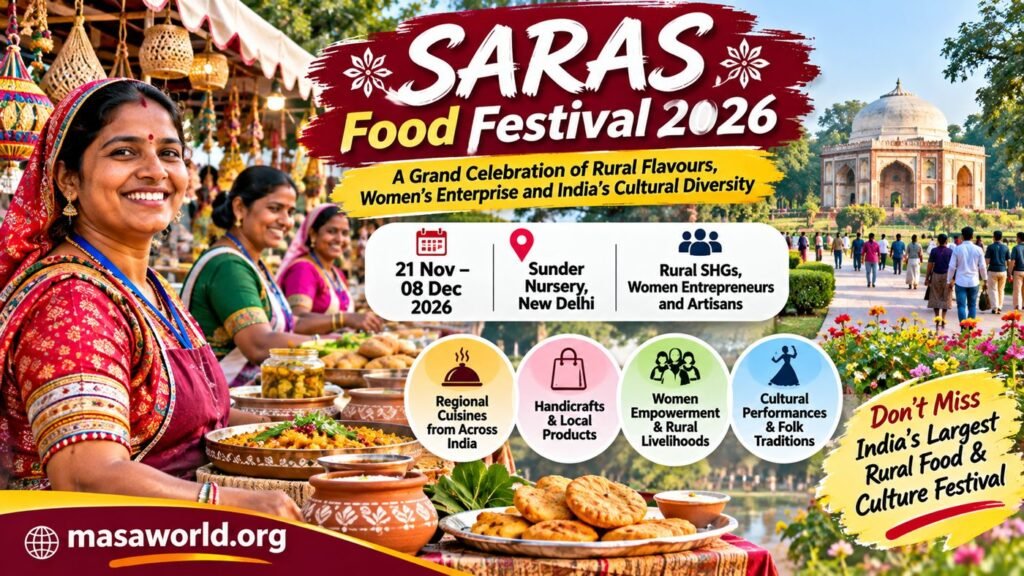
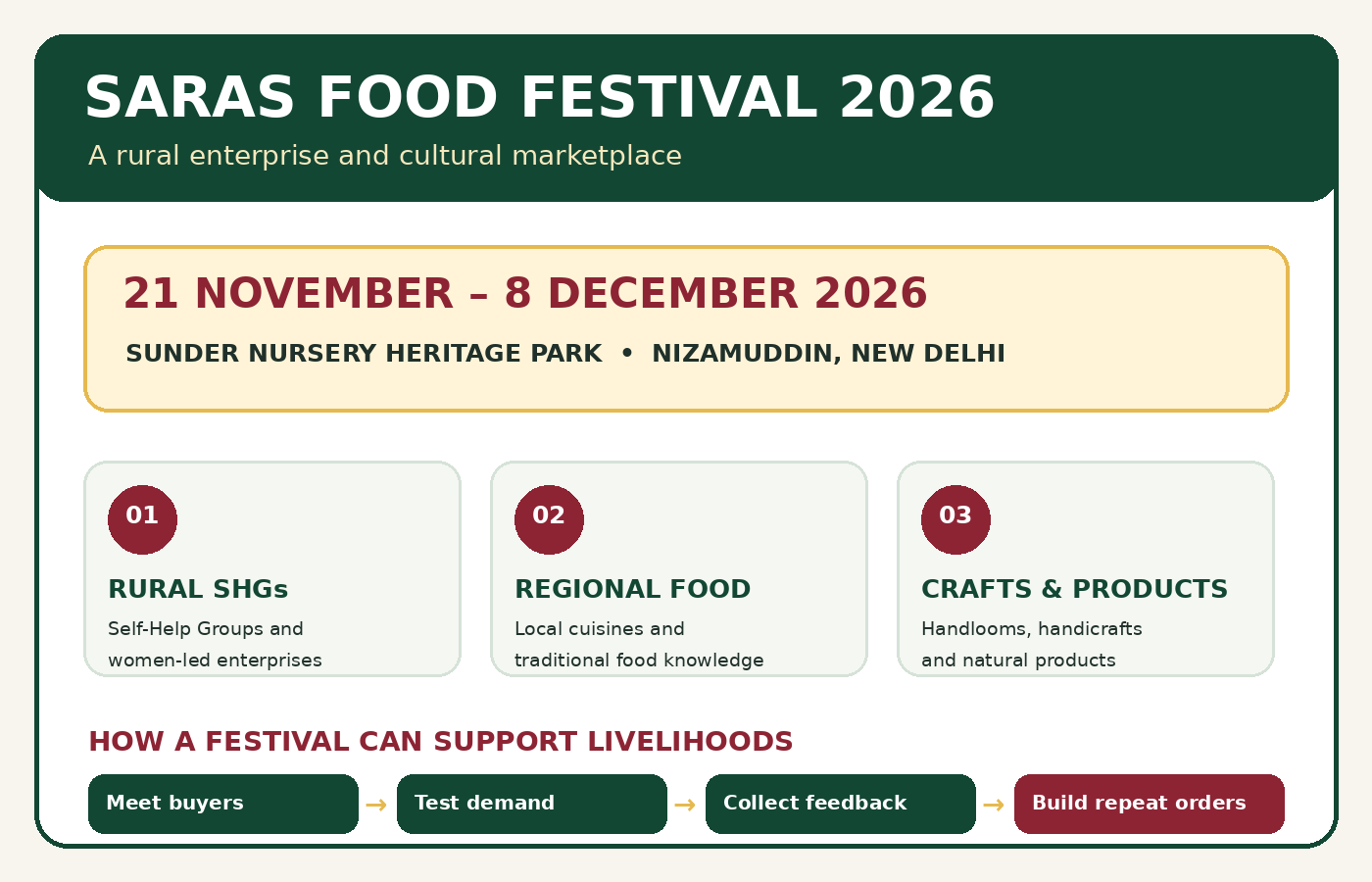
The SARAS Food Festival 2026 is scheduled at Sunder Nursery, New Delhi, from 21 November to 8 December 2026. The Ministry of Rural Development includes the event in its national SARAS Aajeevika Mela calendar for 2026–27. The festival brings rural food, crafts and women-led enterprises closer to urban visitors. It also creates a public space to understand how local skills can support livelihoods.
This guide explains the confirmed schedule, the programme’s purpose, visitor information and the wider role of rural Self-Help Groups (SHGs). It separates confirmed event details from practical advice that visitors should verify before travelling.
Table of Contents
- Executive Summary and Key Details
- What Is the SARAS Food Festival?
- The Programme Behind the Festival
- Dates, Venue and Entry Information
- Regional Food, Crafts and Cultural Knowledge
- Why Women-Led Rural Enterprise Matters
- How to Plan a Responsible Visit
- How to Measure the Festival’s Real Impact
- What Should Happen After the Festival?
- MASA World Editorial Insight & Community Guidance
- Frequently Asked Questions
- Official References
Executive Summary and Key Details
The Ministry’s published calendar confirms the event dates and venue. The official Sunder Nursery event page also lists the festival dates and explains the entry arrangement. Visitors should check both sources again before departure because event operations can change.
| Item | Confirmed information |
|---|---|
| Event | SARAS Food Festival 2026 |
| Dates | 21 November to 8 December 2026 |
| Venue | Sunder Nursery Heritage Park, Nizamuddin, New Delhi |
| Duration | 18 calendar days |
| Institutional programme | SARAS Aajeevika Mela calendar 2026–27 |
| Main focus | Rural SHGs, women entrepreneurs, regional food and crafts |
| Entry information | The event page says event entry is free; a Sunder Nursery entry ticket applies |
| Official venue address | Nizamuddin, New Delhi, Delhi 110013 |
Important: The official sources cited here confirm the dates and venue. They do not establish a fixed daily opening time, a complete stall list or a final programme of performances. Do not rely on unofficial posts for those details.
What Is the SARAS Food Festival?
SARAS events provide market access to rural producer groups, including women’s Self-Help Groups and artisans. These groups make and sell products linked to local skills, food traditions and community resources. A public festival gives them an opportunity to meet customers beyond their home districts.
The food festival places regional cuisine at the centre of this market platform. Visitors may explore food traditions and locally made products while learning about the people behind them. The wider SARAS platform also showcases handlooms, handicrafts, natural products and other regional goods.
The event should therefore be understood as more than a food outing. It is also a market connection between rural producers and urban consumers. The value of that connection depends on fair sales, useful customer feedback and opportunities that continue after the event.
The Programme Behind the Festival
The Ministry of Rural Development lists SARAS activities under the Deendayal Antyodaya Yojana–National Rural Livelihoods Mission (DAY-NRLM). The mission works through community institutions and SHGs to strengthen rural livelihoods. SARAS events form one route through which producer groups can display products and reach wider markets.
The Ministry’s 2026–27 calendar includes several events in the region. It lists the SARAS Aajeevika Mela at Leisure Valley Park, Gurugram, from 22 October to 6 November 2026. It then lists the SARAS Food Festival at Sunder Nursery, Delhi, from 21 November to 8 December 2026. The calendar also lists a national SARAS Aajeevika Mela at Major Dhyan Chand National Stadium, Delhi, from 1 to 28 February 2027.
This sequence shows that SARAS is a continuing programme, not a single exhibition. Different events can give producer groups more than one chance to meet buyers. However, the calendar alone does not confirm which individual groups will attend each event.
Dates, Venue and Entry Information
When is the festival?
The official schedule is 21 November to 8 December 2026. The dates appear in the Ministry’s national calendar and on the Sunder Nursery event page. The festival is scheduled across 18 calendar days.
Where will it take place?
The venue is Sunder Nursery Heritage Park in the Nizamuddin area of New Delhi. The venue’s published address is Nizamuddin, New Delhi, Delhi 110013. Visitors should use the official venue directions and check current traffic and public transport information before travelling.
Does the event have an entry fee?
The Sunder Nursery event page states that entry to the event is free, while an entry ticket to Sunder Nursery applies. These are two separate conditions. Visitors should check the venue’s current ticket information before the visit. Do not assume that free event access means free entry to the entire heritage park.
What about daily timings?
The sources cited in this guide confirm the dates and venue, but do not provide a dependable daily timing schedule. Check the event organiser or Sunder Nursery website for the latest operational notice. The same check should cover stall availability, cultural performances, access arrangements and any temporary restrictions.
Regional Food, Crafts and Cultural Knowledge
Food carries knowledge about geography, farming, climate and family practice. Ingredients that are common in one region may be unfamiliar in another. Cooking methods can reflect local crops, seasonal conditions and the equipment available to households. A regional food event can help visitors understand these connections through direct conversation and tasting.
Food also links with craft and other forms of local production. A community may make food products alongside textiles, household goods or decorative items. These products can share local materials, design traditions and skills passed between generations. A festival can place this work in front of customers who may not otherwise encounter it.
Questions visitors can ask
- Which region or community is associated with this product?
- Which ingredients or materials are used?
- How should the food item be stored after purchase?
- Who makes the product, and how is the group organised?
- Can the producer group accept repeat orders after the event?
These questions make the visit more informative. They also allow producers to explain their work in their own words. Visitors should avoid treating a stall as a display without recognising the business and labour behind it.
Why Women-Led Rural Enterprise Matters
SHGs can help women organise savings, production and collective business activity. Group structures may also support training, access to services and shared decision-making. When groups sell products directly, members can learn what customers value and which products need improvement.
Market access is important, but it does not automatically create a stable enterprise. A group needs to understand production costs, product quality, supply capacity and customer demand. It may also need support with packaging, transport, storage, digital payments and bookkeeping.
Events such as SARAS can reduce one barrier: finding a place to present products to new customers. They can also help groups test prices and receive feedback. But a stall’s sales during one event do not, by themselves, prove long-term income growth. Reliable impact information requires follow-up data.
What makes a market opportunity useful?
- Fair pricing: The selling price should cover materials, labour, packaging and transport.
- Product quality: Food and non-food products should meet relevant safety and quality requirements.
- Clear records: Groups should record sales, expenses and the amount retained by members.
- Customer relationships: Buyers should have a reliable way to place repeat orders.
- Member control: Women should understand and participate in decisions about revenue and business direction.
How to Plan a Responsible Visit
A little preparation can make the visit easier. Check the official event page before leaving home. Confirm the date, park entry ticket, access rules and any updated visitor notice. If you are travelling with children or older family members, plan rest breaks and agree on a meeting point.
Before you leave
- Recheck the official event page for changes to dates or access.
- Confirm Sunder Nursery’s current entry ticket and visitor rules.
- Check traffic, public transport and parking information from current sources.
- Carry suitable payment options and keep personal belongings secure.
- Check weather conditions and plan water and rest breaks.
At the festival
- Ask sellers about ingredients if you have a food allergy.
- Check storage instructions and product labels before buying packaged food.
- Pay the displayed price and respect the work behind each product.
- Ask permission before taking close photographs of sellers or artisans.
- Use waste bins and follow the heritage park’s rules.
Visitors should remember that the venue is also a heritage and landscape space. Keep pathways clear and avoid damaging plants, structures or displays. Follow staff instructions and any safety notice issued during the event.
How to Measure the Festival’s Real Impact
Attendance and public interest are visible measures, but they are not enough to judge the programme’s livelihood value. A useful evaluation should examine what happened to participating groups during and after the event. It should focus on business outcomes as well as cultural visibility.
Relevant measures could include:
- Total sales and net income retained by participating groups.
- Number of new customer contacts and repeat orders.
- Products that attracted demand and products that remained unsold.
- Changes in packaging, pricing, quality or production planning.
- Whether women members took part in business and revenue decisions.
- Transport, stall, storage and other costs faced by producer groups.
These are suggested evaluation measures, not published results for the 2026 festival. The official schedule does not provide sales totals, visitor numbers or income outcomes. Such figures should only be reported when the organiser releases verifiable data.
What Should Happen After the Festival?
The period after the event is important. Producer groups can review sales records and customer questions. They can identify which products need better packaging, clearer labels or a different price. They can also record the cost of transport, ingredients, labour and unsold stock.
Buyers who want to continue working with a group should ask for an authorised business contact or catalogue. Producer groups should share contact details only with consent and should handle customer information responsibly. Institutions can support follow-up through training, logistics, quality guidance and links to regular buyers.
A successful event should create more than a short period of visibility. It should help producers build customer relationships and improve business capability. Public reporting should explain the results without exaggerating them or exposing private information about individual members.
MASA World Editorial Insight & Community Guidance
Visit SARAS with curiosity and respect. Learn about the people behind regional food and local products. Buy directly when possible, pay fairly and share only verified event information. A meaningful market platform should recognise the skills of rural producers and support opportunities beyond the festival dates.
MASA World encourages readers, schools, community organisations and local institutions to treat such events as learning opportunities. Young people can explore regional food and craft traditions. Consumers can support rural businesses through informed purchases. Institutions can help producer groups build long-term market links.
The central question is not only how many people visit. It is whether participating women and producer groups gain fair income, useful business contacts and stronger control over their enterprises. That is the standard by which the lasting value of a livelihood festival should be judged.
Frequently Asked Questions
1. What are the dates of SARAS Food Festival 2026?
The official calendar lists the festival from 21 November to 8 December 2026. The Sunder Nursery event page lists the same dates.
2. Where is SARAS Food Festival 2026 being held?
The scheduled venue is Sunder Nursery Heritage Park in Nizamuddin, New Delhi. The published address is New Delhi, Delhi 110013.
3. Is entry to SARAS Food Festival free?
The venue’s event page says event entry is free, but a Sunder Nursery entry ticket applies. Check the latest ticket information before travelling.
4. Who can visitors expect to meet at the festival?
The programme is designed to provide a platform for rural Self-Help Groups, women entrepreneurs and artisans. The official calendar does not provide a confirmed stall-by-stall participant list.
5. What can visitors buy or explore?
SARAS events showcase regional cuisines, handlooms, handicrafts, natural products and other regional goods. The exact products and participating sellers may vary by event.
Official References
- Press Information Bureau, Ministry of Rural Development: SARAS Aajeevika Mela Calendar 2026–27, 24 April 2026.
- Sunder Nursery: SARAS Food Festival, November 2026 – event dates, venue and entry note.
- Deendayal Antyodaya Yojana–National Rural Livelihoods Mission (DAY-NRLM).
Editorial note: Event dates, venue and entry wording are based on the official references above, checked on 19 November 2026. Daily timings, participant lists and event operations should be confirmed through the organiser’s latest notice.