
Adi Vaani AI Platform: 13 Tribal Languages, Translation Tools and What Works in 2026
Category: Tech & AI | Updated: 19 November 2026
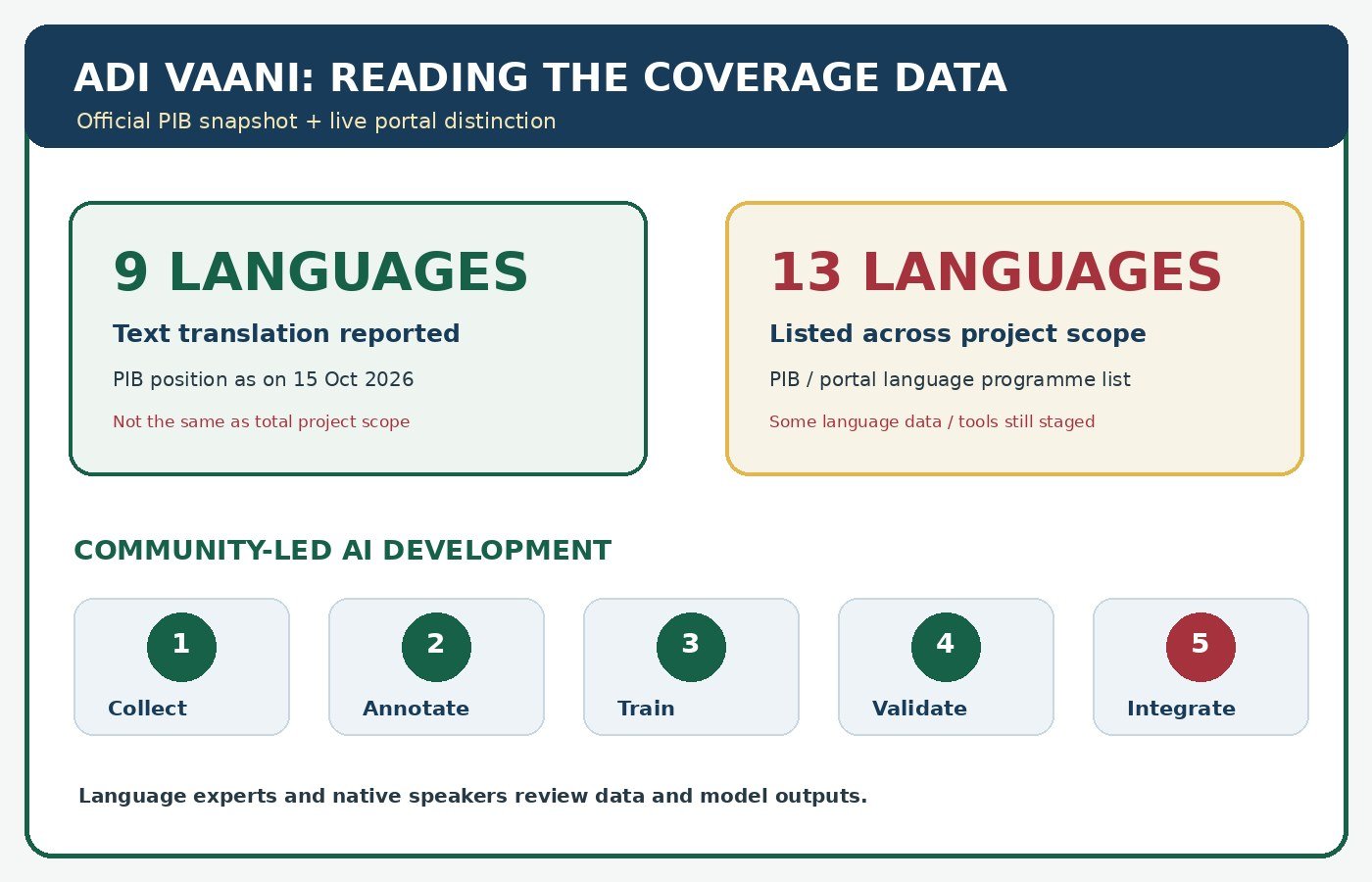
India’s Adi Vaani platform is bringing artificial intelligence to a difficult but important task: making tribal languages easier to use in the digital world. The Ministry of Tribal Affairs launched the platform on 1 September 2025. It was developed with IIT Delhi, research institutions and tribal communities. A Ministry backgrounder published by the Press Information Bureau (PIB) on 15 November 2026 reports text translation in nine tribal languages as of 15 October. The wider project now lists 13 languages, but not every language has the same working features or level of readiness. This difference matters when users assess what the platform can do today.
Adi Vaani combines translation tools with dictionaries, primers, speech resources and community-led language documentation. Its long-term value will depend on accuracy, informed consent and meaningful control by the communities whose languages it represents.
Table of Contents
- Adi Vaani: key facts at a glance
- Why tribal languages need digital support
- What Adi Vaani does
- Nine live text languages and 13 project languages: the difference
- How community data becomes an AI language tool
- Education, healthcare and public-service uses
- Accuracy, privacy and cultural safeguards
- How people can explore the platform
- The National Tribal Language Repository proposal
- MASA World Editorial Insight & Community Guidance
- Frequently Asked Questions
- Official references
Adi Vaani: key facts at a glance
| Measure | Verified information |
|---|---|
| Responsible ministry | Ministry of Tribal Affairs, Government of India |
| Launch date | 1 September 2025 |
| Development consortium | Led by IIT Delhi with BITS Pilani, IIIT Hyderabad, IIIT Nava Raipur and State Tribal Research Institutes |
| Text translation | Nine tribal languages, as reported for 15 October 2026 |
| Wider project coverage | 13 tribal languages listed in the PIB backgrounder and project information |
| Language learning resources | More than 300 primers and 24 dictionaries, according to PIB |
| Android downloads | More than 35,000 as reported in the 15 November backgrounder |
| Monthly users | Around 6,500 as reported in the same backgrounder |
| Community data contributed | About 13.9 lakh text sentences across ten languages and around 300 hours of speech data |
| National Working Group | First meeting held on 15 October 2026 |
How to read these figures: PIB’s nine-language figure refers to text translation availability on 15 October 2026. The 13-language figure describes the wider project list. The official platform also marks individual tools as live, limited or coming soon. These figures are not interchangeable. Read the PIB backgrounder.
Why tribal languages need digital support
Language technology often works best when large amounts of digital text and speech are available. Many tribal languages have far less material online. Some are passed through families and communities mainly through speech. Others have writing traditions but limited digitised books, dictionaries or learning resources. This creates a gap between the languages people use and the languages supported by common digital services.
The gap affects more than convenience. A student may struggle to find learning material in a familiar language. A family may find a public-health message difficult to understand. A citizen may need help reading a government notice. A local researcher may have difficulty locating verified vocabulary or recordings. Digital tools cannot solve every barrier, but they can make trusted language resources easier to find and use.
Language also carries knowledge. It can preserve place names, oral histories, songs, ecological understanding, farming practices and community memory. When a language is poorly represented online, younger speakers may find fewer digital spaces where they can read, hear or use it. Documentation and teaching resources can support intergenerational learning, provided communities decide how their knowledge is recorded and shared.
The Ministry’s backgrounder cites Census 2011 data showing about 10.45 crore Scheduled Tribe people, or around 8.6% of India’s population. This is a national demographic measure. It is not a count of Adi Vaani users or the number of people who speak its listed languages.
What Adi Vaani does
Adi Vaani is an AI-powered translation and language platform of the Ministry of Tribal Affairs. The Ministry launched it on 1 September 2025. A national consortium led by IIT Delhi developed it with BITS Pilani, IIIT Hyderabad, IIIT Nava Raipur and State Tribal Research Institutes. The first participating institutes included those from Jharkhand, Odisha, Madhya Pradesh, Chhattisgarh and Meghalaya. Other State institutes later joined the work.
The platform brings several functions together:
- Text translation: Converts text between supported tribal languages and languages such as Hindi and English.
- Speech-to-text: Converts spoken words into text. This can support oral-language documentation and everyday communication.
- Speech-to-speech: Links speech recognition, translation and speech synthesis to support spoken exchanges.
- Optical Character Recognition: Extracts text from images or scanned documents so users can work with printed material.
- Video subtitling: Supports translated subtitles for video and public information.
- Dictionaries and primers: Offers vocabulary, meanings and basic learning material. PIB reports more than 300 primers and 24 dictionaries.
The live platform also describes learning, exploration and preservation resources. Users can explore stories, audio, dictionaries and language material. The official site warns that AI translations can make mistakes. This warning is important. A generated translation should not be treated as an official or professionally certified version unless it has been checked.
Nine live text languages and 13 project languages: the difference
The latest PIB backgrounder gives a clear date for the nine-language text translation figure: 15 October 2026. It also lists 13 languages within the wider Adi Vaani project. The official portal’s language pages provide a further status breakdown. Some language tools are marked live, some limited and others coming soon. The platform’s About page says 13 languages are included in the programme, while the language index has shown a smaller current-language count. The site’s own status labels are therefore more useful than a single headline number when checking a particular feature.
The 13-language list in the PIB backgrounder is:
| Language | State shown in PIB project table | Script listed | Corpus size reported |
|---|---|---|---|
| Bhili | Madhya Pradesh | Devanagari | 2,53,634 |
| Mundari | Jharkhand | Devanagari | 3,39,394 |
| Santali | Odisha | Ol-Chiki | 2,19,063 |
| Gondi | Chhattisgarh | Devanagari | 1,49,133 |
| Garo (A’chik) | Meghalaya | Latin | 1,33,747 |
| Kui | Odisha | Odia | 95,478 |
| Kokborok | Tripura | Latin | 63,556 |
| Betta Kuruba | Karnataka | Kannada | 33,635 |
| Katkari | Maharashtra | Devanagari | 59,160 |
| Koya | Andhra Pradesh | Telugu | 45,940 |
| Thadou Kuki | Manipur | Latin | Awaiting TRI data |
| Tangkhul | Manipur | Latin | Awaiting TRI data |
| Chodri | Gujarat | Gujarati | Awaiting TRI data |
The State column reflects the project table. It does not mean that a language is spoken only in that State. Some languages extend across State borders. Corpus size means the quantity of language material reported by the relevant State Tribal Research Institutes. It is not a score for translation accuracy or a count of unique speakers. The three entries marked as awaiting TRI data should not be described as having a complete training corpus.
The official portal’s language-specific pages are the best place to check what works now. For example, a language may support text translation while speech, scanning, read-aloud or lessons remain limited or planned. This is why users should check the feature status for their own language before relying on it.
How community data becomes an AI language tool
Adi Vaani’s development model relies on native speakers, State Tribal Research Institutes and language experts. The Ministry describes a five-stage process. Each stage has a different purpose.
- Data collection: Native speakers contribute sentences and speech recordings through State institutes and AdiKosh, the platform’s language word bank.
- Annotation: Tribal Research Institutes and language experts check and label text and speech data. This step helps record meaning, spelling and language context.
- Model training: IIT Delhi and consortium partners use the checked data to train translation, speech and OCR models.
- Validation: Linguists and native speakers review model outputs. They identify errors and language-specific problems.
- Platform integration: A language feature is added to the public platform when it reaches the required stage. Models can be retrained as more validated data becomes available.
PIB reports a target of around one lakh sentence pairs and 100 hours of speech recordings per language. The same backgrounder reports about 13.9 lakh text sentences across ten languages and around 300 hours of speech data contributed by State institutes as of 15 October 2026. The target is a planning figure. The contribution total is a reported cumulative figure. Neither proves that every language has the same dataset size or model performance.
AdiKosh is important because it connects the platform to verified language resources. The Ministry describes it as a word bank containing dictionary entries and spoken sentences. Recordings from verified speakers are reviewed by the language team and validated through State institutes before they are used for model training. This review process helps reduce errors, but it cannot remove every translation risk.
Source: Ministry of Tribal Affairs, PIB backgrounder, 15 November 2026.
Education, healthcare and public-service uses
Mother-tongue education
PIB links Adi Vaani with mother-tongue learning and reports more than 300 primers and 24 dictionaries. The National Education Policy 2020 recommends the home language, mother tongue or local language as the medium of instruction wherever possible, at least until Grade 5 and preferably until Grade 8 and beyond. Language primers can help teachers and learners access basic vocabulary and reading material. They do not replace trained teachers, curriculum planning or locally approved textbooks.
The PIB backgrounder also notes the potential use of these resources across more than 525 Eklavya Model Residential Schools, serving over 1.7 lakh students. This is a potential integration pathway. It should not be read as confirmation that every school already uses Adi Vaani in its classroom routine.
Healthcare communication
Health messages work only when people understand them. Translation may help explain screening, prevention and basic health information. PIB says Adi Vaani includes translated awareness resources on Sickle Cell Disease. The Ministry backgrounder reports more than 7.24 crore screenings in tribal-dominated areas by 16 July 2026 under the National Sickle Cell Anaemia Elimination Mission. This is a programme-wide screening figure, not an Adi Vaani impact figure.
For diagnosis, consent, medicine instructions or treatment decisions, people should use qualified health professionals and trained interpreters. AI can support communication, but it should not become the only source for a high-stakes medical decision.
Government services and livelihoods
Public notices, eligibility rules and application instructions can be difficult to understand when they are available in unfamiliar languages. Translation tools may help citizens explore information before they contact the responsible office. Users should still check the original government notification and seek help from an authorised official when a decision affects benefits, rights or deadlines.
Language access may also help tribal entrepreneurs understand market information, digital platforms and support programmes. PIB reports 4,712 Van Dhan Vikas Kendras sanctioned across 28 States and Union Territories, covering 12.94 lakh beneficiaries as of 13 August 2026. It also reports around 6,000 tribal products on Tribes India and 1,339 products onboarded onto ONDC as of 18 March 2026. These are wider tribal livelihood figures. They are not results caused by Adi Vaani. The platform may complement such work by helping people understand digital information.
Culture and research
Digital dictionaries, recordings, stories and primers can make language resources easier to discover. They can also help researchers study language use and support community-led documentation. But preservation is not simply a technical upload. Communities should decide what can be recorded, who can access it and how cultural knowledge should be credited. Sacred, private or restricted knowledge may need stronger controls than ordinary vocabulary.
Accuracy, privacy and cultural safeguards
AI systems can produce fluent but incorrect translations. A result may miss a local meaning, use the wrong form of address or confuse a dialect variant. The risk increases when a language has limited training data or when the text contains technical, medical or legal terms. Adi Vaani itself warns users that translations may not always be accurate.
Responsible use requires several safeguards:
- Human review: Ask a fluent speaker or trained interpreter to check important information.
- Clear trust labels: Distinguish official-source, expert-verified, community-verified and AI-generated material.
- Informed consent: Contributors should know how their words and recordings may be used.
- Privacy: Avoid collecting unnecessary personal information in speech recordings or examples.
- Attribution: Credit speakers, language experts and community institutions where appropriate.
- Correction routes: Make it easy for users to report mistakes and request updates.
- Dialect respect: Record regional forms without treating every variation as incorrect.
The live Adi Vaani About page describes four trust labels: Official Source, Expert Verified, Community Verified and AI Generated — Needs Review. Users should understand these labels before reusing translations in teaching material, public notices or research. A label does not remove the need for judgement. It tells users what type of review has taken place.
How people can explore the platform
People can visit the official Adi Vaani website to explore translation and language resources. The site provides language-specific pages and explains which tools are live, limited or coming soon. Users can also check the official app information and browser extension page.
- Open the official website and select the language you want to use.
- Check the language page for the status of text, speech, scanning, dictionary and learning features.
- Start with a short, low-risk sentence. Avoid sensitive personal or medical information.
- Compare the result with a fluent speaker or a trusted language resource.
- Use the correction or contribution route if the platform provides it for that language.
- For official forms, legal notices or health instructions, confirm the meaning with the responsible institution.
The official platform says basic translation can be explored without signing in, while signing in can help users save phrases and send corrections. Check the current privacy policy before creating an account or contributing voice recordings. The platform’s functions may change as language datasets and models are updated.
The National Tribal Language Repository proposal
The Ministry’s Working Group on Tribal Languages held its first meeting on 15 October 2026. The group discussed positioning Adi Vaani as the National Tribal Language Repository. This is a proposal under discussion, not a completed national repository. The idea is to bring language corpora, primers, dictionaries and community stories into a more connected resource.
Proposals discussed by the Working Group include preparing a national baseline of tribal languages and available resources, developing digital archives and multilingual learning material, creating district-level community resource groups with trained tribal youth, and strengthening cooperation among research institutes, universities and language experts. The Ministry also discussed a two-year action plan with quarterly reviews.
These steps could help reduce fragmented documentation. They also raise important questions about ownership, access, long-term maintenance and community consent. A national repository should not only gather files. It should make resources discoverable, maintain accurate metadata, preserve source information and respect the decisions of language communities.
The Ministry had earlier introduced an upgraded Adi Vaani version and an iOS application at the National Conclave on Tribal Languages and Museums in Mysuru on 24 August 2026. It also signed an MoU with the Central Institute of Indian Languages on language documentation and corpus development. These developments show that the initiative is expanding beyond a single translation interface.
MASA World Editorial Insight & Community Guidance
Adi Vaani should be judged not only by downloads or the number of languages listed. Its real value will depend on whether speakers can use it accurately, safely and on their own terms. Tribal communities must remain active partners in data collection, review, access and decisions about cultural knowledge. Schools, public offices and health workers should test translations with local speakers before using them for important decisions. Digital tools should strengthen living languages and community leadership.
Frequently Asked Questions
1. What is the Adi Vaani AI platform?
Adi Vaani is an AI-powered language platform of the Ministry of Tribal Affairs. It offers translation and language resources developed with IIT Delhi, State Tribal Research Institutes and tribal communities.
2. Does Adi Vaani support nine or 13 tribal languages?
PIB reported text translation in nine languages as of 15 October 2026. The wider project lists 13 languages, but some language features are limited or still coming soon.
3. What tools are available on Adi Vaani?
The platform includes text and speech translation, speech recognition, OCR, video subtitling, dictionaries and primers. Availability differs by language, so users should check its live status page.
4. Can people use Adi Vaani for medical or legal translation?
It may help users understand basic information, but AI output can be wrong. Medical, legal and benefit-related communication should be checked by qualified people and fluent speakers.
5. How can a speaker contribute to Adi Vaani?
The platform provides community contribution routes through AdiKosh and language resources. Contributors should review the official consent and privacy information before submitting text or voice recordings.
Official references
- PIB, Ministry of Tribal Affairs: Adi Vaani — Bringing India’s Tribal Languages into the Digital Age, 15 November 2026.
- Official Adi Vaani platform.
- Adi Vaani: About, development model, language coverage and trust labels.
- Adi Vaani: Language coverage and feature status.
- Adi Vaani: Translation feature and accuracy notice.
- PIB, Ministry of Tribal Affairs: Adi-Vaani AI-driven platform for tribal languages, 12 March 2026.
- PIB: National Conclave on Tribal Languages and Museums, 24 August 2026.
Editorial note: Language coverage and user metrics in this article are tied to the dates stated by the Ministry or the live platform. A language appearing in the project list does not mean every tool is fully available in that language.