
CyberVitals, NetAnveshak and Cyber Kushti: New Signals in India’s Cybersecurity Ecosystem
Updated: 19 November 2026 | Category: Tech & AI
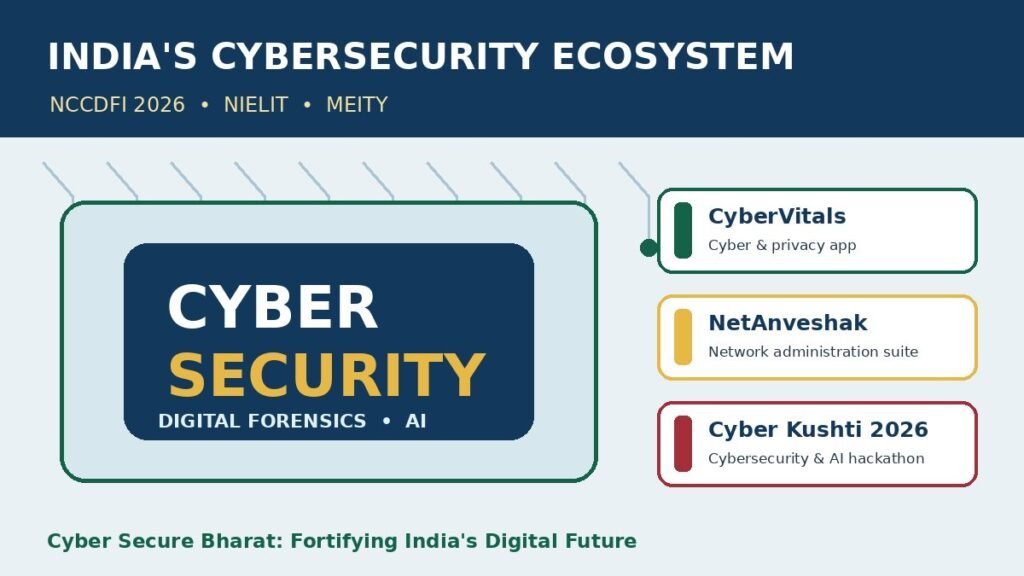
India’s cybersecurity ecosystem received three visible additions at the third National Conference on Cyber Security, Digital Forensics and Intelligence (NCCDFI 2026). The National Institute of Electronics and Information Technology (NIELIT) announced two digital applications: CyberVitals and NetAnveshak. The conference also marked the kick-off of Cyber Kushti 2026, a cybersecurity and artificial intelligence (AI) hackathon.
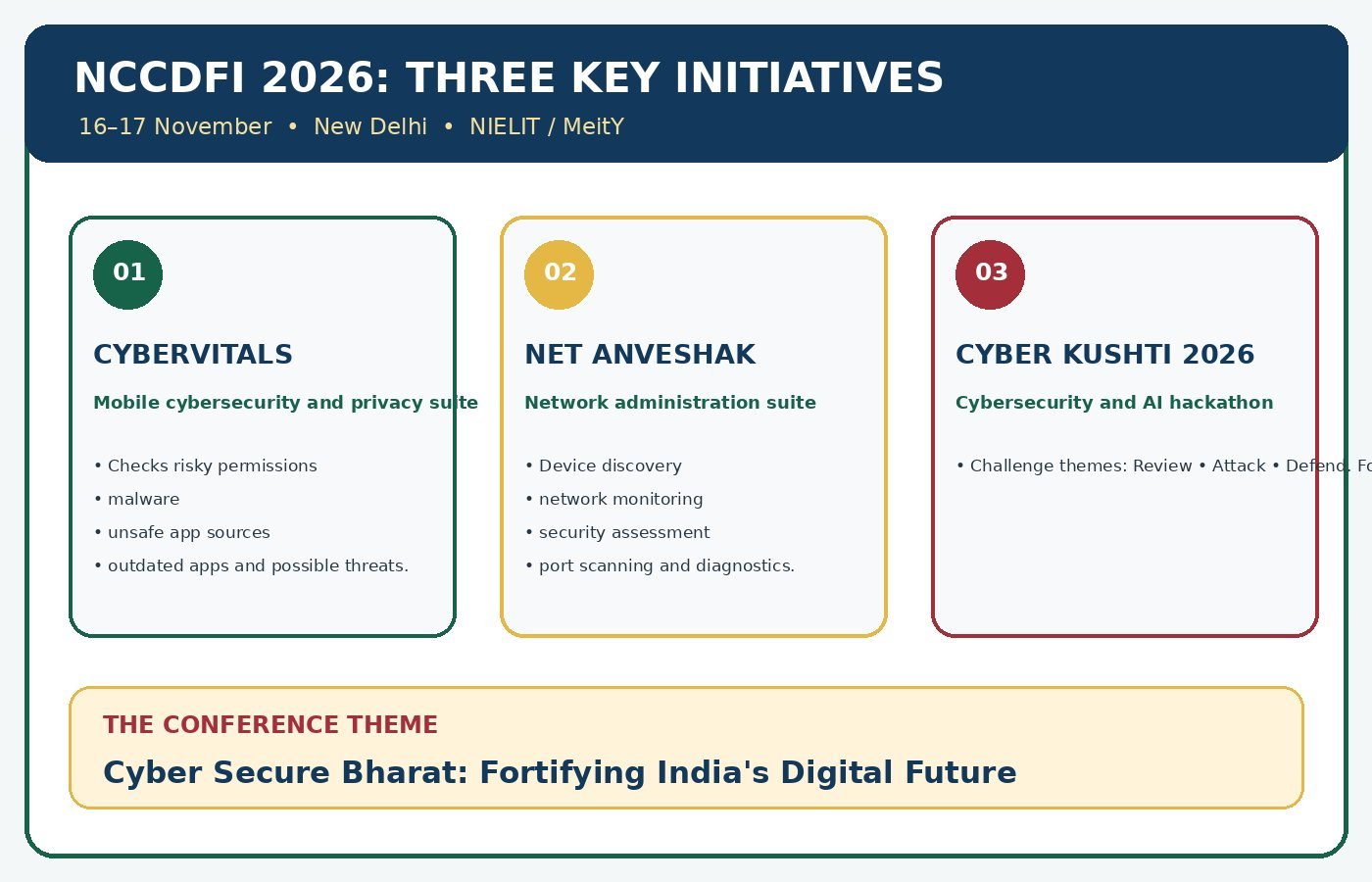
The conference took place in New Delhi on 16 and 17 November 2026. It was organised by NIELIT under the Ministry of Electronics and Information Technology (MeitY). Its theme was “Cyber Secure Bharat: Fortifying India’s Digital Future”. The initiatives address different needs. CyberVitals focuses on device and privacy checks. NetAnveshak supports network administration. Cyber Kushti tests human judgment in cybersecurity challenges.
This article explains what the official announcement confirms, what each initiative is designed to do, and why skills and safeguards matter. It does not assume that every announced tool is available to every user or that a launch announcement proves long-term impact.
Table of Contents
- Executive Summary and Key Details
- What Was NCCDFI 2026?
- CyberVitals: A Cybersecurity and Privacy Suite
- NetAnveshak: A Network Administration Suite
- Cyber Kushti 2026: A Cybersecurity and AI Hackathon
- Why Digital Forensics Matters
- AI, Cybersecurity and Human Judgment
- Skills and Workforce Development
- What Citizens and Organisations Can Do
- Privacy, Accountability and Responsible Use
- What These Initiatives Could Mean for India
- MASA World Editorial Insight & Community Guidance
- Frequently Asked Questions
- Official References
Executive Summary and Key Details
The Ministry of Electronics and Information Technology published the official conference update through the Press Information Bureau (PIB) on 16 November 2026. It confirms the launch of CyberVitals and NetAnveshak and the kick-off of Cyber Kushti 2026. The NIELIT conference website lists the event dates and venue. Read the PIB announcement.
| Item | Confirmed information |
|---|---|
| Conference | 3rd National Conference on Cyber Security, Digital Forensics and Intelligence |
| Short name | NCCDFI 2026 |
| Dates | 16–17 November 2026 |
| Venue | Dr. Ambedkar International Centre, New Delhi |
| Organiser | NIELIT, under MeitY |
| Theme | Cyber Secure Bharat: Fortifying India’s Digital Future |
| Digital applications | CyberVitals and NetAnveshak |
| Hackathon | Cyber Kushti 2026 – Cybersecurity and AI |
| Key areas | Cybersecurity, digital forensics, incident response, AI threats and cyber intelligence |
What Was NCCDFI 2026?
NCCDFI is a national platform for discussion on cybersecurity, digital forensics and intelligence. The 2026 edition brought together government officials, law enforcement agencies, defence personnel, judicial representatives, researchers, industry leaders and cybersecurity professionals. The conference focused on emerging cyber threats and the growing complexity of digital investigations.
The programme covered artificial intelligence-driven threats, digital evidence, critical infrastructure protection, cyber intelligence, incident response, blockchain security, cloud security and cyber law. An industry exhibition presented technologies in digital forensics, cybersecurity, drone technology, surveillance and AI-driven security.
NIELIT operates under MeitY. It works in electronics, information technology and related skills development. Its role in this conference links technical education with public-sector capability. Cybersecurity requires trained people as well as reliable tools. Investigators, administrators, developers and public institutions need different skills, but they must work together.
CyberVitals: A Cybersecurity and Privacy Suite
The PIB announcement describes CyberVitals as a mobile application and a cybersecurity and privacy suite. It is designed to identify several risks linked to mobile devices and applications. The stated functions include checking risky permissions, malware, unsafe application sources, outdated apps and potential security threats.
The announcement also says CyberVitals can analyse images for AI-generated content and provide trust scores. This feature reflects a growing challenge. People increasingly receive images that may be edited or generated using AI. A verification tool can help users assess content, but a score should not be treated as a final proof of authenticity.
What the listed functions mean
- Risky permissions: An application may request access that does not match its main purpose. Reviewing permissions can help users identify unnecessary access.
- Malware checks: Security checks can help identify malicious software or suspicious application behaviour.
- Unsafe app sources: Installing applications from untrusted sources can increase exposure to harmful software.
- Outdated applications: Old versions may lack security fixes. Updates can reduce known risks.
- AI-generated image analysis: The app is described as analysing images and providing trust scores. Users should still verify important claims through reliable sources.
- Monitoring: The PIB release mentions real-time network, app activity and notification monitoring to identify suspicious behaviour.
The Ministry’s announcement says the application is designed to keep user data private. Users should still review the app’s current privacy policy, permissions and data-handling information before installation. The press release does not provide a complete technical specification, independent test report or app-store availability details.
NetAnveshak: A Network Administration Suite
NetAnveshak, also written as Net Anveshak, is described as an in-house Network Administration Suite developed by NIELIT Gorakhpur. It brings several network management and diagnostic functions into one application.
The PIB release lists device discovery, network monitoring, security assessment and diagnostics. It also mentions port scanning, PC security analysis, uptime monitoring and network troubleshooting. These functions are relevant to administrators who need to understand which devices are connected and how a network is operating.
How the listed functions can help
- Device discovery: Helps administrators identify devices connected to a network.
- Network monitoring: Supports observation of network activity and operational status.
- Port scanning: Helps authorised administrators review exposed network services.
- PC security analysis: Can support checks of system security conditions.
- Uptime monitoring: Helps identify whether devices or services remain available.
- Troubleshooting: Supports diagnosis of network problems.
These are administrative and security functions. They must be used only on networks where the operator has permission. Port scanning or device discovery on systems without authorisation can violate rules or disrupt services. Organisations should define scope and access rights before using any network assessment tool.
Cyber Kushti 2026: A Cybersecurity and AI Hackathon
Cyber Kushti 2026 is described as a cybersecurity and AI hackathon. The conference release says the competition is centred on three challenge themes: Review, Attack and Defend. These stages reflect different parts of security work.
- Review: Examine a system, assessment or set of findings. Identify relevant risks and distinguish meaningful issues from weak or incorrect alerts.
- Attack: Assess how weaknesses could be exploited within a controlled and authorised challenge environment.
- Defend: Prioritise fixes, explain decisions and strengthen the system against identified risks.
The competition aims to encourage practical problem-solving and technical excellence. It also highlights a key issue in AI-assisted security. Automated tools can produce useful findings, but they can also produce false positives, duplicate alerts or miss important weaknesses. A skilled analyst must review the evidence and explain the decision.
Cyber Kushti had been announced earlier in 2026. The August PIB release described its design around human judgment, review of AI-generated findings and the ability to defend security decisions. The November conference announcement records the kick-off of the hackathon at NCCDFI. Readers should check the official competition website for rules, stages and results rather than assume registration remains open.
Why Digital Forensics Matters
Digital forensics is the disciplined process of identifying, preserving, examining and reporting digital evidence. Evidence can come from computers, mobile devices, servers, cloud accounts, network logs and other digital systems. Investigators may use it to understand an incident or support a legal process.
Evidence must be handled carefully. Investigators need to record how it was collected, who accessed it and what actions were performed. This record helps protect the integrity of evidence. If files are changed or devices are handled without proper procedure, important information may be lost or challenged.
Core principles for evidence handling
- Obtain legal authority before accessing a device or account.
- Record the source, time and person responsible for collection.
- Preserve original evidence and use approved forensic procedures.
- Maintain a clear chain of custody.
- Document tools, methods and limitations.
- Restrict access to authorised personnel.
Digital forensics is not only a technical activity. It involves law, privacy, documentation and professional judgment. A reliable tool cannot replace a lawful process.
AI, Cybersecurity and Human Judgment
AI can help security teams process large volumes of information. It can group alerts, identify patterns and assist with image or text analysis. It may also help investigators search records faster. These uses can support skilled teams when the tools are tested and applied carefully.
AI systems can also make mistakes. They may label safe activity as suspicious. They may miss a real threat. They may produce an answer that sounds certain but lacks evidence. Image analysis can also be affected by editing, compression and incomplete context.
For these reasons, AI output should be treated as an input for review, not a final decision. Analysts should check the underlying evidence, record uncertainty and explain why they accept or reject a finding. The Cyber Kushti approach is relevant because it places attention on judgment and the quality of decisions, not only the number of alerts detected.
Skills and Workforce Development
Cybersecurity needs a wide range of skills. Technical specialists need knowledge of networks, operating systems, secure coding, cloud services and digital forensics. Investigators need to understand evidence handling and legal procedure. Managers need to assess risk and plan incident response. Citizens need practical knowledge to protect their accounts and devices.
The NCCDFI discussions also highlighted training and institutional cooperation. The PIB release describes NIELIT initiatives in education and specialised capacity building. It refers to programmes for police, judiciary, armed forces and government officials. It also mentions CyberDaksh, an AI-powered assistant being developed to support cybercrime investigators. This is a development initiative; the release does not say it is a fully deployed public service.
Learning path for students
- Build foundations in computer systems, networking and operating systems.
- Learn basic programming and secure software practices.
- Study privacy, cyber law and responsible data handling.
- Practise in authorised training labs and simulated environments.
- Learn incident documentation and digital evidence principles.
- Build communication skills to explain technical findings clearly.
Students should avoid testing tools on public networks or other people’s devices without permission. Practice environments should provide clear rules and safe systems.
What Citizens and Organisations Can Do
New tools can strengthen the ecosystem, but basic cyber hygiene remains important. Individuals and organisations can reduce common risks through consistent habits.
For individuals and families
- Install software updates from trusted sources.
- Use unique passwords and a password manager where practical.
- Enable multi-factor authentication for important accounts.
- Do not share OTPs, passwords or banking credentials.
- Verify urgent payment requests through a separate trusted channel.
- Check app permissions and remove applications that are no longer needed.
- Back up important files and protect access to the backup.
For schools, NGOs and small businesses
- Keep an inventory of devices, accounts and important data.
- Remove access when staff or volunteers leave.
- Limit administrator rights to people who need them.
- Maintain tested backups and a basic incident response plan.
- Train staff to report suspicious messages quickly.
- Use network scanning and security testing only with clear authorisation.
If a person suspects financial cyber fraud, they should contact their bank promptly and use official reporting channels. They should preserve relevant messages and transaction details. They should not delete potential evidence or share sensitive personal information in public groups.
Privacy, Accountability and Responsible Use
Cybersecurity tools can access sensitive information. Device monitoring, network discovery and digital investigations must follow legal authority and privacy safeguards. Institutions should explain what data a tool collects, why it collects it and how long it is retained. Access should be limited to authorised people.
Before adopting a new application, organisations should review its security design, privacy terms, update process and support arrangements. They should also test whether the tool works as described. A launch announcement is an important public update, but it is not a substitute for independent testing or operational evaluation.
AI-based trust scores should not become automatic judgments about a person or a news claim. Users need context and access to the underlying evidence. Public agencies should communicate limitations clearly. Accountability builds trust in digital security systems.
What These Initiatives Could Mean for India
CyberVitals may support safer mobile use if its checks are accurate, accessible and privacy-protective. NetAnveshak may support network administrators who need a unified set of diagnostic tools. Cyber Kushti can help students and researchers practise structured cybersecurity judgment. Together, the initiatives reflect a broader effort to connect tools, training and institutional cooperation.
Their long-term value will depend on adoption, quality, user support, security testing and measurable outcomes. Useful indicators could include verified tool performance, training completion, response time, reduced repeat incidents and stronger evidence-handling practices. These are suggested measures, not published results for the three initiatives.
The conference also recorded MoUs involving organisations from government, academia and industry. The PIB release says these partnerships aim to support joint research, technology development, specialised training and knowledge sharing. The next step is to translate announcements into tested services, skilled teams and clear safeguards.
MASA World Editorial Insight & Community Guidance
Cybersecurity is not only a technology issue. It is also a skills, privacy and public trust issue. Use digital tools with permission. Check AI-generated claims before sharing them. Protect personal data. Learn through authorised practice environments. Institutions must explain how their tools work and how they protect users.
MASA World encourages schools, colleges, NGOs and community organisations to include cyber safety in regular learning. Young people can explore cybersecurity through structured courses and authorised competitions. Small organisations can begin with basic access controls, updates and backups. Public institutions should publish clear guidance and report measurable progress.
India’s digital growth depends on reliable systems and informed users. The initiatives announced at NCCDFI 2026 provide a useful starting point for discussion. Their success should be judged by practical value, responsible use and public benefit.
Frequently Asked Questions
1. What is NCCDFI 2026?
It is the third National Conference on Cyber Security, Digital Forensics and Intelligence. NIELIT organised it in New Delhi on 16–17 November 2026 under the theme “Cyber Secure Bharat: Fortifying India’s Digital Future”.
2. What is CyberVitals?
CyberVitals is a mobile cybersecurity and privacy suite. The PIB release says it checks risky permissions, malware, unsafe app sources, outdated apps and possible threats. It also includes image analysis for AI-generated content and trust scores.
3. What is NetAnveshak?
NetAnveshak is a network administration suite developed by NIELIT Gorakhpur. Its listed functions include device discovery, network monitoring, security assessment, port scanning and troubleshooting.
4. What is Cyber Kushti 2026?
It is a cybersecurity and AI hackathon structured around Review, Attack and Defend. It aims to develop practical problem-solving and technical judgment in cybersecurity.
5. Are these tools available for public download?
The PIB announcement confirms the launch of CyberVitals and NetAnveshak but does not provide complete public download or availability instructions. Check NIELIT’s official channels for current access information.
Official References
- PIB, Ministry of Electronics and IT: NCCDFI 2026 Day 1, CyberVitals, NetAnveshak and Cyber Kushti, 16 November 2026.
- PIB: NCCDFI 2026 conference announcement, 15 November 2026.
- PIB: Cyber Kushti 2026 hackathon announcement, 16 August 2026.
- NCCDFI 2026 official conference website.
- National Institute of Electronics and Information Technology (NIELIT).
- Ministry of Electronics and Information Technology (MeitY).
Editorial note: Product functions and conference announcements in this article are based on the PIB release dated 16 November 2026. The article distinguishes announced capabilities from independently tested outcomes. Check NIELIT’s official channels for current access, documentation and updates.