
Helping Children Build Independence: Everyday Skills, Emotional Support and Safe Boundaries
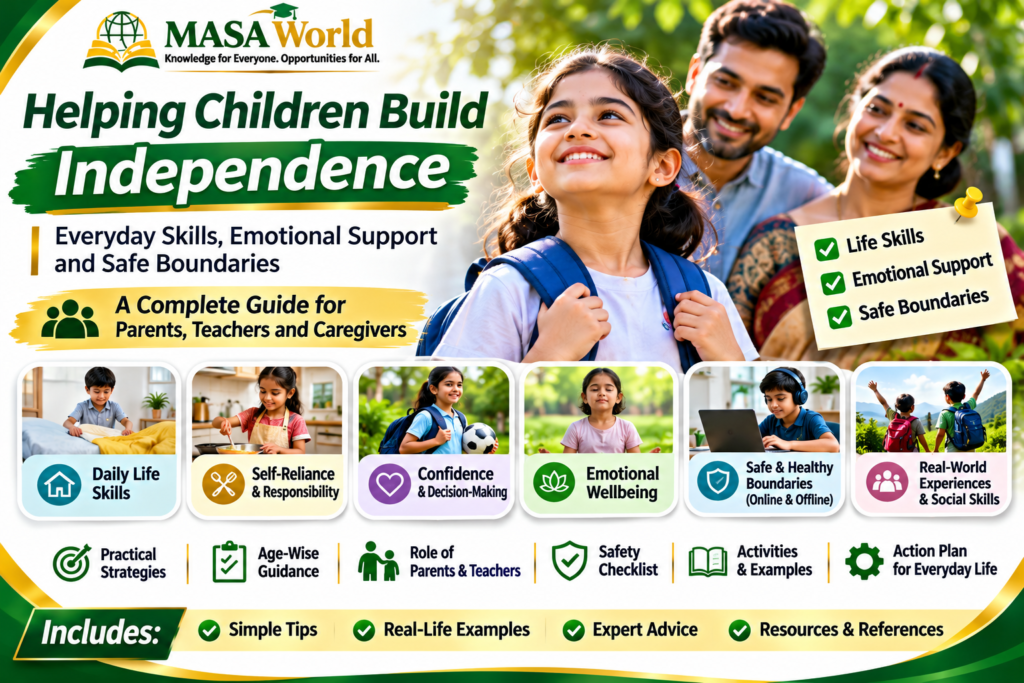
Children become independent through practice, not pressure. Everyday tasks, thoughtful choices and safe opportunities to try help children develop confidence, responsibility and problem-solving skills. The role of adults is to teach, guide and protect—then gradually make room for children to do what they are ready to do.
This guide explains how families, teachers and caregivers can build those abilities in ways that respect a child’s age, personality, culture, circumstances and individual support needs. It includes practical examples, a simple teaching method, safety guidance, a family action plan and a checklist that can be adapted at home or school.
1. What independence means in childhood
Childhood independence is the growing ability to take part in everyday life: caring for personal belongings, completing suitable tasks, making simple decisions, handling small challenges and knowing when to ask for help. It does not mean that a child must manage everything alone. Children still need affection, protection, teaching and dependable adults.
Healthy independence develops gradually. A young child may choose between two outfits; an older child may prepare a school bag; a teenager may plan a journey with appropriate safety arrangements. Each step builds on practice and support. The aim is not to make children behave like adults, but to help them gain skills that fit their stage of development.
These skills matter because they help children participate in family, school and community life. A child who knows how to begin a task, explain a difficulty or try another approach may feel more capable. Independence can also support cooperation: children learn that they have a role in shared spaces and that asking for help is a responsible choice.
A useful principle: give children the greatest level of choice and responsibility that is safe and realistic for them today—not the greatest level that their age alone might suggest.
2. Match responsibility to age, ability and readiness
Age ranges can offer broad ideas, but they are not strict deadlines. Children develop at different rates. Disability, health, neurodiversity, language, culture, previous experience, stress and access to suitable tools can all affect how a task should be taught. A child may be confident in one area and need substantial help in another.
| Stage | Possible practice opportunities | Adult support |
|---|---|---|
| Early childhood | Put toys in a basket, choose between two suitable options, wash hands with help, carry a light item. | Demonstrate, use simple words and stay close for safety. |
| Primary-school years | Put belongings in a regular place, follow a picture checklist, help set the table, prepare a simple snack with supervision. | Break tasks into steps, practise together and check important details. |
| Pre-teens | Organise school materials, plan a short homework session, help prepare a meal, care for personal belongings. | Agree on expectations, review plans and remain available when needed. |
| Teenagers | Manage a simple budget, plan time, practise safe travel, protect digital privacy and make informed everyday choices. | Discuss risks, agree on boundaries and expand freedom as skills and circumstances allow. |
Before introducing a task, ask: Can the child understand the instructions? Is the activity physically and emotionally safe? What part can they do now? What support or adaptation would make participation possible? If the answer is uncertain, simplify the task and supervise more closely.
Developmental milestone information can help adults decide what questions to raise with a professional, but it should not be used to label or diagnose a child. If a child loses a skill they previously had, or ongoing difficulties significantly affect daily life, discuss the concern with a qualified health or education professional.
3. Teach everyday skills in small, repeatable steps
Children are more likely to learn when adults show what a task involves and allow time to practise. Telling a child to “be responsible” is too vague. Explain the specific action, show it, practise together and gradually reduce reminders as the child becomes more confident.
A simple teaching method: explain, show, practise, step back
- Explain the purpose. Use a short, respectful reason: “We put the books in one place so they are easy to find tomorrow.”
- Show the steps. Demonstrate slowly. Use pictures, labels or a written checklist when they make the task easier to understand.
- Practise together. Let the child complete the parts they can manage while you support the harder steps.
- Give one prompt at a time. Avoid repeating a long list of instructions. Ask, “What comes next?” or offer a small hint.
- Step back gradually. Allow the child to start and finish independently when it is safe. Stay available for questions.
- Review without blame. Notice what worked and decide whether the task needs more practice, a clearer instruction or a useful adaptation.
Everyday skills worth practising
- Personal care: handwashing, brushing teeth, choosing suitable clothes and putting used clothing in the right place.
- Organisation: keeping school items together, checking a timetable, returning belongings and preparing for the next day.
- Home contribution: putting away toys, watering a plant, setting the table, sorting clean laundry or helping with a simple household routine.
- Food awareness: washing fruit, choosing a balanced snack and learning basic kitchen hygiene. Heat, sharp tools and appliances require close, age-appropriate supervision.
- Communication: greeting others, explaining a need, asking a question, saying no respectfully and identifying a trusted adult.
- Community awareness: following agreed safety rules, recognising safe meeting points and knowing what to do if separated from a caregiver.
Do not turn every routine into a test. Choose one skill, practise it consistently and make the task easier if it repeatedly causes frustration. The purpose is useful learning, not perfect performance.
4. Build emotional confidence alongside practical skills
Children may know what to do and still find it difficult to begin because they feel worried, embarrassed, tired or frustrated. Emotional support helps them stay engaged with a manageable challenge. Listen first, name the feeling without judgement and help the child identify a next step.
For example, try: “It looks like this feels difficult. Would you like to pause, try the first part together or take a short break?” This recognises the emotion without taking away every opportunity to practise. Avoid dismissive comments such as “There is nothing to be upset about” or “Big children do not cry.”
Children can learn to notice feelings and choose strategies that help them settle. Depending on the child, this might include slow breathing, movement, drawing, quiet time, talking with a trusted person or breaking a task into smaller parts. Practise these strategies during calm moments so the child has experience using them when upset.
Use specific encouragement. “You checked the list and found what was missing” tells a child which action helped. Avoid comparing siblings or classmates, and do not make affection or approval depend on success. A mistake is information about what needs practice; it is not proof that a child is incapable.
5. Help children solve problems without taking over
When a child faces a small, safe difficulty, pause before solving it for them. Ask one question at a time: “What happened?”, “What have you tried?”, “What could you try next?” or “Would you like a hint?” Give enough help to prevent the task from becoming overwhelming, then let the child complete the part they can do.
Consider a school project. Instead of completing it for the child, help them identify the task, choose a topic, list materials, divide the work into short steps and decide when to ask the teacher a question. For a disagreement with a friend, listen to what happened, help the child consider different viewpoints and practise respectful words for a conversation.
Some situations are not suitable for independent problem-solving. Adults should step in when there is danger, bullying, abuse, exploitation, serious distress, a significant power imbalance or a decision beyond the child’s capacity. Independence includes recognising when to seek help—not being expected to handle every situation alone.
6. Set clear boundaries that protect children
Freedom and safety belong together. Children need simple, repeated guidance about physical safety, personal boundaries, privacy, online activity and asking for help. Explain rules in language they can understand and give a reason whenever possible. Revisit rules as the child’s skills and circumstances change.
Body boundaries and trusted adults
Teach children that their body deserves respect, that they can express discomfort and that they can tell a trusted adult if someone’s behaviour worries them. Adults—not children—are responsible for preventing abuse, providing safe environments and responding appropriately to disclosures. Never blame a child for abuse or for not resisting, leaving or reporting sooner.
Help the child identify more than one trusted adult where possible. Make it clear that they can keep telling a safe adult until someone listens. If a child shares a concern, stay calm, listen, reassure them that they are not to blame and follow local safeguarding and reporting procedures.
Digital and community safety
- Agree on age-appropriate rules for devices, games, messaging, photos and online contact.
- Explain why passwords, home addresses, school details, live location and private images should not be shared casually.
- Encourage children to show a trusted adult messages that feel threatening, confusing, secretive or uncomfortable.
- Discuss safe travel, road awareness, meeting points and what to do if separated from a caregiver.
- Supervise activities involving water, traffic, heat, sharp tools, medicines, strangers or other risks according to the child’s age and ability.
When a child reports a mistake or an uncomfortable online interaction, respond without humiliation. A child who expects blame may hide the next problem. Keep communication open and make sure they know that asking for help is always allowed.
7. Create consistent support at home and school
Children benefit when adults use clear, respectful expectations. Home and school routines will differ, but adults can agree on a few shared approaches: give instructions in manageable steps, allow time to practise, encourage questions and respond calmly to mistakes.
For parents and caregivers
- Keep frequently used belongings in predictable places.
- Offer limited, meaningful choices, such as choosing between two suitable tasks or deciding which routine to practise first.
- Give children enough time to complete tasks instead of rushing to do everything for them.
- Share responsibilities fairly and avoid assigning tasks based on stereotypes about gender or ability.
- Review what is working and change the routine when family circumstances change.
For teachers and school staff
- Explain assignment requirements and show examples of what a completed task may look like.
- Use classroom responsibilities, self-check routines and group roles that give different students a chance to contribute.
- Teach students how to ask for clarification, organise materials and communicate when they need support.
- Give feedback privately and constructively; never use public embarrassment as motivation.
- Work with families and relevant specialists when a child needs additional support.
For children with learning, communication, sensory, mobility or health needs, adapt the task and provide appropriate accommodations. Visual schedules, assistive tools, extra time, adapted equipment or adult support may make independence more accessible. Do not remove an established support simply to see whether a child can manage without it.
8. Common mistakes that can hold progress back
- Expecting too much too soon: make the task smaller and teach the next achievable step.
- Doing everything for the child: pause, offer a prompt and allow safe practice instead of automatically taking over.
- Using shame or comparison: describe the action that needs attention and explain how to improve it.
- Confusing independence with obedience: children should be able to ask questions, express discomfort and seek help.
- Ignoring individual needs: support and accommodations are part of good teaching, not signs of failure.
- Giving too many instructions: use short directions and check that the child understands.
- Removing supervision too early: increase responsibility only when the task and environment are safe.
- Changing rules without explanation: predictable boundaries help children understand what to expect.
9. A practical seven-day family action plan
Choose one skill that would make everyday life easier—for example, preparing a school bag, putting away play materials or following a simple morning routine. Adapt the steps to the child. Short, positive practice is more useful than a demanding schedule.
| Day | Adult’s role | Child’s opportunity |
|---|---|---|
| 1 – Choose | Discuss options and agree on one realistic goal. | Choose a skill they want to practise. |
| 2 – Demonstrate | Show each step and explain any safety rule. | Watch, ask questions and try one step. |
| 3 – Practise together | Support the difficult parts without taking over. | Complete the parts they can manage. |
| 4 – Use a prompt | Offer a picture list or one short reminder. | Try to begin the routine independently. |
| 5 – Solve a small problem | Ask what might help if something goes wrong. | Suggest and try a safe next step. |
| 6 – Review safety | Check whether the task or support needs adjusting. | Explain which part feels easy or difficult. |
| 7 – Reflect | Notice progress and agree whether to repeat or adapt. | Describe what they learned and what help remains useful. |
If the child is tired, unwell or overwhelmed, pause and return to the activity later. A family plan should reduce stress, not become another source of pressure.
10. A one-page skill plan adults can reuse
| Skill to practise | Write one clear task, such as “put school items in the bag”. |
|---|---|
| Why it matters | Explain the real-life benefit in one sentence. |
| Steps | List three to five short actions in the correct order. |
| Safety or support | Record supervision, tools, adaptations or reminders needed. |
| What the child can do now | Identify the steps they can already manage. |
| Next small step | Choose one achievable action to practise next. |
| Review date | Agree when to discuss what is working and what needs changing. |
Keep this plan simple. It is a teaching aid, not a performance score. Do not rank children or compare one child’s progress with another’s.
11. Can technology and AI help?
Simple tools can make routines easier to remember. A family calendar, visual timer, reminder or shared checklist may help when it suits the child. An adult may also use an AI tool to draft a simple routine, create age-appropriate practice ideas or rewrite instructions in clearer language.
Review every suggestion before using it. AI can make mistakes and does not know the child’s full circumstances. Do not enter a child’s name, address, school, photographs, health information or other private details into a public AI service. Do not use AI to diagnose a child, secretly monitor them or make important decisions about their safety or education. Read MASA World’s guide to AI literacy and responsible use for broader digital-safety advice.
12. When additional support may be helpful
Some children need more time, repeated teaching or tailored support. Consider speaking with the child’s teacher, paediatrician or another qualified professional if difficulties persist, significantly affect daily activities, cause substantial distress or appear alongside a loss of previously learned skills. Follow local safeguarding procedures promptly if you are concerned about abuse, exploitation, bullying or immediate safety.
Ask what practical changes could help the child participate: clearer instructions, a smaller task, adapted equipment, a predictable routine, communication support or a different level of supervision. The goal is to understand the barrier and provide useful support—not to blame the child or family.
Frequently asked questions
Where should I begin?
Start with one familiar task the child can almost manage, such as putting toys away or checking a school-bag list. Show the steps, practise together and reduce help slowly.
Am I helping too much?
If you routinely complete a task the child could safely attempt, pause and offer a prompt. But help is appropriate when a task is unsafe, inaccessible or beyond the child’s current ability.
What if my child refuses to try?
Consider why. The task may be confusing, too difficult, tiring or worrying. Offer a smaller first step or two suitable choices. Avoid turning practice into a power struggle; return to it when everyone is calmer.
What if progress is slow?
Repeat the same steps, use reminders and notice small improvements. Change the method if the child remains stuck. If the difficulty affects daily life over time, ask a qualified professional for guidance.
How do I balance freedom and safety?
Explain which risks require adult supervision and why. Give choices within safe limits, practise the relevant skills and increase responsibility gradually. A child should never be expected to manage a dangerous situation alone.
Does asking for help mean a child is not independent?
No. Recognising a limit and asking a trusted person for help are important life skills. Healthy independence includes knowing what you can do, what you are still learning and when support is needed.
Key takeaways
- Independence is learned gradually through safe, repeated practice and supportive relationships.
- Match tasks to the individual child’s abilities, readiness and circumstances—not age alone.
- Teach one skill at a time: explain, demonstrate, practise, prompt and gradually step back.
- Build emotional confidence by listening, encouraging effort and treating mistakes as part of learning.
- Set clear physical, digital and community safety boundaries. Adults remain responsible for protection.
- Adapt routines and provide accommodations so every child can participate as fully as possible.
- Asking for help is a strength, not a failure of independence.
Continue learning with MASA World
Explore related MASA World resources on responsible AI use, checking information and evidence and setting and achieving goals. These guides can help families, learners and educators build practical skills for everyday life.
Trusted sources and further reading
- UNICEF India – Early Childhood Development and Parenting: information about nurturing care, responsive relationships and early learning.
- Harvard University Center on the Developing Child – Activities Guide: activities for practising executive-function and self-regulation skills.
- U.S. Centers for Disease Control and Prevention – Developmental Milestones: developmental information and guidance on when to raise concerns. Its milestone guidance is U.S.-based and should not be treated as a universal diagnostic standard.
Editorial note: This article provides general educational information, not individual medical, developmental, psychological or legal advice. Laws, safeguarding procedures and available services differ by country. Consult qualified local professionals about concerns specific to a child.