Nasha Mukt Yuva Quiz 2026: 28,876 Participants and a 25 November Closing Date
Updated: 19 November 2026 | Category: Social Impact
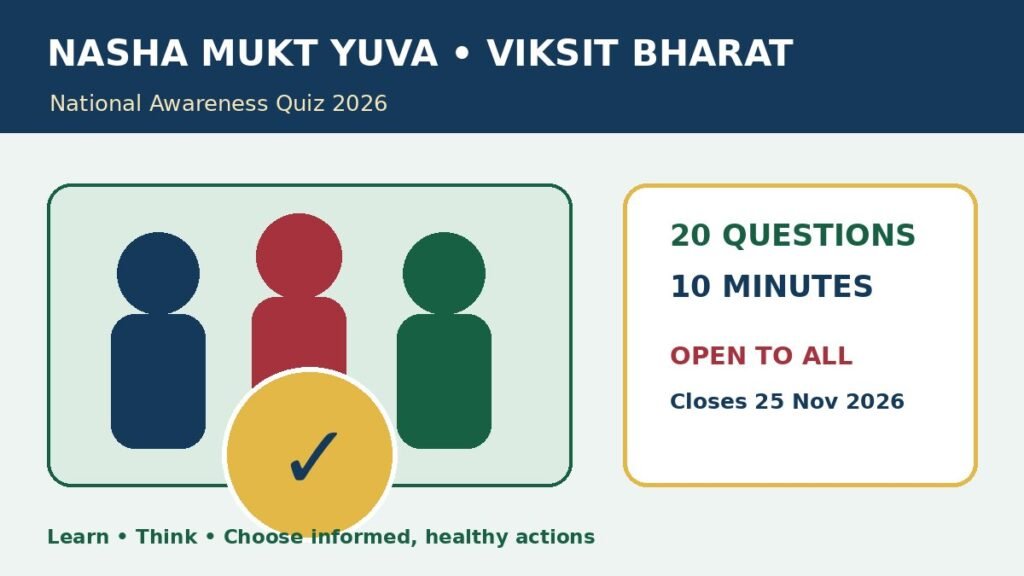
The Ministry of Social Justice and Empowerment has invited citizens to take part in the Nasha Mukt Yuva, Viksit Bharat Quiz. The quiz is part of the Nasha Mukt Bharat Abhiyaan. It opened on 26 October 2026 and remains open until 25 November 2026. The Ministry reported 28,876 participants as of 13 November.
The quiz has 20 multiple-choice questions. Participants have 10 minutes to complete it. A participation certificate is generated after successful submission. Participants can also view the correct answers after completing the quiz. The Ministry says the activity is open to all citizens.
The quiz is one part of a wider prevention campaign. The Ministry also reports national outreach, treatment and rehabilitation activity, de-addiction centres, pledges and volunteer participation. These figures show the scale of reported activity. They do not, by themselves, prove a reduction in substance use. This guide explains the quiz, the campaign’s approach and how communities can support prevention with dignity.
Table of Contents
- Quiz Snapshot and Important Dates
- What Is the Nasha Mukt Yuva Quiz?
- How to Take Part in the Quiz
- What the Nasha Mukt Bharat Abhiyaan Does
- What the Ministry’s Latest Figures Show
- Why Prevention Needs More Than a Quiz
- How Schools, Colleges and Youth Groups Can Help
- Treatment, Rehabilitation and Support
- Dignity, Privacy and Safe Communication
- How to Measure Real Progress
- MASA World Editorial Insight & Community Guidance
- Frequently Asked Questions
- Official References
Quiz Snapshot and Important Dates
The Ministry’s PIB release dated 13 November 2026 confirms the participant count, quiz dates, format and access route. The quiz remains open through 25 November 2026. Read the official PIB update.
| Item | Official information |
|---|---|
| Quiz name | Nasha Mukt Yuva, Viksit Bharat Quiz |
| Organising ministry | Ministry of Social Justice and Empowerment |
| Campaign | Nasha Mukt Bharat Abhiyaan |
| Quiz launch | 26 October 2026 |
| Closing date | 25 November 2026 |
| Participants by 13 November | 28,876 citizens |
| Format | 20 multiple-choice questions |
| Time limit | 10 minutes |
| Certificate | Generated after successful submission |
| Who can participate? | All citizens, according to the Ministry |
Official participation link: Take the Nasha Mukt Yuva, Viksit Bharat Quiz on MY Bharat.
What Is the Nasha Mukt Yuva Quiz?
The Nasha Mukt Yuva, Viksit Bharat Quiz is an online public-awareness activity. The Ministry launched it on 26 October 2026 under the Nasha Mukt Bharat Abhiyaan. It aims to improve awareness about the harmful effects of substance use. It also encourages citizens, especially young people, to take part in prevention efforts.
The quiz uses a short multiple-choice format. Participants answer 20 questions within 10 minutes. The Ministry says a participation certificate is generated after a successful submission. Participants can view the correct answers after they finish. This allows them to review their responses and learn from the activity.
The quiz is open to all citizens, according to the Ministry. It is not described as a professional qualification or a clinical assessment. Completing it does not make a participant a counsellor or treatment expert. It is a learning and awareness activity.
How to Take Part in the Quiz
- Open the official MY Bharat quiz page.
- Review the page and follow the sign-in or registration instructions shown by MY Bharat.
- Read the quiz instructions before starting.
- Answer the 20 multiple-choice questions within the 10-minute limit.
- Review your responses before submitting, if the interface allows it.
- Submit the quiz successfully.
- Check the result and view the correct answers.
- Save the participation certificate if it is generated.
The Ministry’s announcement does not state that the quiz provides a cash prize, scholarship or employment benefit. Do not trust unofficial messages that promise guaranteed rewards. Use the official MY Bharat link only.
Safety while registering
- Use your own details and a contact method you can access.
- Never share an OTP, password or banking PIN.
- Do not pay an agent to complete the quiz for you.
- Do not use a third-party link sent by an unknown person.
- Keep a copy of the certificate if you need it for your records.
What the Nasha Mukt Bharat Abhiyaan Does
The Nasha Mukt Bharat Abhiyaan was launched on 15 August 2020. The Ministry says it began in 272 vulnerable districts and has since expanded to cover all districts across India.
The campaign aims to reduce demand for harmful substances through several connected activities. These include preventive education, public awareness, treatment, rehabilitation and community participation. The approach recognises that prevention cannot depend on one quiz or one public event.
Schools, colleges, youth groups, families, community leaders and service providers can all contribute. Their roles are different. Educators can share accurate information. Youth volunteers can promote healthy choices and refer people to trusted services. Qualified professionals provide assessment and treatment. Government-supported centres can support de-addiction and rehabilitation.
The Ministry’s campaign also includes Nasha Mukti Mitras. These are volunteers who support awareness and community engagement. Their role is to encourage informed choices and help connect people with appropriate support. They should not replace medical or mental health professionals.
What the Ministry’s Latest Figures Show
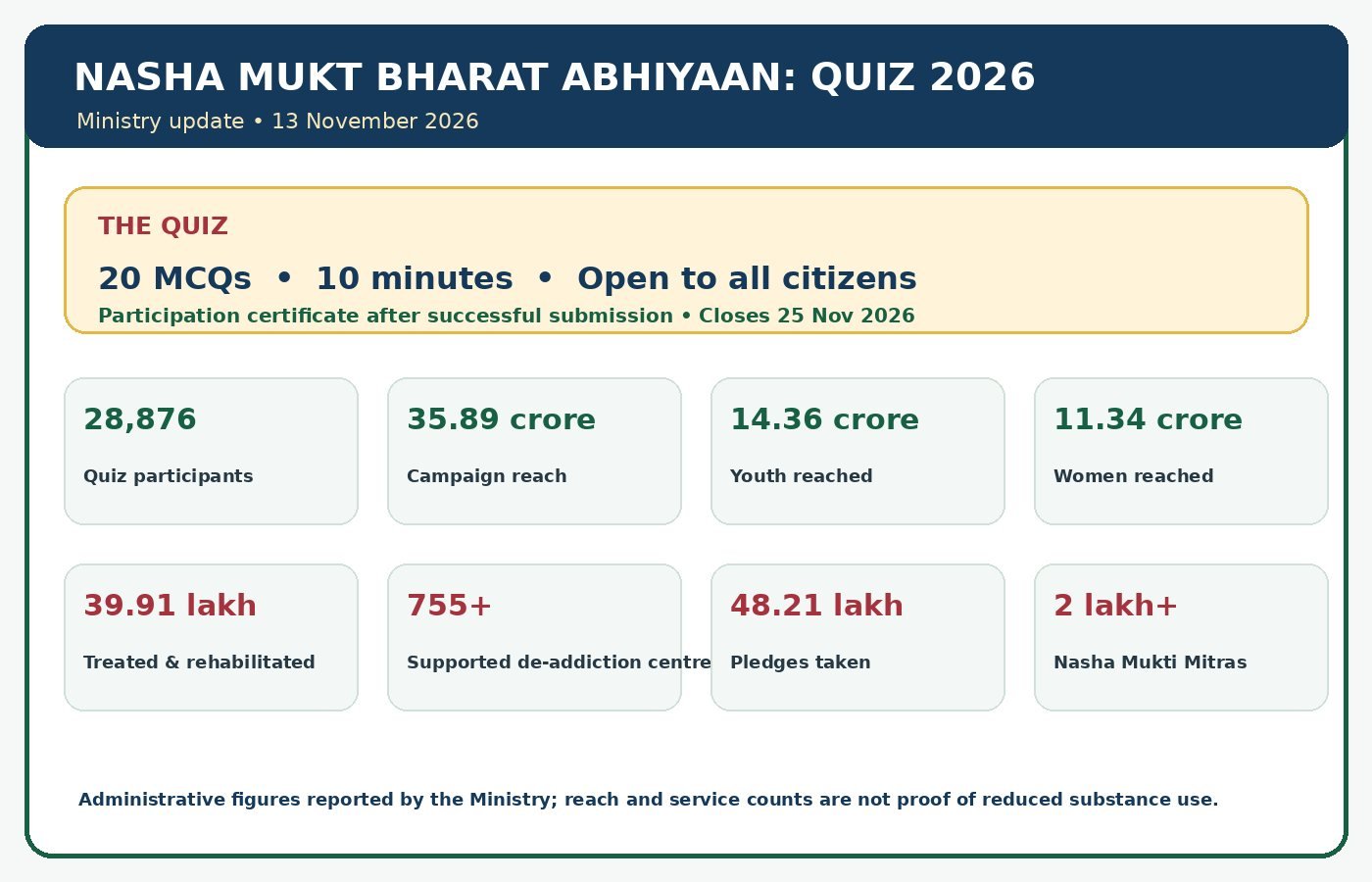
The Ministry’s 13 November update reports the following campaign figures:
| Measure | Reported figure |
|---|---|
| Total campaign reach | More than 35.89 crore people |
| Youth reached | 14.36 crore |
| Women reached | 11.34 crore |
| People treated and rehabilitated | 39.91 lakh |
| Department-supported de-addiction centres | More than 755 |
| Nasha Mukt pledges | More than 48.21 lakh |
| Nasha Mukti Mitras registered | More than 2 lakh |
| Quiz participants by 13 November | 28,876 |
These are administrative figures reported by the Ministry. They describe reported outreach and service activity. They do not measure the same thing. Campaign reach, pledge counts, treatment numbers and quiz entries should not be added together or treated as a single outcome.
The PIB release contains a difference in its educational activity count. Its headline cites over 34.08 lakh activities in educational institutions. The detailed body text states over 33.57 lakh. This article does not select one figure as definitive because the same release gives both values.
To evaluate long-term impact, more information is needed. This may include follow-up data, treatment outcomes, service quality, repeat treatment needs and local access barriers. Outreach totals alone cannot show whether substance use has fallen.
Why Prevention Needs More Than a Quiz
A quiz can introduce important information. It can also encourage young people to discuss substance-use prevention. But knowledge is only one part of behaviour change. People may face peer pressure, stress, isolation, family difficulties or limited access to support. A single online activity cannot address every cause.
Effective prevention needs accurate information and supportive environments. Young people should be able to ask questions without fear of humiliation. They should know how to seek help for themselves or a friend. They should also have access to trusted adults and qualified services.
What useful prevention education includes
- Age-appropriate information about health risks.
- Skills to respond to peer pressure.
- Reliable information about counselling and treatment.
- Support for mental health and emotional wellbeing.
- Positive opportunities through sports, arts and volunteering.
- Clear referral routes when someone needs professional help.
Prevention messages should avoid fear-based claims. They should not label or shame people. Substance dependence is a health and social issue. People affected by it deserve dignity and access to appropriate care.
How Schools, Colleges and Youth Groups Can Help
Schools and colleges can use the quiz as a starting point for learning. Teachers can explain how to check health information and identify trustworthy sources. They can invite qualified health professionals to discuss prevention and available support. Participation should remain voluntary.
Youth organisations, sports clubs and community groups can also help. They can organise awareness sessions and share verified service contacts. Coaches and mentors can encourage positive routines and supportive peer networks. They should not diagnose people or attempt to provide treatment.
Practical activities for institutions
- Share the official quiz link and explain the deadline.
- Discuss the quiz answers after participants complete it.
- Invite a qualified professional for a question-and-answer session.
- Display verified contact details for local support services.
- Train volunteers on privacy and safe referral practices.
- Make sports, arts and mentoring activities accessible to young people.
Organisers should not ask participants to disclose personal or family experiences in public. They should not collect sensitive information without a clear purpose and proper safeguards. A person who asks for help should be treated respectfully.
Treatment, Rehabilitation and Support
People who need help with substance use may require professional assessment. Treatment depends on the person’s health, circumstances and needs. It may involve medical care, counselling, rehabilitation and continuing support. Families can help by listening and encouraging professional care.
The Ministry reports more than 755 Department of Social Justice and Empowerment-supported de-addiction centres and 39.91 lakh people treated and rehabilitated. People seeking help should verify the nearest authorised service through official government channels. The availability and type of support can vary by location.
Friends, teachers and volunteers can help someone find a service. They should not recommend unverified remedies or attempt to manage withdrawal without medical advice. If a person may be in immediate danger, seek urgent assistance from local emergency or qualified health services.
Supportive behaviour matters
- Listen without judgement.
- Protect the person’s privacy.
- Encourage contact with qualified health professionals.
- Do not spread rumours or personal details.
- Offer practical support where appropriate.
- Respect the person’s choices and dignity.
Dignity, Privacy and Safe Communication
Public awareness campaigns should protect the dignity of people affected by substance use. Stigma can discourage people from seeking help. Avoid labels that reduce a person to a health condition. Do not share someone’s personal story without informed consent.
Schools and youth clubs should have a safe process for responding to disclosures or safeguarding concerns. Volunteers should know the limits of their role. They can listen, share verified information and help connect someone with a qualified service. They should not diagnose, promise recovery or provide untested treatment advice.
Campaign organisers should collect only the information needed for their activity. They should explain why it is collected and who can access it. Sensitive personal information should not be posted in public groups or used to shame participants.
How to Measure Real Progress
Quiz participation shows engagement. It does not prove behaviour change. Pledges show stated commitment. They do not confirm that a person has changed their actions. Treatment counts show service use, but do not automatically show long-term recovery.
Useful evaluation can include:
- Knowledge gained and understanding retained after the activity.
- Awareness of trusted referral and treatment services.
- Access to counselling and timely professional assessment.
- Service quality and continuity of support.
- Feedback from young people and families.
- Privacy and safeguarding standards in community programmes.
- Longer-term trends based on reliable public health data.
These are suggested measures, not official targets announced for the quiz. Public reporting should distinguish between outreach, participation, treatment and outcomes. Clear data helps communities understand what is working and where more support is needed.
MASA World Editorial Insight & Community Guidance
Young people should be partners in prevention, not only an audience for awareness messages. Give them accurate information, trusted adults, safe activities and clear referral pathways. Measure success through access to help and sustained community support, not only quiz entries or pledges.
MASA World encourages schools, sports clubs, NGOs and youth organisations to share the official quiz link before 25 November. They can use the quiz to start a practical discussion about health, peer pressure and available support. They should protect privacy and avoid judgement.
Prevention is a shared responsibility. Communities can promote awareness and support. Qualified professionals must provide clinical care. Government institutions should make treatment and rehabilitation services accessible. Respect and reliable information should guide every part of this work.
Frequently Asked Questions
1. When does the Nasha Mukt Yuva, Viksit Bharat Quiz close?
The Ministry says the quiz remains open until 25 November 2026. Participants should use the official MY Bharat link.
2. How many people had participated by 13 November?
The Ministry reported 28,876 participants as of 13 November 2026.
3. How many questions are in the quiz?
The quiz contains 20 multiple-choice questions. Participants have 10 minutes to complete it.
4. Do participants receive a certificate?
The Ministry says a participation certificate is generated after successful submission. Participants can also view the correct answers.
5. Is the quiz a treatment or counselling programme?
No. It is an awareness and learning activity. People who need support should contact qualified health or rehabilitation services.
Official References
- PIB, Ministry of Social Justice and Empowerment: Quiz participation and campaign update, 13 November 2026.
- MY Bharat: Nasha Mukt Yuva, Viksit Bharat Quiz — official participation page.
- Ministry of Social Justice and Empowerment.
- Nasha Mukt Bharat Abhiyaan — official portal.
Editorial note: Quiz dates, format and campaign figures are based on the PIB update dated 13 November 2026. The Ministry’s release contains two different figures for educational institution activities: 34.08 lakh in the headline and 33.57 lakh in the body. This article flags the difference rather than presenting one as settled. Readers should check the official MY Bharat page for current participation instructions.