
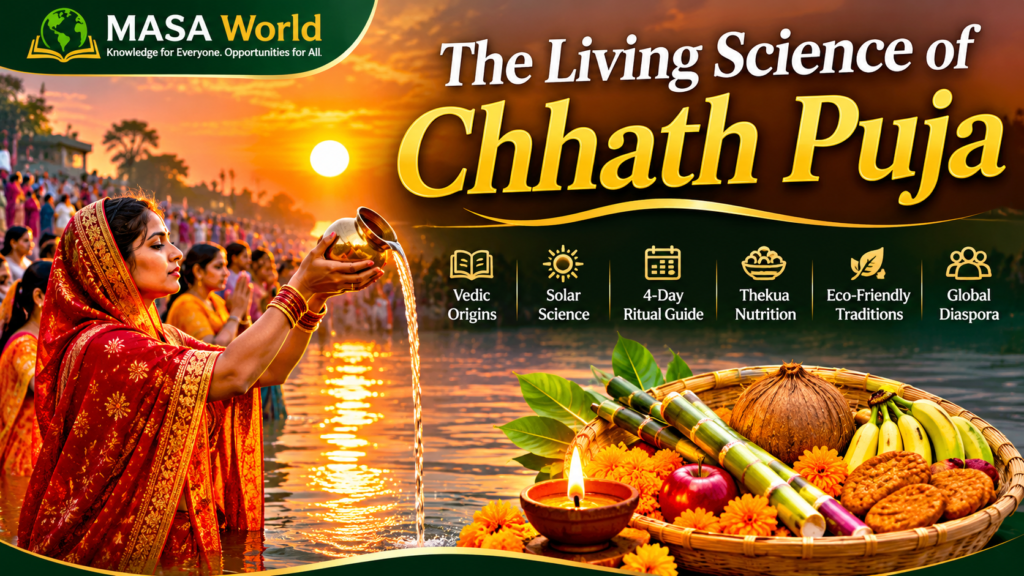
Chhath Puja is a festival in which people stand at the edge of a river, face the Sun, and give thanks for the conditions that make life possible. That simple scene carries several layers of meaning: devotion to Surya, reverence for Chhathi Maiya, a disciplined four-day household observance, the memory of agrarian communities, the sharing of food, and the care of a public water space. It is at once intimate and collective. A family prepares offerings at home; an entire neighbourhood may help make a ghat safe and welcoming.
This guide looks at Chhath from several angles without confusing them. It explains what religious traditions say, what historians can reasonably establish, what solar and nutritional science can tell us, and where evidence is still limited. The aim is not to reduce faith to chemistry or to dress belief in scientific language. It is to give readers a fuller, more useful understanding of a living tradition.
1. Executive overview: a festival built around gratitude
Chhath is especially associated with Bihar, Jharkhand, eastern Uttar Pradesh and the Mithila and Terai regions of Nepal. It is also observed in many other parts of India and by diaspora communities abroad. The festival honours the Sun as a visible source of energy and life and invokes Chhathi Maiya for family welfare, children’s well-being and protection. Practices differ between households, districts and generations, but the four-day structure gives the observance a recognisable rhythm.
Unlike festivals centred on elaborate temple ceremonies or large idol processions, Chhath often places the devotee directly before the natural horizon. The main offerings are made in or beside water, commonly using bamboo baskets and seasonal produce. A priest is not essential in many customary forms of the observance; the vratin and family lead the worship according to inherited practice. That does not mean every community follows exactly the same rules, nor does it mean social inequalities disappear at the ghat. It means the ritual gives direct participation a central place.
The festival’s most striking gesture is its two-part salute to the Sun: first at sunset, then at sunrise. The evening offering recognises the day that has passed; the morning offering welcomes the day beginning. Read symbolically, the sequence makes room for both completion and renewal. Read socially, it gathers families and neighbours at a shared public space. Read ecologically, it reminds participants that clean water, safe riverbanks and healthy local environments are not background details: they are part of the setting that makes the festival possible.
2. Chhath Puja 2026: dates and quick facts
| Observance | Date in 2026 | Common meaning |
|---|---|---|
| Nahay-Khay | Friday, 13 November | Bathing, cleaning and beginning the disciplined observance |
| Kharna / Lohanda | Saturday, 14 November | Daytime fast followed by evening worship and prasad |
| Sandhya Arghya | Sunday, 15 November | Offering to the setting Sun |
| Usha Arghya and Parana | Monday, 16 November | Offering to the rising Sun and completion of the vrat |
These dates are the commonly published 2026 festival sequence. The Hindu lunar calendar determines the observance, while sunrise and sunset are local astronomical events. A timing for Patna, Delhi, Kathmandu or Mauritius will not be identical. Weather, river access, municipal arrangements and family traditions can also affect when people gather. Confirm the local panchang and public ghat instructions before travelling.
What does “Arghya” mean? It is a respectful offering, commonly water poured from a vessel or held in the hands towards the Sun, accompanied by prayer. The exact gestures and accompanying mantras vary. In Chhath, the offering is often made while standing at the water’s edge, with family members nearby holding the daura and soop containing offerings.
3. Historical, Vedic and textual roots: what can we say with confidence?
Sun reverence is ancient in South Asia. The Rigveda contains hymns addressed to Surya, describing the Sun as a radiant presence that makes the world visible and marks the movement of time. Rigveda 1.50 is a well-known hymn to Surya. Its imagery celebrates the rising light, the Sun’s movement across the sky and the way daylight reveals the world. These verses provide important context for the long history of solar devotion in Vedic religion.
Another frequently mentioned text is Rigveda 3.62.10, the Savitr verse widely known as the Gayatri mantra. It is a prayer for illumination of the intellect, addressed to Savitr, a solar deity. It is important to make one distinction: the verse is Vedic and solar in reference, but it is not a Chhath-specific instruction. The existence of Vedic solar hymns demonstrates an old religious and poetic tradition of honouring the Sun; it does not, by itself, prove that today’s exact four-day Chhath protocol was already practised in the Rigvedic period.
That distinction matters because festivals evolve. A contemporary observance can draw on ancient religious ideas while its present-day schedule, food customs, songs, baskets and community organisation take shape over centuries. Chhath is best understood as a living tradition with deep historical layers, not as a ritual whose every current detail can be traced unchanged to one ancient text.
Epic stories and regional memory
Popular devotional accounts connect solar worship with figures such as Karna and Draupadi. In some tellings, Karna’s devotion to Surya is remembered as an example of discipline and reverence; other stories associate Draupadi with vows and prayers during hardship. Such narratives are culturally influential and may be shared in family kathas, folk performances and festival conversations. However, versions differ, and they should not be treated as conclusive proof that the modern Chhath sequence originated with a particular epic character. The critical textual history of the epics is complex, and later regional retellings often add local meaning.
Shashthi traditions and Chhathi Maiya
Chhath is also connected in regional belief with Shashthi, a protective mother figure associated in several Hindu traditions with children and fertility. The names and theological relationships used for Chhathi Maiya vary. Some communities link her with Usha or other divine feminine forms; others focus on her maternal protection and the welfare of the household. This diversity is a feature of living religious practice, not a problem that needs to be forced into a single definition.
Magadha, Mithila and the making of a regional festival
The cultural heartland of Chhath includes the historical regions of Magadha and Mithila, where agriculture, river systems, seasonal cycles and local devotional traditions shaped community life. A precise single “birth date” for the festival is not established by the available evidence. Historical study of regional practices is complicated by the fact that many customs were transmitted orally rather than recorded in a single canonical manual. The responsible conclusion is that Chhath belongs to a long South Asian history of solar and seasonal observance and acquired its distinctive regional form through generations of practice.
Some accounts mention Shakdwipi Brahmins in discussions of solar worship in eastern India. Research on Shakdwipi communities traces migration and religious roles across different periods, but this does not establish that they invented Chhath or introduced its complete modern ritual structure. A historical connection should not be turned into a claim of exclusive origin without direct evidence.
4. Surya, Usha and Chhathi Maiya: understanding the devotional world
Surya is the visible Sun, but in Hindu thought solar deities are not always interchangeable. Surya, Savitr, Mitra, Pushan and other names appear in different textual and ritual contexts. Usha personifies dawn in Vedic poetry. Chhathi Maiya, meanwhile, belongs strongly to the devotional and regional world of Chhath. The festival brings these ideas together through the daily movement of light, the care of family life and the sacred status given to the natural world.
Devotees may pray for children, health, stability, gratitude, fulfilment of vows or recovery after difficult periods. These are religious intentions, not guaranteed medical outcomes. A family may understand the vrat as thanksgiving after a wish has been fulfilled; another may observe it as an inherited family duty; another may take part because the songs, gathering and ritual discipline connect them with their community. There is no need to flatten these motivations into one explanation.
The Sun is not worshipped because it is a distant abstraction. It is a daily, visible presence whose energy drives weather systems, photosynthesis and much of the food web. Scientific description can explain those physical processes. Devotional practice gives them symbolic and ethical meaning. Both can be discussed respectfully as long as one is not presented as proof of the other.
5. The four-day ritual blueprint: preparation, offering and completion
Day 1 — Nahay-Khay: preparation begins
Nahay-Khay is commonly understood as “bathe and eat”. The household cleans the cooking area, utensils and spaces used for worship. The vratin bathes and takes a simple meal prepared according to family custom. Rice, pulses and seasonal vegetables are common in many places, but ingredients are not universal. Some families follow strict rules about the source of water, the cooking vessel, the fuel or the person preparing the food. These are household disciplines that should be described as customs rather than imposed as a single universal code.
The practical work is often shared. Family members clean, shop, arrange produce, prepare baskets and plan travel to the ghat. This preparation is part of the festival’s social structure: the person keeping the vrat is supported by a network of people who may not be fasting themselves.
Day 2 — Kharna or Lohanda: the evening meal and the longer fast
On Kharna, the vratin usually fasts through the day and performs worship in the evening. A meal such as rice pudding or kheer and roti is commonly prepared, though recipes differ. The food is offered first and then shared as prasad. After this meal, many devotees begin a longer fast that continues through Sandhya Arghya and Usha Arghya. The duration is often described as around 36 hours, but the actual interval varies with local timing and personal practice.
The fast is a demanding devotional commitment, not a medical treatment. A person’s age, pregnancy status, health conditions, medication, climate and physical workload matter. No one should be pressured to observe a nirjala fast, and religious participation does not require a person to risk their health. Families can preserve the spirit of the festival through prayer, preparation, volunteering and shared offerings without every person undertaking the same fast.
Day 3 — Sandhya Arghya: honouring the setting Sun
On the third day, families carry the daura and soop to a riverbank, pond, lake or authorised ghat. The baskets may contain thekua, seasonal fruits, sugarcane, coconut, ginger, turmeric, rice preparations and other offerings chosen according to local custom. Devotees gather before sunset. The vratin stands at the water’s edge and offers arghya to the setting Sun, while relatives support the ritual and community members sing traditional songs.
The sunset offering has a distinctive emotional quality. It recognises that a day’s light is ending and that life includes completion, change and uncertainty. The worship of the setting Sun is not a rejection of the rising Sun; it gives dignity to both ends of the daily cycle. The evening may also include Kosi traditions in which sugarcane structures, lamps and offerings are arranged. Kosi customs vary and are not performed by every household.
Day 4 — Usha Arghya and Parana: greeting the returning light
Before dawn, families return to the ghat for the final offering. The vratin offers arghya to the rising Sun, prayers are completed, and the fast is ended according to family custom. This conclusion is often called Parana. Prasad is shared with relatives, neighbours and visitors. The festival moves from disciplined restraint back into ordinary meals and daily life.
The paired sequence—sunset followed by sunrise—can be read as a ritual movement from gratitude for what has passed to hope for what is beginning. It also makes the festival unusually dependent on a shared public landscape. Safe access to water, clean surroundings, lighting, crowd management and emergency support are practical requirements, not optional decorations.
6. Solar science and human biology: what happens at sunrise and sunset?
The Sun supplies almost all the energy that drives Earth’s climate system and supports photosynthesis. Plants capture solar energy and convert it into chemical energy; food chains depend on that process. Solar heating influences winds, evaporation and the water cycle. It is therefore scientifically accurate to say that human life depends on solar energy, although the Sun is not the only condition required for life. Water, atmospheric chemistry, soil, biodiversity and stable ecological systems are also essential.
Why does the Sun look red or golden near the horizon?
At sunrise and sunset, sunlight travels through a longer path in the atmosphere than it does when the Sun is high overhead. Shorter wavelengths are scattered more strongly, leaving more red and orange light in the direct beam reaching the eye. Dust, humidity, smoke and pollution can alter the colour and intensity. The beautiful colour of a Chhath evening is therefore a real atmospheric effect, but it is not evidence that the rays have a special healing composition.
UV radiation: lower does not mean zero
The World Health Organization explains that ultraviolet radiation depends on solar elevation, latitude, altitude, cloud cover, ozone and reflection from surfaces such as water and sand. UV levels are generally lower when the Sun is near the horizon because its rays pass through more atmosphere. However, early and late sunlight is not UV-free. Water can reflect radiation, clouds do not always block it, and local conditions change exposure. People should not stare directly at the Sun during arghya or assume that sunrise and sunset viewing is harmless to the eyes.
Sunlight, circadian rhythms and sleep
Light entering the eyes helps regulate the body’s circadian clock, the internal timing system that influences sleep and wakefulness. Morning light can help synchronise that clock, especially when it is part of a consistent daily routine. The effect depends on light intensity, duration, timing, season and individual circumstances. Chhath’s early-morning gathering may create a meaningful opportunity to experience daylight and a regular waking time, but it should not be advertised as a cure for insomnia, depression or other conditions.
Sunlight and vitamin D: an important correction
Vitamin D production in skin depends mainly on UVB radiation, not simply on visible brightness or warmth. The US National Institutes of Health Office of Dietary Supplements notes that season, time of day, cloud, air pollution, skin pigmentation, age, clothing and sunscreen affect how much vitamin D the skin produces. UVB does not pass through ordinary window glass. Because exposure needs differ and excess UV increases skin-cancer risk, there is no one-size-fits-all prescription to stand in the Sun for a fixed number of minutes. Chhath rituals should not be presented as a reliable vitamin D treatment.
Water, reflection and thermal comfort
Standing in shallow water can feel cooling because water conducts heat away from the body more effectively than still air. But cold water, slippery steps, sudden depth changes and crowd pressure create hazards. The body’s response depends on water temperature, exposure duration, health and clothing. A ritual setting beside water is not automatically a safe setting inside water. Follow local barriers and ghat instructions; never enter a river channel or deep pond simply to reproduce a photograph or customary position.
7. Fasting: devotional discipline, physiology and safety
Fasting has a long history in religious and cultural life. It can mark commitment, self-restraint, gratitude or a break from ordinary routines. From a biological perspective, fasting changes the timing of food and fluid intake, affects blood glucose and energy use, and can produce symptoms such as hunger, headache, fatigue or dizziness. A dry fast adds the absence of fluids and therefore raises concerns about dehydration, particularly in hot weather or during prolonged standing and travel.
Research on prolonged fasting in humans is not a licence to generalise results to every religious fast. A 2024 review in Nutrition Reviews examined trials of multi-day water fasting and reported changes in weight and metabolic markers, but also noted loss of lean mass and limitations in the evidence. Those studies are not direct trials of Chhath observance, and water fasting is not the same as a nirjala fast. Claims that a 36-hour dry fast reliably “detoxes” the body, cures disease, resets immunity or guarantees autophagy benefits are not supported by adequate clinical evidence.
Families can make the observance safer by reducing unnecessary exertion, arranging shade and seating, planning transport, keeping children away from deep water, and ensuring that someone knows how to contact emergency services. A person who cannot fast can still participate meaningfully. Devotion should not be measured by how much physical risk someone is willing to take.
8. Thekua: ingredients, food science and nutrition
Thekua is one of the best-known foods associated with Chhath. A common version uses whole-wheat flour, jaggery and ghee, with flavourings such as fennel, cardamom or coconut. The dough is shaped, often with a carved wooden mould called a saancha, and fried until crisp. Recipes differ between households: some use more or less jaggery, some add coconut, and some use different fats or flavourings. Bihar Tourism describes thekua as a traditional Bihari sweet commonly offered as Chhath prasad.
What each ingredient contributes
- Whole-wheat flour: provides starch, some protein, fibre and minerals. The amount of fibre depends on how refined the flour is.
- Jaggery: contributes sweetness and small amounts of minerals, but it is still a concentrated source of sugar. It should not be treated as a medicinal sweetener.
- Ghee or oil: supplies fat and helps create a crisp texture. It also raises the energy density of the finished food.
- Fennel and cardamom: add aroma and flavour; the quantities used in a typical recipe are small.
- Coconut: adds texture and fat when included, changing the recipe’s energy and nutrient profile.
Thekua is a culturally significant festive food, not automatically a “health food”. Whole-wheat flour can provide more fibre than refined flour, but frying and added sweetener make portion size relevant. Jaggery is not sugar-free, and traditional preparation does not remove the need for balanced eating. The best way to enjoy it is as a meaningful festive offering in sensible portions, alongside a varied diet.
Food hygiene and storage
Use clean hands, utensils and work surfaces. Store ingredients in dry, sealed containers and keep prepared thekua away from moisture, insects and contaminated surfaces. Cooling completely before packing helps prevent trapped steam from softening the pieces. Shelf life varies with moisture, frying, recipe, packaging and storage temperature; avoid promising a fixed number of days unless the recipe has been tested under controlled conditions. Discard food that smells rancid, shows mould or has been exposed to contamination.
Prasad is shared as an act of community care. That makes safe preparation especially important: label common allergens where possible, avoid touching ready-to-eat food unnecessarily, and provide clean serving utensils. A traditional recipe can be preserved while modern food-safety practices are improved.
9. Water, ecology and responsible celebration
Chhath depends on rivers, ponds, lakes and other water bodies, which makes environmental responsibility central to a sustainable celebration. A clean ghat is not merely attractive; it protects public health, aquatic life and the dignity of the people who use the water after the festival. The event can also be an opportunity to strengthen local cooperation between residents, civic bodies, volunteers and environmental groups.
What can pollute a ghat?
Pollution may come from plastic packaging, synthetic decorations, discarded food, flowers wrapped in plastic, untreated wastewater, oil, paint, household waste and poor sanitation. Large gatherings can also create pressure on public toilets, drinking-water points, waste collection and transport routes. Not all pollution is caused by festival participants; river health is shaped by year-round sewage treatment, industrial discharge, farming runoff and urban planning. A fair environmental account recognises both festival-day behaviour and the larger systems that determine water quality.
Practical steps for a cleaner Chhath
- Use reusable bamboo baskets, metal vessels and cloth bags where practical.
- Choose natural, locally sourced offerings and avoid unnecessary plastic wrapping.
- Keep waste segregated; use clearly marked bins and authorised collection points.
- Do not throw plastic, foil, synthetic cloth, chemical colours or non-biodegradable decorations into water.
- Follow local instructions for flowers and food offerings; use designated collection or composting systems where available.
- Do not use detergents, soaps or oils in rivers and ponds during ritual bathing.
- Support year-round river restoration, sewage treatment and wetland protection rather than treating one clean-up drive as a complete solution.
Government and civic initiatives have demonstrated that waste segregation, composting, plastic restrictions and planned ghat services can improve festival management. Their effectiveness depends on implementation, monitoring and public participation. “Eco-friendly Chhath” should therefore mean measurable practices—less single-use waste, safe sanitation, clean-up after the event and protection of the water body—not simply a green slogan.
10. Gender, equality and community life: the social meaning of the ghat
The vratin is often a woman in many families, although men also observe the fast. The work surrounding Chhath can include cooking, cleaning, shopping, arranging offerings, caring for children and coordinating travel. It is important to recognise this labour rather than romanticise it. Families can make the festival more equitable by sharing preparation, transport, childcare and post-event cleaning. A woman’s devotion should not become an excuse for placing all domestic responsibility on her.
Chhath gatherings can bring together people from different castes, occupations and income groups around a shared ritual space. Public ghats and community-organised services may create visible moments of cooperation. But it would be inaccurate to claim that the festival has erased caste hierarchy or social discrimination. Access to clean water, safe spaces, resources and public facilities is not always equal. A meaningful celebration should turn the language of equality into practical behaviour: inclusive access, respectful treatment of sanitation workers, accessible routes for older and disabled people, and no exclusion based on social identity.
There is also a strong intergenerational dimension. Children learn songs, recipes, the names of offerings and the sequence of rituals by watching relatives. Migrant families may use Chhath to maintain a connection with home. These forms of cultural transmission are powerful, but they should remain voluntary and welcoming. Young people can preserve tradition while asking sensible questions about health, environmental impact and fair distribution of work.
11. Chhath around the world: migration, memory and adaptation
Chhath’s international presence is connected to migration, especially the movement of people from north India and the Bhojpuri- and Awadhi-speaking regions during the colonial indenture era, as well as later labour, education and professional migration. Nineteenth-century indentured migration took people to plantation colonies including Mauritius, British Guiana (now Guyana), Trinidad, Suriname and Fiji. The system was coercive and exploitative; it should not be described as a simple voluntary travel story. Families carried languages, songs, foodways and religious practices into new societies, where traditions changed in response to local conditions.
Cambridge University Press scholarship on the global Indian diaspora documents the indenture system and the identities formed by migrants. The presence of Indian-origin communities in a country, however, does not prove that every community there observes Chhath or follows the same ritual sequence. The strength and visibility of the festival vary by locality, generation, migration history and the availability of public water spaces.
How a tradition adapts outside its original landscape
In places where a natural riverbank is not accessible, communities may use a lake, reservoir, public pool or a specially arranged safe water space, subject to local law. In colder climates, timing and clothing may need adjustment. In dense cities, community groups may book public facilities and coordinate with local authorities. Overseas celebrations may include cultural associations, diaspora organisations and family networks. These adaptations do not make the observance less meaningful; they show how a living tradition is carried into new environments.
In Mauritius, Guyana, Trinidad and Tobago, Suriname, Fiji, the United Kingdom, North America, Australia and the Gulf, the wider Indian diaspora includes people with varied regional histories. Chhath is particularly associated with communities from Bihar, eastern Uttar Pradesh, Jharkhand and Nepal, but local participation should be described using evidence from each place rather than assuming a uniform global practice.
12. Chhath and other solar traditions: comparison without false equivalence
Many societies have marked the Sun’s movement through seasonal festivals, agricultural calendars and religious ceremonies. Examples include Inti Raymi in the Andean world, celebrations associated with Amaterasu in Japan, solstice observances in parts of Europe, and solar imagery in ancient Egyptian religion. These traditions arise from different histories, cosmologies and social systems. Their shared attention to sunlight does not mean they are the same festival or that one directly descended from another.
| Tradition | Region / cultural setting | Solar connection | Important distinction |
|---|---|---|---|
| Chhath Puja | Bihar, Jharkhand, eastern Uttar Pradesh, Nepal and diaspora communities | Arghya to setting and rising Sun within a four-day observance | Includes Chhathi Maiya devotion, fasting, prasad and ghat-based worship |
| Inti Raymi | Andean / Inca heritage, especially Peru | Festival honouring Inti and associated with the June solstice | Historically tied to Inca state ritual and agricultural cycles; modern public ceremony is a revival |
| Amaterasu traditions | Japanese Shinto | Sun goddess central to important Shinto narratives and shrines | Different theology and ritual history; not a four-day riverbank fast |
| Winter and summer solstice customs | Various cultures worldwide | Mark turning points in the annual solar cycle | Practices differ widely and may be seasonal, civic or religious |
| Ancient Egyptian solar cults | Ancient Egypt | Solar deities such as Ra associated with kingship, creation and cosmic order | Distinct ancient state religion and iconography |
The useful comparison is not “all cultures worship the same Sun in the same way”. It is that human communities have repeatedly used the Sun’s predictable movement to organise time, agriculture, authority, memory and ritual. Chhath has its own specific language, foods, songs and devotional structure within that much wider human story.
13. Practical guide for families and first-time visitors
Before going to the ghat
- Check the local date, sunset or sunrise time and official access arrangements.
- Use an authorised ghat; avoid unstable banks, fast-flowing water and unauthorised temporary platforms.
- Plan transport and a meeting point in case family members become separated.
- Carry drinking water for people who are not fasting, basic medicines, a charged phone and essential contact details.
- Keep children under close adult supervision and away from deep water, boats and electrical equipment.
At the ghat
- Follow crowd-control barriers and instructions from volunteers or public authorities.
- Do not push for a photograph or enter water beyond the marked safe area.
- Keep pathways clear for emergency access, older people and people with disabilities.
- Do not stare at the Sun through a camera, binoculars or the naked eye.
- Use designated waste points and take personal belongings and packaging home if bins are full.
For visitors who are not observing the vrat
Dress modestly, ask before photographing people at prayer, do not block the vratin’s path, and avoid treating the event as a performance staged for visitors. If you want to help, ask the local organising committee what is needed. Water, sanitation, accessibility and waste-management support are often more useful than unsolicited donations of decorative items.
14. Frequently asked questions
When is Chhath Puja in 2026?
The four-day Kartik Chhath observance is commonly listed from 13 to 16 November 2026: Nahay-Khay, Kharna, Sandhya Arghya and Usha Arghya with Parana. Confirm local panchang timings for your city.
Why do devotees worship the setting Sun as well as the rising Sun?
The ritual honours both evening and morning phases of the daily cycle. Devotional explanations emphasise gratitude, humility, continuity and renewal. The practice is distinctive to Chhath’s ritual sequence, although solar traditions elsewhere also mark dawn, dusk or seasonal turning points.
Who is Chhathi Maiya?
Chhathi Maiya is a revered mother figure in Chhath traditions, invoked for children’s welfare, family well-being and protection. Her identification and stories vary by region and household; she is often associated with Shashthi Devi and, in some explanations, Usha.
Is Chhath Puja directly described in the Rigveda?
The Rigveda contains hymns to Surya and Savitr, including Rigveda 1.50 and the Savitr verse at 3.62.10. These establish ancient Vedic solar devotion, but they do not set out the complete modern four-day Chhath ritual protocol.
Is the 36-hour fast compulsory for everyone?
Many devotees observe a demanding fast after Kharna, often described as around 36 hours, but practices and durations vary. It is not medically suitable for everyone. People with health risks should seek medical advice and should never be pressured to undertake a dry fast.
Does sunrise or sunset sunlight provide a special health benefit?
Low-angle sunlight often contains lower UV levels than midday sunlight, but it is not UV-free. Morning light can support circadian timing, but Chhath is not a proven treatment for disease or a reliable vitamin D therapy. Never look directly at the Sun.
Is jaggery healthier than refined sugar in thekua?
Jaggery may contain small amounts of minerals, but it remains a concentrated sweetener. Thekua is a festive food whose nutritional value depends on the flour, fat, portion size and preparation method. It should not be described as sugar-free or medicinal.
Can people participate without fasting?
Yes. They can help prepare offerings, support the vratin, sing, volunteer, manage waste, assist older people or share prasad. Participation should be respectful and safe; fasting is not the only way to contribute.
How can Chhath be more environmentally responsible?
Use reusable baskets and containers, avoid plastic and synthetic decorations, follow local waste rules, keep offerings out of waterways unless an authorised collection method is provided, and support year-round river and wetland protection.
Is Chhath celebrated outside India and Nepal?
Yes, Chhath is observed by some diaspora communities in countries including Mauritius, the Caribbean, Fiji, the United Kingdom, North America and elsewhere. The scale and exact form vary; local community evidence is needed before describing a particular country’s practice.
15. Research references and further reading
The references below are selected to help readers distinguish official festival descriptions, primary textual material, academic historical context and health-science guidance. A tourism page is useful for the contemporary ritual sequence; it is not a substitute for a peer-reviewed history. A health fact sheet can explain UV exposure; it cannot determine the religious meaning of arghya.
- Bihar Tourism — Chhath Puja: four-day observance, regional context and ritual sequence.
- Incredible India, Ministry of Tourism — Chhath Puja: overview of Nahay-Khay, Kharna, Sandhya Arghya and Usha Arghya.
- Utsav, Government of India / Bihar Tourism — Chhath Puja: public festival description and offerings.
- Rigveda 1.50 — Hymn to Surya: Sanskrit text and translation reference.
- Crispin Bates and Ashutosh Kumar, eds., Girmitiyas and the Global Indian Diaspora, Cambridge University Press: scholarly context for indentured migration and diaspora histories.
- World Health Organization — Ultraviolet radiation: UV exposure factors and health risks.
- US National Institutes of Health, Office of Dietary Supplements — Vitamin D: UVB, skin synthesis and factors affecting vitamin D production.
- Ezpeleta et al., “Efficacy and safety of prolonged water fasting: a narrative review of human trials,” Nutrition Reviews (2024): evidence and limitations concerning prolonged water fasting; not a clinical study of Chhath.
- Bihar Tourism — Thekua: traditional ingredients and preparation context.
- Bihar Foundation — Art, Culture and Festivals: state cultural context and Chhath’s regional significance.
Published by MASA World — Knowledge for Everyone. Opportunities for All.