
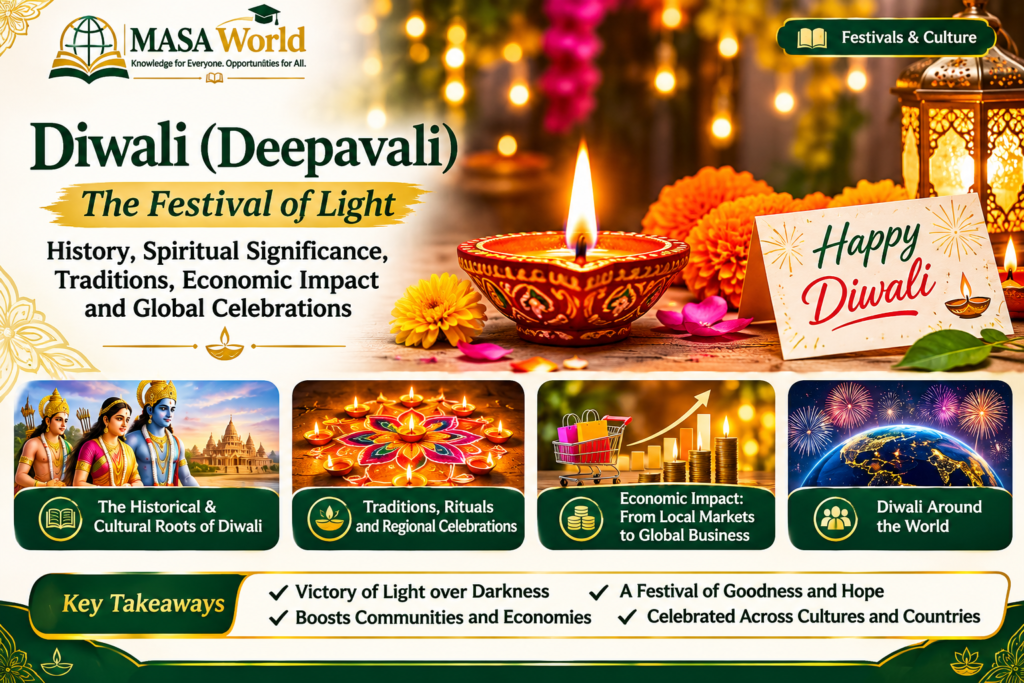
Diwali, widely known as the Festival of Lights, is one of the most recognisable celebrations associated with South Asia. It is observed by millions of people in India and across the world, but it is not a single, uniform festival with one story or one way of celebrating. Its meaning changes across regions, communities and faith traditions. For many Hindus, it is associated with the return of Rama to Ayodhya, the worship of Lakshmi, or the victory of light over darkness. Jain communities connect the day with the liberation of Mahavira. Sikhs mark Bandi Chhor Divas, remembering the release of Guru Hargobind Sahib and other prisoners. In Nepal, the wider season is celebrated as Tihar, with its own sequence of days and customs.
Beyond religion and family life, Diwali is also a major economic season. It influences retail, travel, hospitality, jewellery, consumer goods, logistics, small businesses and financial-market traditions. Its public visibility has grown internationally through diaspora communities, civic celebrations, cultural programming and public-holiday arrangements in several countries.
This guide explores Diwali through history, literature, multiple faith traditions, economic activity, global recognition and environmental responsibility. It distinguishes documented history from religious tradition and avoids treating diverse practices as if they were identical.
Diwali at a glance
- Name: Diwali or Deepavali, commonly translated as a row or series of lamps.
- Calendar: Usually falls in October or November, around the new-moon period of the Hindu lunisolar month of Kartika; exact dates vary each year.
- Duration: Commonly observed over several days, with regional calendars and customs differing.
- Communities: Celebrated in different ways by Hindu, Jain and Sikh communities; related seasonal observances also exist in Nepal and among wider South Asian communities.
- Common themes: Light, renewal, knowledge, prosperity, freedom, ethical conduct, family and community.
- Global reach: Observed by diaspora communities and recognised through public events, cultural programmes and holidays in a number of countries.
1. Historical and literary origins: a festival with many layers
The history of Diwali is not reducible to one founding event. The festival developed through regional calendars, religious narratives, seasonal practices, pilgrimage traditions, trade and community life. The Sanskrit term dīpāvali is commonly explained as a row of lamps. The use of lamps during the dark fortnight around Kartika is an important part of the festival’s identity, but the meanings attached to the lights differ across traditions.
One influential Hindu account links Diwali in parts of North India with Rama’s return to Ayodhya after the defeat of Ravana and the completion of his exile. In this telling, lamps welcome Rama, Sita and Lakshmana home. The story is associated with the Ramayana, a major epic that exists in numerous Sanskrit, regional-language and performance traditions. The versions are not identical, and the prominence of the return narrative varies by region.
Other Hindu traditions place emphasis on Lakshmi, the goddess associated with prosperity and well-being, or on Krishna’s defeat of Narakasura. In parts of eastern India, Kali Puja is central to the same festival period. In western India, the season may also mark the beginning of a new business year. These differences are not contradictions to be resolved into one universal account; they are part of Diwali’s diverse cultural history.
Historical references to lamp festivals and seasonal observances appear across South Asian literary and travel writing, but individual references need careful interpretation. A text mentioning lamps or a celebration in a particular month does not automatically prove that it describes the modern festival in its present form. The safest historical approach is to recognise Diwali as a festival whose practices and stories evolved over time, rather than assign it a single, universally accepted date of origin.
2. Diwali across faith traditions
Hindu traditions
For many Hindus, Diwali represents the triumph of good over evil, knowledge over ignorance and hope over despair. The meaning may be expressed through the Rama story, Lakshmi worship, Krishna-related narratives, Kali Puja or other local traditions. Families may clean and decorate homes, light lamps, share meals, visit relatives and take part in community events. The timing and emphasis vary substantially between regions and households.
Jain traditions: Mahavira’s nirvana
For Jains, Diwali is closely associated with the nirvana, or liberation, of Mahavira, the twenty-fourth Tirthankara. Jain tradition places this event at Pavapuri. The observance is connected with spiritual reflection, learning and the ideal of liberation. Some Jain accounts explain the lighting of lamps as a symbolic response to the loss of Mahavira’s physical presence: the community keeps the light of knowledge alive. The traditional chronology is religiously significant, but should not be confused with a date established by modern historical methods.
Sikh traditions: Bandi Chhor Divas
Sikhs observe Bandi Chhor Divas around the same period as Diwali. It commemorates the release of the sixth Sikh Guru, Guru Hargobind Sahib, from imprisonment at Gwalior Fort, along with other detained rulers, according to Sikh tradition. The event is remembered as a story of freedom, justice and concern for others. The Golden Temple and other gurdwaras are illuminated, and congregations gather for prayers, kirtan and community service. Bandi Chhor Divas has its own Sikh historical and spiritual meaning; it should not be described simply as a Sikh version of a Hindu festival.
Buddhist intersections and regional context
Diwali is not a universal Buddhist festival, and it is inaccurate to claim that all Buddhists celebrate it. In some regions and communities, seasonal festivals of lights overlap with local Buddhist cultural calendars or are observed by people from more than one religious background. In Nepal, Tihar is a major multi-day festival with distinct observances honouring crows, dogs, cows, Lakshmi and brothers. Some Newar Buddhist communities also participate in the wider cultural season. These regional intersections are best understood locally rather than treated as a single pan-Buddhist Diwali tradition.
3. The economic impact: from neighbourhood shops to national markets
Diwali is one of India’s most important annual consumption periods. Household purchases, gifting, food, clothing, electronics, home improvement, transport, travel, hospitality and event services all contribute to seasonal demand. The benefits are distributed across large retailers and small enterprises: neighbourhood stores, artisans, street vendors, self-help groups, makers of decorative goods, packaging suppliers, delivery workers and local service providers.
Trade organisations such as the Confederation of All India Traders (CAIT) publish estimates of festive-season business. These figures are useful indicators of market sentiment and the scale of expected activity, but they are trade-body estimates rather than official national accounts. They should always be reported with the year, the scope of the estimate and whether the figure represents actual sales or a projection. A single headline number cannot capture the different experiences of sectors, regions and business sizes.
Dhanteras, jewellery and household purchases
Dhanteras is an important shopping day for many households. Purchases may include gold and silver, utensils, appliances, vehicles and other durable goods. Jewellery demand is influenced by cultural preference, household savings, weddings, price movements and the broader economy. Gold purchases are not simply a measure of festival spending: they can also reflect long-standing savings practices. Retailers and consumers should compare purity, hallmarking, making charges, return policies and invoices rather than rely only on promotional claims.
Chopda Pujan and the business year
In parts of western India, especially among Gujarati and some trading communities, Chopda Pujan is associated with the worship or ceremonial opening of new account books. It symbolises a fresh financial beginning and hopes for an ethical, prosperous year. The custom reflects the historical relationship between commerce, community and the festival calendar. Modern businesses may use digital accounting systems, but the symbolic idea of reviewing accounts and beginning a new cycle remains meaningful for many traders.
Muhurat Trading and financial markets
Indian stock exchanges have a long-standing tradition of a special Muhurat Trading session around Diwali. It is a symbolic session that many market participants associate with the start of a new Samvat year. The exchange announces the exact date and timings each year. Muhurat Trading is a cultural-market tradition, not a guarantee of returns or a substitute for investment research. Investors should make decisions based on their goals, risk tolerance and reliable financial information—not on the auspicious timing of a trading session.
For small businesses, the season can bring higher sales but also pressure: inventory costs, temporary staffing, delivery capacity, cash flow and competition. Responsible festive commerce includes transparent pricing, safe working conditions, timely payments to suppliers and support for local producers.
4. Diwali around the world: public life and civic recognition
Diwali’s international presence is closely connected to migration, trade, education and the growth of South Asian communities abroad. Public celebrations can include lighting ceremonies, cultural performances, food festivals, exhibitions, school programmes and civic receptions. These events allow people from different backgrounds to encounter the festival as part of the shared cultural life of a city.
In countries with substantial South Asian populations, Diwali may be marked by public holidays, regional holidays or official civic events. Nepal celebrates the broader Tihar festival over several days. In Malaysia, Deepavali is a national public holiday, with specific regional exceptions in the holiday calendar. Singapore recognises Deepavali as a public holiday. In Fiji, Mauritius, Guyana, Trinidad and Tobago, Sri Lanka and other places, the festival is visible through community observances and, depending on local law, public-holiday recognition. In the United Kingdom, Canada, the United States, Australia and New Zealand, public celebrations and civic recognition vary by jurisdiction; a city event or school observance does not automatically mean a nationwide public holiday.
International recognition is therefore best described precisely. The legal status of a holiday can differ between countries, states, provinces and territories, and official calendars can change. Employers, schools and public agencies should consult the relevant government calendar for the current year rather than assume a uniform global arrangement.
Diwali’s global story is not only about the movement of a festival from one country to another. It is also about adaptation: families preserve inherited practices while developing new community traditions in the places where they live. Public celebrations can become spaces for cultural exchange, belonging and intergenerational learning.
5. Environmental stewardship: celebrating with care
Large-scale celebrations can create environmental pressures, including air and noise pollution, waste, traffic, energy use and risks from unsafe products. The impact depends on local conditions and the choices made by households, organisers, businesses and authorities. A responsible approach does not require abandoning celebration; it means reducing avoidable harm and making safer choices.
People can consider reusable decorations, locally made products, energy-efficient lighting, shared community events, minimal packaging, waste segregation and careful disposal of oil and other materials. Open flames should be kept away from curtains, paper, clothing and crowded walkways. Children should be supervised around lamps and electrical decorations. Fireworks can cause injuries, fires, noise disturbance and air pollution; avoiding them or choosing quieter, safer community alternatives can reduce these risks.
Green crackers and emissions claims
India’s green-cracker programme has involved scientific and regulatory work, including research associated with CSIR-NEERI and product categories such as SWAS, STAR and SAFAL. These names refer to specific formulations or categories developed under the programme; they do not mean that every product marketed as “green” is automatically safe or pollution-free. Any stated reduction percentage must be read in relation to the particular pollutant, test method, product and regulatory standard. It should not be presented as a guaranteed reduction in a city’s overall air pollution or AQI.
Consumers should follow current directions from the relevant pollution-control and local authorities, purchase only products permitted under applicable rules, and avoid counterfeit or unlabelled fireworks. CPCB and state pollution-control boards publish guidance and monitor air and noise quality. Local restrictions can vary, so current official orders matter more than old social-media messages or generic claims printed on packaging.
6. What makes Diwali globally meaningful?
Diwali’s international appeal comes from the way it combines local memory with themes that many people can understand: hope, renewal, freedom, generosity, knowledge and community. Its many narratives should remain distinct, because respect begins with recognising that different communities attach different meanings to the same calendar period.
For diaspora families, the festival can connect children with language, food, music, family histories and places they may know mainly through stories. For host communities, public events can create opportunities to learn about South Asian cultures beyond stereotypes. For businesses and artists, the season supports creative work and cultural exchange. For civic institutions, inclusive recognition can communicate that the histories and contributions of minority communities are part of the wider public story.
The strongest global celebration is not one that makes every practice identical. It is one that creates room for difference while encouraging safety, dignity, environmental care and mutual respect.
Frequently asked questions
Is Diwali a Hindu-only festival?
No. Diwali is especially prominent in Hindu traditions, but it also has important meanings in Jain and Sikh communities. Related seasonal observances and local cultural intersections exist in other South Asian communities. Each tradition has its own history and should be described accurately.
Why does the date of Diwali change every year?
Diwali follows a lunisolar calendar rather than a fixed Gregorian date. It generally falls in October or November, and the exact date is determined by the relevant calendar calculations and regional observance.
Is Bandi Chhor Divas the same as Diwali?
They occur around the same time, but Bandi Chhor Divas has a distinct Sikh significance centred on Guru Hargobind Sahib’s release from imprisonment and the release of other detainees, as remembered in Sikh tradition.
Is Diwali a public holiday worldwide?
No. It is an official public holiday in some countries and jurisdictions, while elsewhere it is recognised through community celebrations, civic events, school programmes or local observances. Always check the current official calendar for the relevant location.
What is Muhurat Trading?
It is a special Diwali-period trading session organised by Indian stock exchanges. It is a cultural and symbolic market tradition, not a promise of profit or investment advice.
Are green crackers pollution-free?
No. “Green” does not mean pollution-free or risk-free. Product claims must be assessed against the relevant certification, testing and regulatory requirements, and local restrictions must be followed.
How can families celebrate more sustainably?
Choose reusable decorations, reduce packaging and food waste, use efficient lighting, support local artisans, segregate waste, avoid unsafe fireworks and follow local safety and pollution-control guidance.
References and further reading
- Encyclopaedia Britannica – Diwali (general overview and regional traditions).
- Jainpedia (Jain history, Mahavira and religious traditions).
- Shiromani Gurdwara Parbandhak Committee (Sikh institutions and religious context).
- National Stock Exchange of India (official annual Muhurat Trading announcements and timings).
- Confederation of All India Traders (trade-body festive market estimates; check the year and whether figures are projections).
- CSIR–National Environmental Engineering Research Institute (research and information on green-cracker development).
- Central Pollution Control Board (air and noise pollution guidance and monitoring).
- Ministry of External Affairs, Government of India (official international and diaspora context).
Editorial note: Diwali dates, public-holiday status, market estimates and environmental rules are time-sensitive. Readers should consult the relevant official calendar, exchange notice, regulator or trade-body release for the specific year and location.