
Preserving India’s Living Heritage: Languages, Local Arts, Food, Festivals and Community Stories
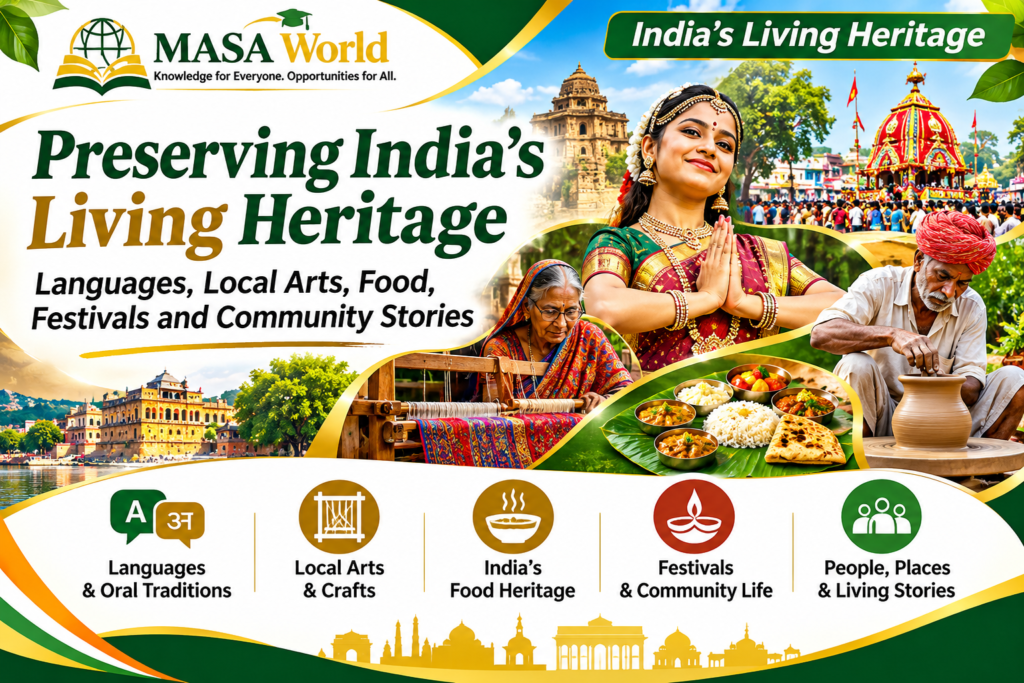
India’s living heritage is more than a record of the past—it is knowledge, identity, creativity and community life carried forward every day. It lives in the languages spoken at home, songs and oral histories, classical and folk performances, festivals, food traditions, healing and ecological knowledge, craft skills, local architecture and the memories attached to places. From Himalayan communities and the North-East to coastal regions, deserts, forests, towns and cities, India’s cultural life is diverse, layered and continually changing.
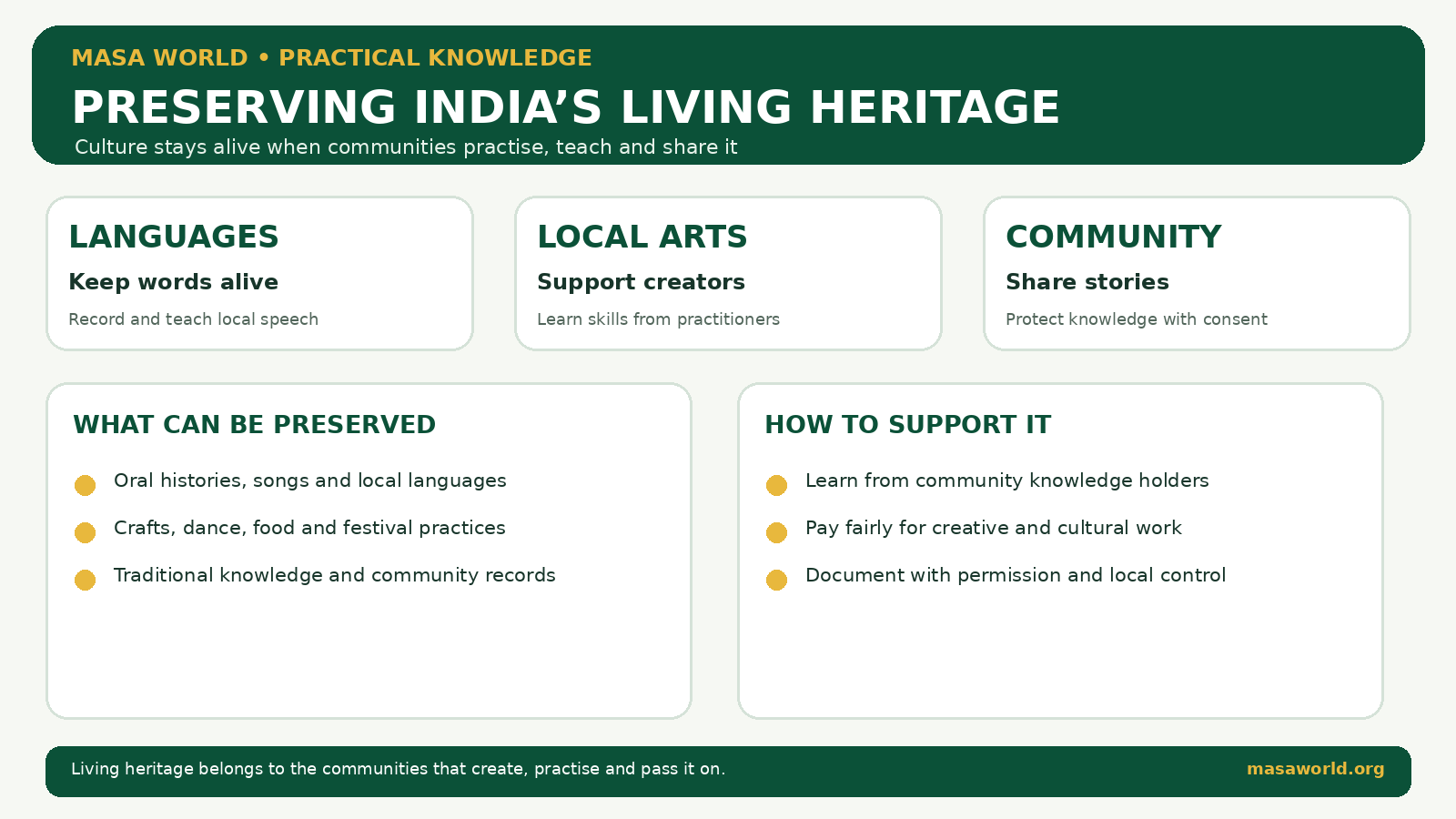
Preserving this heritage is not simply about putting old objects behind glass or organising an annual cultural show. It means ensuring that the people who hold, practise and transmit knowledge have dignity, voice, fair opportunities and the freedom to decide how their traditions are shared. It also means helping children and young people learn about their roots while building a future in which cultural knowledge can continue to evolve.
This guide explains what living heritage includes, why it matters, what threatens it, and how families, schools, artists, local institutions, civil society organisations and young people can take practical action. It approaches preservation as a shared responsibility connected to education, inclusion, livelihoods, sustainability and community development—areas central to MASA World’s wider social mission.
1. What do we mean by living cultural heritage?
Cultural heritage is often associated with monuments, historic buildings, archaeological sites, manuscripts and museum collections. These are important forms of tangible heritage. But heritage also includes living practices and knowledge that communities recognise as part of their identity. These are commonly described as intangible cultural heritage.
UNESCO’s framework groups intangible heritage into five broad domains:
- Oral traditions and expressions: languages, storytelling, songs, proverbs, folk narratives and forms of spoken knowledge.
- Performing arts: music, dance, theatre, puppetry and community performance traditions.
- Social practices, rituals and festive events: ceremonies, seasonal gatherings, celebrations, customary practices and community occasions.
- Knowledge concerning nature and the universe: local ecological knowledge, farming practices, weather observations, food knowledge and relationships with landscapes.
- Traditional craftsmanship: weaving, pottery, metalwork, woodwork, painting, embroidery, instrument-making and other skilled practices.
These categories overlap. A festival may bring together language, music, food, craft, ritual and ecological knowledge. A traditional textile may carry regional identity, technical skill, trade history and symbolic meaning. Heritage is therefore best understood in its full social context, not as a disconnected list of performances or objects.
2. Why preserving India’s heritage matters
Identity, belonging and intergenerational connection
Stories, languages, songs, recipes and shared celebrations help people understand where they come from and how communities have experienced change. They can connect children with grandparents and neighbours, strengthen a sense of belonging and make room for multiple identities. Respect for one tradition should never require disrespect for another.
Education and lifelong learning
Local heritage can make learning meaningful. Students can explore history through family archives, geography through traditional place names, science through craft materials and local ecosystems, mathematics through patterns and measurements, and language through oral histories. Such learning should be evidence-based and should distinguish documented history, community memory, belief and interpretation.
Livelihoods and local economies
Artists, performers, craftspeople, storytellers, cooks, guides and cultural educators contribute knowledge and skilled labour. Fair markets, responsible cultural tourism, apprenticeships, commissions and direct purchasing can support livelihoods. Cultural work should not depend on unpaid labour or the expectation that practitioners will share knowledge for exposure alone.
Social inclusion and mutual respect
Heritage work can bring attention to communities and art forms that receive limited institutional visibility. It can support dialogue across regions and generations. However, documentation and promotion must not stereotype communities, appropriate sacred practices or treat any group as a cultural exhibit.
Environmental knowledge and resilience
Many communities hold place-specific knowledge about water, crops, forests, food preservation, building materials and seasonal patterns. This knowledge can contribute to local sustainability discussions. It should be documented with care, assessed alongside scientific evidence where relevant, and never romanticised as automatically correct or universally applicable.
3. India’s heritage: many regions, many living traditions
India’s heritage cannot be represented by a single costume, language, cuisine or festival. Each region contains internal diversity, and traditions often cross present-day state and national borders. The following examples are illustrative, not an exhaustive inventory:
- Himalayan and trans-Himalayan regions: oral histories, Buddhist and other devotional traditions, seasonal festivals, weaving, pastoral knowledge, architecture adapted to mountain environments and distinct musical practices.
- North-East India: community festivals, oral epics, weaving, bamboo and cane crafts, diverse languages, agricultural knowledge and performance traditions belonging to many different communities.
- North and central India: folk theatre, devotional music, storytelling, embroidery, metalwork, painting traditions, regional foodways and craft lineages.
- Western India: embroidery, block printing, textile traditions, desert and pastoral knowledge, folk music, community celebrations and distinctive forms of architecture.
- Eastern India: scroll painting, terracotta, handloom traditions, folk theatre, music, literature, seasonal celebrations and craft practices linked to local materials.
- Southern India: classical and folk performance, temple and community arts, handloom and metal crafts, oral traditions, culinary knowledge and diverse regional literary cultures.
- Coastal and island communities: maritime knowledge, boat-making, fishing practices, food preservation, songs, festivals and relationships with fragile coastal ecosystems.
These examples should be explored through local voices. A broad regional label can hide important differences between villages, language groups, castes, tribes, faith communities, practitioners and generations.
4. Protect languages, dialects and oral histories
Language carries more than vocabulary. It can preserve place names, humour, ecological observations, family relationships, poetry, local history and ways of describing the world. When a language becomes less used, the loss may affect the stories and knowledge expressed through it.
Practical steps include:
- Encourage children to speak with family members in the languages they know, without shaming them for using other languages.
- Record stories, songs, sayings and interviews only after obtaining clear, informed permission.
- Keep original audio and video files, and add carefully checked transcripts and translations where contributors agree.
- Record the speaker’s preferred name, language or variety, date, context and permitted uses.
- Support community-led classes, reading circles, children’s books, local dictionaries and digital resources.
- Respect knowledge that contributors do not want recorded, translated or made public.
Do not assume that a dialect is an inferior version of a language or that one speaker can represent everyone. Ask fluent speakers how they describe their language and how they want it written or credited.
5. Keep traditional arts and craftsmanship alive
A craft survives when skills can be learned, materials remain accessible, practitioners can earn fairly and there is a reason for the next generation to continue. A photograph of a finished object cannot preserve the full knowledge of how it was made.
Communities, schools and buyers can help by:
- Purchasing directly from makers, recognised cooperatives or transparent fair-trade channels.
- Paying prices that recognise time, skill, materials and design knowledge.
- Commissioning work and workshops with written clarity about fees, credit, ownership and permitted reproduction.
- Creating apprenticeships and intergenerational learning opportunities led by practising artisans.
- Supporting access to tools, safe workspaces, raw materials, market information and digital skills.
- Explaining the origin and process of a craft accurately rather than using vague labels such as “traditional” or “ethnic”.
Traditional designs and techniques may be connected to community identity and intellectual property. Do not copy, commercialise or digitally reproduce them without appropriate permission. Where a design is collectively held, seek guidance from the relevant community or practitioner body rather than assuming that one individual can grant every right.
6. Food traditions, festivals and community practices
Food traditions include cultivation, ingredients, preparation techniques, preservation, utensils, seasonal calendars, family memory and the social meaning of eating together. Documenting a recipe should therefore include its context: who shared it, when it is prepared, how ingredients vary locally and whether the contributor wishes to be named.
Festivals and public celebrations can sustain music, craft, food, performance and community relationships. Responsible participation means learning the local context, following organisers’ guidance, respecting religious and cultural differences, making events accessible and considering waste, crowd safety, noise and environmental impact. Avoid presenting a community’s sacred or private practices as entertainment for outsiders.
Communities are not uniform. People may observe the same festival differently, disagree about its meaning or choose not to participate. A respectful guide should make space for these differences instead of presenting one practice as the only authentic version.
7. Protect monuments, archives, manuscripts and historic places
Living heritage is connected to physical places and objects: historic neighbourhoods, monuments, places of worship, memorials, libraries, family photographs, letters, manuscripts, tools and community archives. Their protection requires appropriate conservation expertise and respect for legal responsibilities.
Individuals can help by avoiding damage, graffiti, unauthorised removal of objects and careless handling of old documents. Local groups can organise supervised heritage walks, oral-history projects and awareness activities in partnership with qualified institutions. Photographs and scans should be made only where permitted, and fragile materials should not be cleaned, repaired or chemically treated without expert advice.
For protected monuments and archaeological sites, follow the directions of the Archaeological Survey of India or the relevant state authority. Community enthusiasm is valuable, but structural repairs and conservation interventions should be carried out by qualified professionals.
8. What threatens cultural heritage today?
- Declining transmission: younger generations may have fewer opportunities to learn a language, craft, song or performance from experienced practitioners.
- Unfair economics: low returns, unstable demand, costly materials and lack of social protection can make cultural work difficult to sustain.
- Migration and urban change: displacement, changing neighbourhoods and loss of traditional workspaces can weaken community networks.
- Misrepresentation and appropriation: inaccurate storytelling, unauthorised copying and commercial use without consent can harm practitioners and communities.
- Environmental pressures: climate change, pollution, resource scarcity and damage to local ecosystems can affect materials, places and seasonal practices.
- Digital loss or misuse: files can disappear, be stripped of context, circulated without permission or used to train and generate content in ways contributors did not agree to.
- Exclusion: women, marginalised groups, persons with disabilities, minority communities and less visible practitioners may be left out of decisions and benefits.
These challenges are interconnected. A documentation project alone cannot solve a livelihood problem; a festival alone cannot replace long-term teaching; and online visibility does not automatically mean community control or benefit.
9. Ethical documentation: consent, credit and community control
Before recording an interview, performance, ritual, craft process or family archive, explain the purpose in a language the contributor understands. State where the material may appear, who may access it, whether it may be edited or translated, whether it may be used commercially and how a contributor can raise concerns. Obtain consent before recording and revisit it if the intended use changes.
Good practice includes:
- Ask, do not assume: permission to attend an event is not automatically permission to record or publish it.
- Agree on access: some material may be public, some restricted to a community, and some unsuitable for recording.
- Credit accurately: use the names and descriptions contributors prefer, and acknowledge collective knowledge where appropriate.
- Share benefits: agree on honoraria, fees, copies, access to the finished work or other benefits before the project begins.
- Protect sensitive information: avoid publishing precise locations, personal details or sacred knowledge where disclosure could cause harm.
- Keep records secure: store files safely, maintain backups and document permissions and usage conditions.
- Allow review: where practical, let contributors check names, translations, context and excerpts before publication.
Ethical documentation is not just a legal formality. It is a relationship of trust and accountability.
10. The role of young people, schools and families
Young people should be participants and creators—not simply an audience asked to memorise cultural facts. Schools, colleges, clubs and families can connect heritage with practical learning:
- Interview a willing family or community member and create a short, consented oral-history record.
- Map local historic places and collect the stories associated with them, checking facts with reliable sources.
- Invite a craftsperson, musician, storyteller or performer to lead a paid learning session.
- Create bilingual posters, podcasts, short films or exhibitions after contributors approve the content and its use.
- Explore local food traditions through ingredients, agriculture, nutrition, geography and family memory without making unsupported health claims.
- Organise supervised visits to museums, archives, heritage sites and cultural institutions.
- Make activities accessible to children with different abilities, languages and learning needs.
Teachers should distinguish historical evidence from legends, oral memory, religious belief and contemporary interpretation. This distinction does not dismiss community narratives; it helps present them honestly and respectfully.
11. Digital technology and the future of heritage
Digital tools can support audio archives, virtual exhibitions, language learning, searchable catalogues, craft tutorials and access to cultural resources. They can also create risks: unauthorised copying, loss of context, deepfakes, false attribution and the circulation of material beyond the audience for which it was intended.
Use technology with clear purpose and community agreement. Preserve original files, record metadata, maintain backups, use captions and accessible formats, and choose appropriate access controls. Clearly label reconstructions, translations and AI-assisted material. Do not use AI-generated images or audio as evidence of a real tradition, historical event or practitioner. Never upload restricted cultural material to a public AI service without the rights-holder’s informed permission.
12. Institutions, policies and support in India
Heritage safeguarding involves public institutions, cultural academies, universities, museums, libraries, local bodies, practitioners and civil society. The Ministry of Culture and its institutions support different aspects of cultural preservation and promotion. Sangeet Natak Akademi is an important national institution for performing arts and serves as India’s nodal agency for intangible cultural heritage-related work.
Relevant starting points for research and partnership include:
- Ministry of Culture — schemes and programmes: check current scheme guidelines, eligibility, application windows and funding conditions directly.
- Sangeet Natak Akademi — Intangible Cultural Heritage: information on India’s ICH work, domains and documentation.
- UNESCO — India country page: the current list of Indian elements inscribed on UNESCO’s Representative List and related information.
- Archaeological Survey of India: information on centrally protected monuments and archaeological heritage.
- Indian Culture Portal: curated cultural resources and learning material.
- Sahitya Akademi: literary and language-related programmes and resources.
Government schemes and eligibility rules can change. An organisation should read the latest official notification, confirm whether it is eligible, prepare the required governance and financial documents, and never describe a grant as guaranteed. A listed UNESCO element is not a quality ranking and does not mean that other traditions are less valuable.
13. India and UNESCO: recognition is a tool, not the whole goal
UNESCO’s Intangible Cultural Heritage lists raise awareness and encourage safeguarding, but inscription is not the same as preservation by itself. The central purpose is to support the continued practice and transmission of heritage with the participation of the communities concerned.
UNESCO’s India country page records 16 elements on the Representative List, including Deepavali (inscribed in 2025). The list includes traditions such as Vedic chanting, Ramlila, Kutiyattam, Chhau, Yoga, Kumbh Mela, Durga Puja in Kolkata and Garba of Gujarat. These examples show the breadth of living practices, but they are not a complete representation of India’s cultural diversity. Many valuable traditions are not on an international list and still deserve community-led safeguarding.
Use UNESCO recognition as a source for learning and context—not as a reason to rank cultures, claim ownership or promote a tradition without consulting its practitioners.
14. How MASA World can contribute: from awareness to community action
For MASA World, cultural heritage should be connected with education, youth participation, community development and inclusive opportunity. The role of a social organisation is not to speak on behalf of every community or claim authority over traditions. It is to help create respectful platforms, connect people with knowledge and resources, and support community-led initiatives.
A practical MASA World programme could include:
- Community Heritage Documentation: consent-based oral histories, local-language recordings, craft profiles and community-reviewed digital archives.
- Youth Heritage Clubs: school and college activities, heritage walks, interviews, exhibitions and intergenerational learning.
- Artist and Artisan Connect: workshops, fair-paid demonstrations, market linkages and opportunities for practitioners to teach.
- Culture and Education Resources: reliable articles, bilingual learning material, regional heritage explainers and fact-checked educational content.
- Inclusive Cultural Events: accessible events that give practitioners and community organisations meaningful control over how their work is presented.
- Partnership and Referral Network: collaboration with cultural institutions, universities, local bodies, libraries, museums and established practitioner groups.
- Responsible Digital Heritage: accessible archives with clear permissions, attribution, preservation copies and restrictions for sensitive material.
Each initiative should have a written purpose, community partners, consent process, safeguarding arrangements, realistic budget and measurable outcomes. MASA World should publish what was done, who participated, how practitioners benefited and what needs improvement—without exaggerating impact.
15. A practical 90-day community heritage action plan
Days 1–15: Listen and identify
- Choose one local language, craft, performance, food tradition, historic place or oral-history theme.
- Identify relevant practitioners, community groups and institutions.
- Hold listening conversations and ask what the community considers useful and appropriate.
- Define what must remain private and what may be documented.
Days 16–30: Plan responsibly
- Agree on the project’s scope, roles, schedule and budget.
- Prepare consent information in accessible language.
- Set fair fees, honoraria, travel support and credit arrangements.
- Choose safe storage, access permissions and review procedures for records.
Days 31–60: Learn and document
- Conduct a small number of consented interviews or workshops.
- Record names, context, language, dates and usage permissions accurately.
- Have knowledgeable contributors check translations and descriptions.
- Give participants copies of the material where appropriate.
Days 61–90: Share, evaluate and continue
- Publish only the material approved for public sharing.
- Organise a community presentation, school session or exhibition with practitioner involvement.
- Ask participants whether the project was respectful, useful and fairly managed.
- Record lessons, expenses, participation and next steps in a transparent report.
Start small and complete the work properly. One well-consented oral history or a fairly paid artisan-led workshop is more valuable than a large online collection without context, permission or community benefit.
16. How should a heritage project measure success?
Success should not be measured only by views, photographs, attendance or the number of files uploaded. Useful indicators may include:
- Number of practitioners and community groups who helped design the project.
- Number of young people who completed a learning activity or apprenticeship.
- Fees and honoraria paid to artists, researchers and knowledge holders.
- Languages, skills or practices supported through ongoing learning—not just one-time recording.
- Percentage of published records with documented permission, accurate attribution and contributor review.
- Accessibility improvements, community feedback and participation across different groups.
- Whether the community wants the project to continue and has a role in deciding how.
Collect only the data needed, protect personal information and publish findings honestly. A community may decide that keeping knowledge private is the right outcome; that decision should be respected as a successful safeguarding choice.
Frequently asked questions
What is the difference between tangible and intangible cultural heritage?
Tangible heritage includes physical places and objects such as monuments, historic buildings, manuscripts and artefacts. Intangible heritage includes living knowledge and practices such as languages, oral traditions, performing arts, rituals, festivals and traditional craftsmanship. They often depend on and strengthen one another.
Does preserving heritage mean keeping every tradition unchanged?
No. Living traditions naturally adapt. Safeguarding means supporting the ability of communities to practise, transmit and shape their heritage while respecting rights, meaning and community decisions. It does not require freezing culture in the past.
Can an NGO or school document a local tradition?
Yes, when the relevant practitioners and community members agree, the project has a clear purpose, permissions are informed and the material is handled responsibly. Some knowledge may be restricted and should not be recorded or published.
How can young people help?
They can learn a language or skill, interview willing family members, support local artists, visit cultural institutions, create community-reviewed learning resources and take part in accessible heritage activities.
How can traditional artists and craftspeople be supported?
Pay fairly for work and teaching, buy directly where possible, support apprenticeships, provide access to markets and materials, credit practitioners and obtain permission before reproducing designs or recordings.
Does UNESCO listing guarantee that a tradition is protected?
No. International recognition can increase visibility, but safeguarding depends on continued community participation, transmission, appropriate support and respect for the people concerned.
Where can organisations find official information about support?
Start with the Ministry of Culture, Sangeet Natak Akademi, relevant state cultural departments and established cultural institutions. Check current official guidelines and eligibility directly before applying for any scheme or funding.
Conclusion: keep heritage alive by supporting the people who carry it
India’s living heritage is not simply something to admire during a festival or read about in a history book. It is sustained by people who speak languages, teach skills, make art, prepare food, tell stories, care for places and pass knowledge to the next generation. Their work deserves recognition, fair opportunity and a meaningful voice in decisions about how their heritage is represented.
Preservation begins with listening. It grows through education, ethical documentation, fair livelihoods, inclusive participation and partnerships that respect community leadership. Families can begin at home; schools can make local knowledge part of learning; institutions can provide resources; and organisations such as MASA World can help connect communities with opportunities and platforms.
The goal is not to preserve culture as a frozen picture of the past. The goal is to help living traditions remain meaningful, respected and possible for future generations.
Official and reliable resources
- UNESCO — Intangible Cultural Heritage: India
- UNESCO — Intangible Cultural Heritage Convention and resources
- Ministry of Culture, Government of India
- Sangeet Natak Akademi — Intangible Cultural Heritage
- Archaeological Survey of India
- Indian Culture Portal
- Sahitya Akademi
Editorial note: This guide is educational and intended to encourage responsible community action. Legal permissions, conservation work, funding eligibility and cultural rights should be confirmed with the relevant authorities, qualified professionals and communities concerned.