
India Plans a Sustainable Sports League Ecosystem: What the New 14-Member Committee Must Deliver
Updated: 19 November 2026 | Category: Sports & Fitness
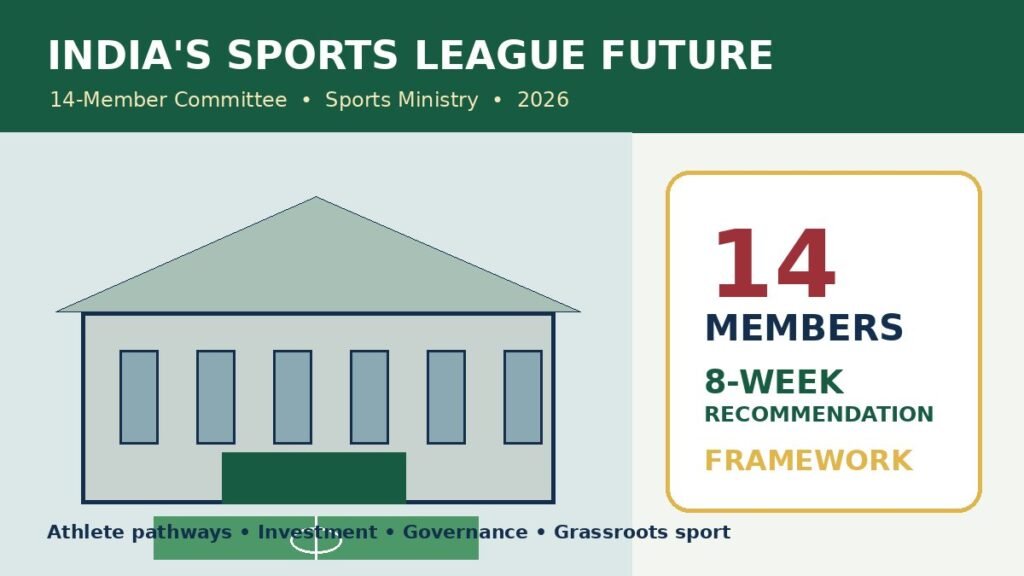
The Ministry of Youth Affairs and Sports has formed a 14-member committee to develop a sustainable sports league ecosystem in India. The Department of Sports announced the committee on 18 November 2026. It will study barriers that prevent leagues from starting and continuing. It will also recommend ways to improve athlete pathways, attract investment and strengthen governance.
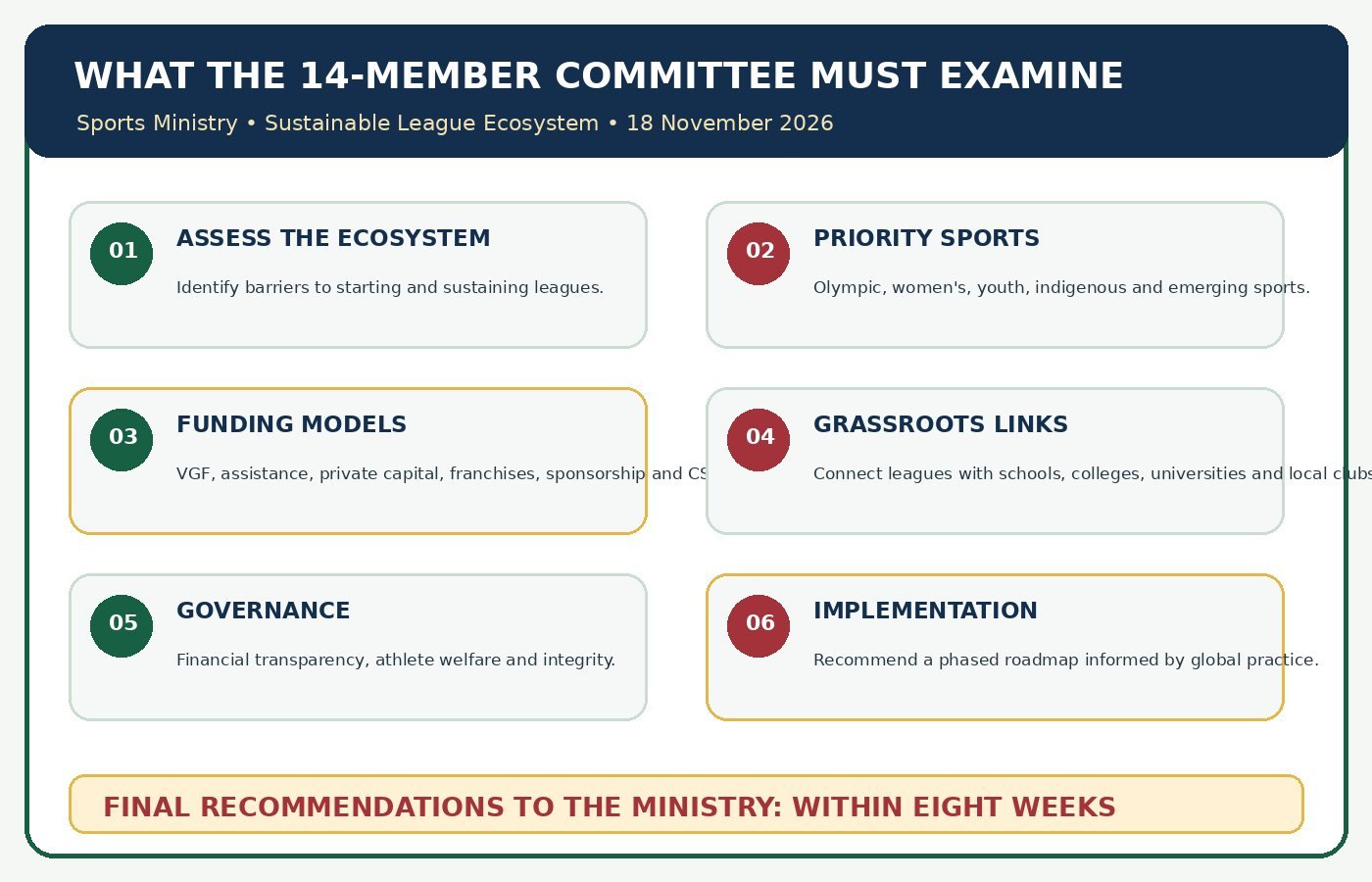
The committee’s work covers Olympic sports, women’s sports, youth sports, indigenous sports and emerging disciplines. It will examine government support, private investment, broadcasting, digital rights and Corporate Social Responsibility (CSR) funding. It must submit its final recommendations to the Ministry within eight weeks.
This is a committee announcement, not a final league policy. The recommendations are still to come. This guide explains the committee’s mandate, its membership, the proposed funding options and the issues that a credible framework should address.
Table of Contents
- Executive Summary and Key Details
- Why the Sports Ministry Formed the Committee
- Who Is on the 14-Member Committee?
- What the Committee Must Examine
- Funding and Commercial Sustainability
- Connecting Leagues with Grassroots Sport
- Governance and Athlete Welfare
- Different Sports Need Different League Models
- Employment and the Wider Sports Economy
- How to Measure the Framework’s Success
- Eight-Week Recommendation Timeline
- MASA World Editorial Insight & Community Guidance
- Frequently Asked Questions
- Official References
Executive Summary and Key Details
The Ministry’s Press Information Bureau (PIB) release confirms the committee’s size, broad mandate, consultation powers and eight-week reporting period. It links the initiative with Khelo Bharat Niti and the national vision of Viksit Bharat @2047. Read the official PIB announcement.
| Item | Official detail |
|---|---|
| Announced by | Ministry of Youth Affairs and Sports, Department of Sports |
| Announcement date | 18 November 2026 |
| Committee size | 14 members |
| Convener | Kunal, Joint Secretary (Governance) |
| Main task | Develop a framework for professionally managed and financially sustainable sports leagues |
| Priority areas | Olympic, women’s, youth, indigenous and emerging sports |
| Consultation powers | National Sports Federations, league officials, investors and sports technology firms |
| Recommendation period | Within eight weeks |
| Policy context | Khelo Bharat Niti and Viksit Bharat @2047 |
Why the Sports Ministry Formed the Committee
Sports leagues can create regular competition and give athletes more opportunities to perform. They can also attract sponsors, broadcasters, technology firms and local businesses. But a league needs a stable operating model. It needs venues, officials, trained staff, player contracts, medical support and reliable revenue.
The Ministry says several Indian leagues have achieved different levels of success. It also notes that many sports with strong sporting and social potential face commercial viability challenges during their early stages. This gap matters. A sport may have talented athletes and community interest, but still lack the money and organisational capacity to run a professional league.
The committee will examine these barriers. It will identify priority sports and recommend operating models suited to each sport’s sporting and commercial potential. Its role is to develop a framework, not to announce that every sport will receive a new league or funding allocation.
The policy context includes Khelo Bharat Niti and Viksit Bharat @2047. The Ministry’s stated ambition is to build regular, high-quality competitive pathways. It also wants leagues to support talent identification, athlete development and employment across the sports economy.
Who Is on the 14-Member Committee?
The Ministry’s announcement names government officials, sports administrators, private-sector representatives, broadcasters and a legal professional. The list below follows the official PIB release.
| No. | Name | Role or organisation stated in release |
|---|---|---|
| 1 | Kunal | Joint Secretary (Governance) — Convener |
| 2 | Vineel Krishna | Joint Secretary (Khelo India) — Member |
| 3 | Raghuram Iyer | CEO, Indian Olympic Association — Member |
| 4 | B. Srinivasan | Reliance Industries Limited — Member |
| 5 | Hemang Amin | COO, IPL, BCCI — Member |
| 6 | P.K.S.V. Sagar | GMR Sports — Member |
| 7 | Sanjay Adesara | Adani Sportsline — Member |
| 8 | Divyanshu Singh | JSW Sports — Member |
| 9 | Ishan Chatterjee | Jio Hotstar — Member |
| 10 | Rajesh Kaul | Sony Pictures — Member |
| 11 | Anupam Swaroop | DD Sports — Member |
| 12 | Parag Darade | Zee Entertainment — Member |
| 13 | Abhijit Bhattacharya | BVL — Member |
| 14 | Nandan Kamath | Advocate — Member |
The composition brings together policy, sports administration, league operations, investment, broadcasting and legal perspectives. This mix may help the committee understand different parts of the league business. However, representation alone does not guarantee a balanced outcome. The quality of consultation and the evidence used will matter.
What the Committee Must Examine
The PIB release describes several connected tasks. These tasks form the foundation of the proposed framework.
1. Assess the existing league ecosystem
The committee will identify the main barriers affecting the creation and sustainability of leagues. These may include weak revenue models, high operating costs, limited venues, short competition calendars and gaps in professional management. The official release does not publish a detailed problem list. The committee is expected to assess these constraints.
2. Identify priority sports
The Ministry specifically names Olympic sports, women’s sports, youth sports, indigenous sports and emerging sports. The committee must consider the sporting and commercial potential of each category. A sport should not be selected only because it can attract a large television audience. Participation, talent depth, access and long-term development also matter.
3. Recommend suitable operating models
Different sports may need different league structures. A team-based franchise model may suit some sports. A regional circuit, club competition or shorter seasonal format may suit others. The committee is expected to recommend models that match each sport’s needs and realistic market potential.
4. Examine government and private-sector roles
The Ministry wants structured government facilitation alongside active participation from private companies, sports organisations, State Governments, local bodies and communities. The committee will examine support options such as Viability Gap Funding (VGF), direct and indirect financial assistance and concessional access to government sports infrastructure.
5. Strengthen governance
The framework must cover financial transparency, athlete welfare and integrity. It should also include a phased implementation roadmap informed by global best practices. These issues are central to trust. A league needs clear rules for ownership, contracts, payments, disputes, safeguarding and sporting integrity.
Funding and Commercial Sustainability
A professional league needs a realistic financial plan. It must pay for competition operations, venues, officials, medical support, travel, broadcasting and administration. A strong first season does not guarantee a stable business. Organisers need to plan for changes in sponsorship, ticket sales and media demand.
The Ministry’s release identifies several possible sources of support:
- Corporate capital: Investment from companies that support the league’s long-term development.
- Franchise ownership: Team ownership models where suitable for the sport and market.
- Sponsorships: Commercial partnerships linked to teams, events or the league.
- Broadcasting and digital rights: Revenue from television, streaming and digital distribution.
- CSR financing: Corporate Social Responsibility support where the activity meets applicable rules.
- Government facilitation: Potential VGF, financial assistance or concessional access to sports infrastructure.
These are mechanisms for the committee to examine. The announcement does not approve a specific VGF amount, budget or grant for any league. Any future support will depend on the recommendations, government decisions, eligibility rules and available resources.
Why VGF may matter
Viability Gap Funding can help address a gap between the cost of delivering a project and the revenue it can reasonably generate. For sports, this could be relevant where a league has public value but cannot cover all early costs through commercial income. Any support should have clear conditions, performance measures and a transparent exit plan. Public money should not become an automatic subsidy for weak management.
Connecting Leagues with Grassroots Sport
A league should not exist separately from the wider sporting system. The Ministry’s mandate asks the committee to consider links with schools, colleges, universities and local clubs. These links can help create a route from early participation to higher levels of competition.
A strong pathway may include:
- School and community participation programmes.
- Local clubs and district-level competitions.
- State-level events and talent identification.
- Structured coaching and athlete development support.
- League opportunities for athletes who meet the sporting standards.
- Progression to national and international competition where appropriate.
Women and young athletes are explicit priorities in the Ministry’s announcement. A credible system should consider safe transport, suitable facilities, trained coaches, medical support and clear safeguarding procedures. It should also make opportunities available beyond a small number of major cities.
Indigenous and emerging sports may need different routes. Community participation, cultural knowledge and local institutions can be important assets. The committee should consider models that protect these strengths while improving competition quality and financial management.
Governance and Athlete Welfare
Commercial investment can help leagues grow. It can also create pressure to prioritise short-term revenue. Good governance helps balance business interests with sporting values.
Financial transparency
Leagues should publish clear rules for ownership, budgets, payments and related-party transactions. Teams and athletes need to know when payments are due. Independent audits and transparent reporting can help partners assess financial health.
Athlete contracts and welfare
Contracts should explain salary, prize money, insurance, injury support, travel, accommodation and dispute resolution. Athletes should understand image rights and sponsorship obligations. Young players need special safeguarding. Women athletes need safe facilities and clear channels to report harassment or discrimination.
Sporting integrity
Leagues need consistent rules for selection, officiating, anti-doping, disciplinary action and conflicts of interest. Match integrity must be protected. Disputes should be handled through a fair and independent process. Rules should apply consistently to teams, officials and administrators.
Legal and policy alignment
League governance should fit with the wider sports policy and applicable laws. Organisers should coordinate with National Sports Federations and relevant authorities. They should also respect athlete rights and international competition requirements where applicable. A commercial league must not create confusion about national team selection or recognised competition pathways.
Different Sports Need Different League Models
One structure will not work for every sport. A sport with a large audience may attract franchise owners and broadcast partners. A developing sport may need a regional competition with lower operating costs. A women’s league may need dedicated investment in facilities, marketing and long-term player development.
The committee should compare options using clear criteria:
- Number of active athletes and clubs.
- Existing competition structure and federation capacity.
- Venue availability and travel costs.
- Audience interest and realistic commercial demand.
- Potential for youth and women’s participation.
- Coaching, officiating and sports science capacity.
- Ability to create a stable calendar and athlete pathway.
Some leagues may need a short season or a regional structure before they can support a national competition. Others may benefit from school and university links. The right model should build the sport’s base rather than copy the format of a successful league in another discipline.
Employment and the Wider Sports Economy
The Ministry identifies employment opportunities in sports management, broadcasting, technology, events and allied services. A league can create work beyond the playing field. It needs event managers, venue staff, officials, coaches, physiotherapists, strength and conditioning specialists, analysts, media teams and technology support.
Training institutions can help prepare this workforce. Colleges and universities can develop courses in sports management, event operations, sports science, data analysis and broadcasting. Local clubs can provide practical experience. Professional leagues can create internships and entry-level roles, but these opportunities should include fair pay and clear responsibilities.
Jobs should not be counted only through temporary event staffing. A stronger ecosystem should build stable careers and professional standards. The committee’s recommendations can help identify which skills are needed and how training can connect with real league operations.
How to Measure the Framework’s Success
The Ministry has announced the committee and its mandate. It has not yet published the final framework or performance results. The following measures are suggested ways to evaluate future implementation. They are not official targets.
| Area | Possible measure |
|---|---|
| Competition access | Number of sports with regular, published competition calendars |
| Athlete development | Progression from school, club and State events to higher competition |
| Inclusion | Participation and retention of women, youth and para-athletes |
| Regional reach | Access for athletes and clubs outside major metropolitan areas |
| Financial health | Transparent accounts, diversified revenue and timely payments |
| Welfare and integrity | Insurance coverage, safeguarding, fair contracts and independent dispute handling |
| Employment | Stable jobs and recognised skills across sports operations |
Public reporting should distinguish between money announced, money spent, athletes reached and outcomes achieved. This helps citizens and sports organisations understand whether the framework is delivering practical value.
Eight-Week Recommendation Timeline
The Ministry has directed the committee to submit its final recommendations within eight weeks. It can consult National Sports Federations, existing league officials, investors and sports technology firms. Its meetings may take place in person, online or in hybrid form.
The announcement does not provide a detailed week-by-week schedule. A practical process could include reviewing the current ecosystem, consulting stakeholders, comparing models, assessing funding options and drafting recommendations. This is an editorial outline, not an official committee calendar.
After the committee submits its report, the Ministry will need to consider the recommendations and decide on the next steps. A final policy, funding scheme or implementation timetable should only be reported when the government publishes it.
MASA World Editorial Insight & Community Guidance
India needs sports leagues that develop athletes, not only brands. Investment should support fair competition, safe facilities and reliable athlete pathways. Schools, local clubs and State organisations must have a place in the system. Public support should be transparent and linked to measurable outcomes.
MASA World encourages sports clubs, coaches, schools, universities and athlete groups to follow the committee’s work. They can prepare practical feedback about facilities, coaching, competition calendars, athlete welfare and local participation. Community organisations should make sure that smaller sports and emerging athletes are heard.
The strongest framework will balance commercial growth with sporting development. It should recognise different needs across disciplines. It should also protect athletes from unfair contracts and unstable competitions. A sustainable league is one that can continue while strengthening the sport around it.
Frequently Asked Questions
1. How many members are on the Sports Ministry committee?
The Ministry has constituted a 14-member committee. Kunal, Joint Secretary (Governance), is the convener.
2. What is the committee’s main objective?
It will formulate a framework for a wider, professionally managed and financially sustainable sports league ecosystem in India.
3. Which sports are a priority?
The Ministry specifically names Olympic sports, women’s sports, youth sports, indigenous sports and emerging sports.
4. Will the government provide funding to all leagues?
The committee will examine options such as Viability Gap Funding, financial assistance and concessional access to government sports infrastructure. The announcement does not approve funding for every league.
5. When will the committee submit its recommendations?
The Ministry says the committee must submit its final recommendations within eight weeks. A detailed week-by-week timetable has not been published in the announcement.
Official References
- Press Information Bureau, Ministry of Youth Affairs and Sports: High-Level Committee to Build a Sustainable Sports League Ecosystem in India, 18 November 2026.
- Ministry of Youth Affairs and Sports — official website.
- Sports Authority of India — official website.
Editorial note: Committee composition, mandate and eight-week reporting period are based on the PIB release dated 18 November 2026. The article’s suggested performance measures and implementation considerations are editorial analysis, not announced government targets.