
NMMSS 2026–27: Institute Verification by 30 November, District Verification by 15 December
Category: Career & Education | Updated: 19 November 2026
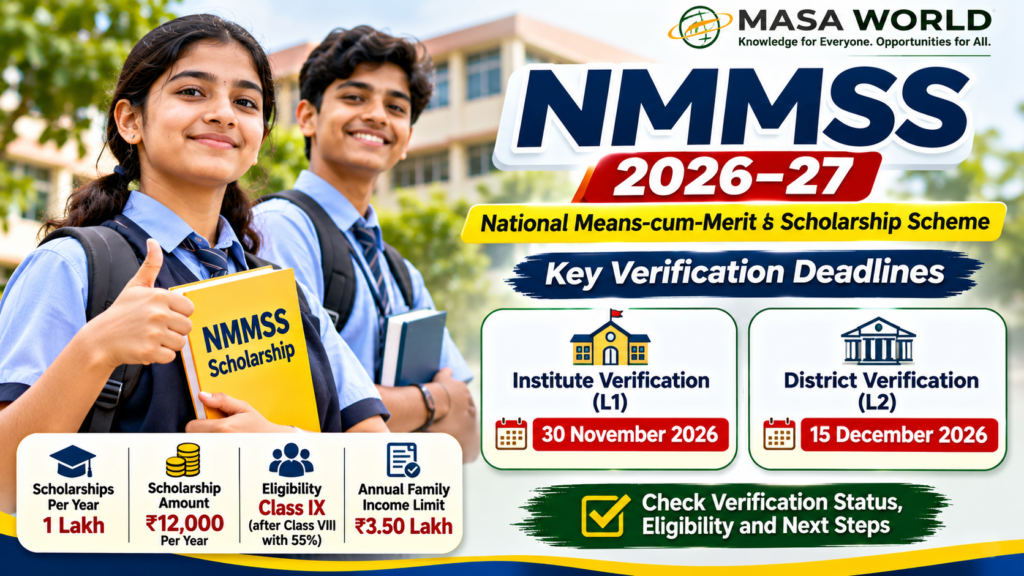
The student application window for the National Means-cum-Merit Scholarship Scheme (NMMSS) 2026–27 closed on 15 November 2026. The next stage is institutional verification. Institute Nodal Officers must complete Level 1 (L1) verification by 30 November. District Nodal Officers must complete Level 2 (L2) verification by 15 December. Students who submitted forms should now check their application status and contact their schools if action is pending.
This guide explains the revised dates, scheme benefits, eligibility basics and the steps that students, parents and schools should take. It also explains what verification does not mean: a submitted or verified application is not, by itself, a final scholarship sanction or payment confirmation.
Table of Contents
- NMMSS 2026–27: Key dates and facts
- What is the NMMSS scheme?
- Who can qualify?
- How selection and scholarship renewal work
- What L1 and L2 verification mean
- What students and parents should do now
- What schools and officers must complete
- Common application and verification problems
- Why the scholarship matters
- MASA World Editorial Insight & Community Guidance
- Frequently Asked Questions
- Official references
NMMSS 2026–27: Key dates and facts
| Item | Official information |
|---|---|
| Student application deadline | 15 November 2026 — closed |
| Institute Nodal Officer verification (L1) | 30 November 2026 |
| District Nodal Officer verification (L2) | 15 December 2026 |
| Fresh scholarships each year | 1,00,000 |
| Scholarship amount | ₹12,000 per year |
| Fresh award class | Class IX, after qualifying in the State/UT selection examination |
| Parental income ceiling | ₹3.50 lakh per year |
| Application and status portal | National Scholarship Portal (NSP) |
Important: The Ministry of Education announced the revised schedule on 31 October 2026. The Ministry’s notice gives 30 November for L1 and 15 December for L2. The National Scholarship Portal’s NMMSS listing also shows the application closed on 15 November and these verification dates.
What is the NMMSS scheme?
The National Means-cum-Merit Scholarship Scheme is a Central Sector Scheme run by the Department of School Education and Literacy under the Ministry of Education. It supports meritorious students from economically weaker families. Its central aim is to reduce dropouts after Class VIII and help students continue school education up to Class XII.
The scheme provides one lakh fresh scholarships each year. Fresh awards go to eligible students entering Class IX after they qualify in the selection examination conducted by their respective State or Union Territory. The scholarship can continue through Classes X, XI and XII through renewal, subject to the prescribed conditions.
The annual scholarship amount is ₹12,000. The Ministry says the amount is transferred directly to beneficiaries’ bank accounts through Direct Benefit Transfer (DBT). This is a merit-linked support programme. It is not an automatic payment to every student who meets the income limit.
Who can qualify?
The Ministry’s published scheme summary identifies the main eligibility conditions. Students and families should also read the current scheme guidelines and the instructions issued by their State or Union Territory.
- School stage: Fresh scholarship applicants are selected from eligible students studying in Class IX.
- School type: The scheme covers eligible students in State Government, Government-aided and local body schools.
- Class VII marks: A student must have secured at least 55% marks or an equivalent grade in the Class VII examination to appear in the selection test.
- Relaxation: The minimum marks requirement is relaxed by five percentage points for SC and ST students. On the stated 55% threshold, this means 50% for these categories.
- Family income: Parental income from all sources must not exceed ₹3.50 lakh per year.
- Selection test: The student must qualify in the examination conducted by the concerned State or Union Territory.
Meeting the basic conditions does not guarantee selection. The State or UT conducts the selection examination and determines qualifying candidates under the applicable rules. Families should check their own State’s official examination notice for test dates, syllabus, qualifying requirements and document instructions.
Students from schools outside the listed school categories should not assume that the scheme applies to them. They should confirm their institution’s eligibility through the official guidelines or the State/UT education authority before relying on informal advice.
How selection and scholarship renewal work
The process has several stages. First, the student must meet the scheme’s basic conditions and take the State or UT selection examination. The selection process identifies eligible merit candidates for fresh awards in Class IX. The student then submits the scholarship application through the National Scholarship Portal after completing the required One-Time Registration (OTR).
After submission, the application moves through institutional and district verification. These checks confirm the application and supporting details. They are separate from the selection examination and from the later payment process. A successful portal submission does not mean the scholarship has already been approved.
Students selected for a fresh award may continue the scholarship in Classes X to XII through renewal. Renewal is subject to the scheme’s prescribed academic and other continuation requirements. Families should read the current renewal rules rather than assume that a fresh award automatically continues for all four years.
For academic year 2026–27, the Ministry also stated that students may apply for one merit-based scholarship scheme and one or more welfare-based scholarship schemes at the same time, subject to the eligibility rules of each scheme. This is not permission to claim multiple scholarships that have conflicting conditions. Students should check the individual scheme rules before applying.
What L1 and L2 verification mean
The revised 2026–27 calendar gives two separate verification deadlines. The first is handled by the Institute Nodal Officer. The second is handled by the District Nodal Officer.
Level 1: Institute Nodal Officer (L1)
The Institute Nodal Officer checks the application at the school or institution level. The officer reviews the application information and verifies it through the prescribed portal process. The deadline for this stage is 30 November 2026.
Level 2: District Nodal Officer (L2)
After the institute stage, the application is subject to district-level verification by the District Nodal Officer. The deadline for this stage is 15 December 2026. Students should not treat completion of L1 as final approval. L2 and later administrative processing remain separate steps.
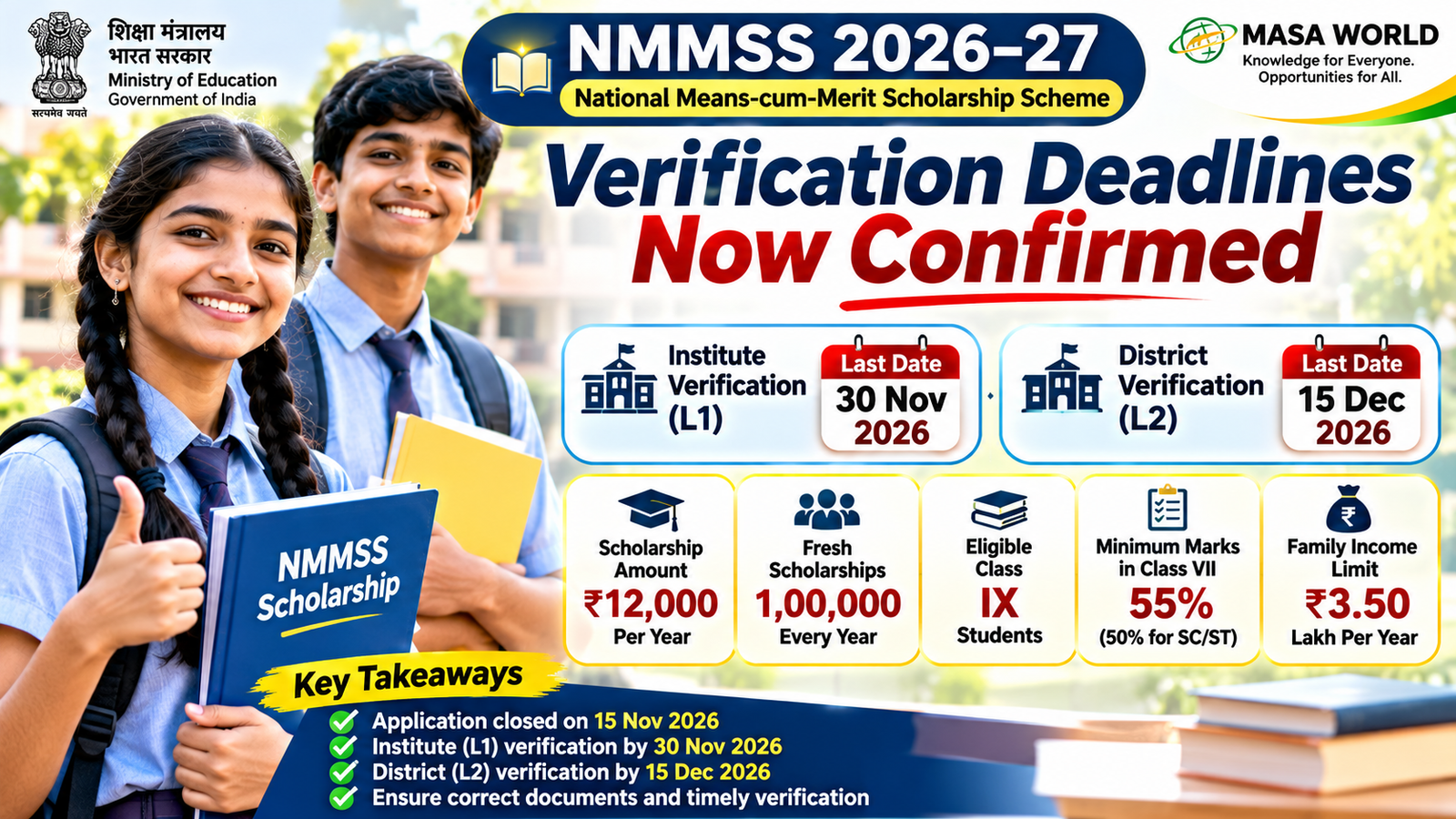
The Ministry’s 31 October notice reported that, as of 30 October 2026, the portal had received 90,483 fresh applications and 1,99,531 renewal applications. These are application counts at that date. They are not the number of approved scholarships or confirmed beneficiaries.
What students and parents should do now
The student application window has closed. Students who submitted an application should focus on status checks and timely follow-up. They cannot complete the institute or district verification themselves, but they can help schools resolve missing or inconsistent information.
- Open the official NSP: Visit scholarships.gov.in. Use the official student login route for the 2026–27 academic year.
- Check the exact status: Note whether the application is submitted, pending at the institute, returned for correction, institute-verified or awaiting district verification. Follow the wording shown on the portal.
- Contact the school: If institute verification is pending, contact the school’s authorised nodal officer or office. Share the application ID through the school’s approved channel.
- Check records: Confirm that the student’s name, date of birth, class, school details and bank information match the relevant official records.
- Respond to a correction request: If the portal shows a defect or asks for clarification, ask the school what correction is required and how it must be submitted.
- Keep evidence: Save the application acknowledgement and keep a dated note of school follow-ups and portal status changes.
- Recheck after verification: Check the portal again after the L1 and L2 deadlines. Do not assume that a deadline passing means the individual application has been approved.
Never share an NSP password, OTP, ATM PIN or full banking credentials with an agent. Do not pay anyone who promises guaranteed selection or faster approval. Use the portal and authorised school or government contacts.
What schools and officers must complete
Schools should identify the authorised Institute Nodal Officer and review the pending application list before the 30 November deadline. They should compare portal entries with the records and documents required under the scheme. If an application needs correction, the school should tell the student what is missing and explain the official correction route.
District authorities should plan the L2 workload and complete verification by 15 December. Clear communication between schools and district offices can reduce avoidable delays. Schools should maintain a basic tracking record with application ID, current status, action required and date of follow-up. This record should be handled securely because it contains student information.
Verification is an administrative responsibility. Students should not be asked to pay unofficial fees for an officer to process an application. Any demand for money, passwords or OTPs should be treated as suspicious and reported through an authorised channel.
Common application and verification problems
- Name or date-of-birth mismatch: Differences between the portal, school records and identity documents may require clarification.
- Incorrect bank information: A wrong account number or account-holder detail can create problems during later payment processing.
- Wrong school information: The institution details must match the eligible school and the portal record.
- Incomplete or unclear documents: Poor scans or missing records can delay verification where supporting documents are required.
- Confusing status messages: Submitted, institute-verified, district-verified and sanctioned are different stages. Read the exact status.
- Unverified online advice: Old deadlines from earlier notices may no longer apply. Use the latest Ministry notice and the current NSP listing.
If the status does not change, record the message and date. Ask the school nodal officer whether L1 action is pending or whether the application has been returned. If the issue remains unresolved, use the official NSP help or grievance route. Do not create a duplicate application unless an authorised instruction specifically requires it.
Why the scholarship matters
The transition from Class VIII to secondary school can increase costs for families. Transport, books, uniforms, examination needs and other school expenses can affect attendance and continuation. A predictable annual scholarship can help reduce some of this pressure for selected students.
The scheme also depends on an effective administrative chain. A student may qualify in the State examination, but the benefit still requires accurate portal records and timely verification. Schools and district officers therefore play a direct role in making public support accessible.
The published figures show the scale of the application process. The Ministry reported more than 90,000 fresh applications and nearly two lakh renewal applications by 30 October. These numbers indicate substantial participation, but they should not be described as approved awards. Public reporting must keep application counts separate from selection, sanction and payment data.
MASA World Editorial Insight & Community Guidance
NMMSS can support students only when information and verification work together. Students should keep their records accurate and check the portal. Parents should use official school contacts. Schools must complete L1 verification on time, while district officers must complete L2 checks. No family should pay an unofficial fee or share private login details to obtain a public scholarship. Clear communication is as important as the deadline itself.
Frequently Asked Questions
1. Is the NMMSS 2026–27 application window still open?
No. The Ministry of Education extended the student application deadline to 15 November 2026. The application window is now closed.
2. What is the last date for institute verification?
The Institute Nodal Officer must complete Level 1 verification by 30 November 2026.
3. What is the district verification deadline?
The District Nodal Officer must complete Level 2 verification by 15 December 2026.
4. How much money does NMMSS provide?
The scheme provides ₹12,000 per year to selected students. Renewal in Classes X to XII is subject to the prescribed continuation conditions.
5. Where can students check their NMMSS application status?
Students should use the official National Scholarship Portal at scholarships.gov.in and contact their school’s authorised nodal officer for institute-level issues.
Official references
- Press Information Bureau, Ministry of Education — NMMSS 2026–27 application deadline extended to 15 November 2026, 31 October 2026.
- National Scholarship Portal — NMMSS 2026–27 scheme listing and verification dates.
- Press Information Bureau, Ministry of Education — NMMSS scheme structure and 2026–27 application guidance.
- Ministry of Education, Government of India.
- Department of School Education and Literacy.
Editorial note: Deadlines and scheme facts in this article are based on official Ministry of Education and National Scholarship Portal information checked on 19 November 2026. Any later extension or correction should be confirmed through an official notice.