
Jay Shah Reappointed as ICC Chair for a Second Term: What the Decision Means for Global Cricket
Category: Trending | Updated: 19 November 2026
The International Cricket Council (ICC) has confirmed Jay Shah’s unopposed reappointment as Chair for a second term. The announcement followed the ICC Board meetings in Bali, Indonesia, and was published on 16 November 2026. The decision provides leadership continuity as cricket prepares for its return to the Olympic Games at Los Angeles 2028. It also places renewed attention on the ICC’s plans for women’s cricket, Associate Members, integrity and sustainable growth.
The reappointment is a leadership decision, not a performance score. Its value will depend on what the ICC and its members deliver during the next phase. This article explains the official announcement, the priorities stated by the ICC, the LA28 opportunity and the questions that players and fans should watch.
Table of Contents
- Key Facts at a Glance
- What the ICC Board Decided
- What the ICC Chair Does
- Five Priorities for the Next Phase
- Cricket at Los Angeles 2028
- Women’s Cricket and Equal Pathways
- Associate Members and Global Growth
- Integrity, Governance and Commercial Sustainability
- How to Assess the Second Term
- What the Decision Means for Players and Fans
- MASA World Editorial Insight & Community Guidance
- Frequently Asked Questions
- Official References
Key Facts at a Glance
| Item | Verified detail |
|---|---|
| Decision | Unopposed reappointment |
| Office | Chair of the International Cricket Council |
| Term | Second term |
| Announcement date | 16 November 2026 |
| Decision setting | ICC Board meetings in Bali, Indonesia |
| Prior ICC Chair tenure | Assumed office in December 2024 |
| Major upcoming milestone | Cricket’s return to the Olympic Games at LA28 |
| LA28 cricket format | Men’s and women’s T20 competitions, six teams per gender |
The ICC announcement confirms a second term but does not state its exact duration in the release. This article does not assume a term length. Read the ICC announcement.
What the ICC Board Decided
The ICC Board announced Shah’s unopposed reappointment after a proposal by ICC directors at the Board meetings in Bali. The ICC said the decision reflected the Board’s confidence in his leadership. It also described the timing as important for global expansion, fan growth and commercial development.
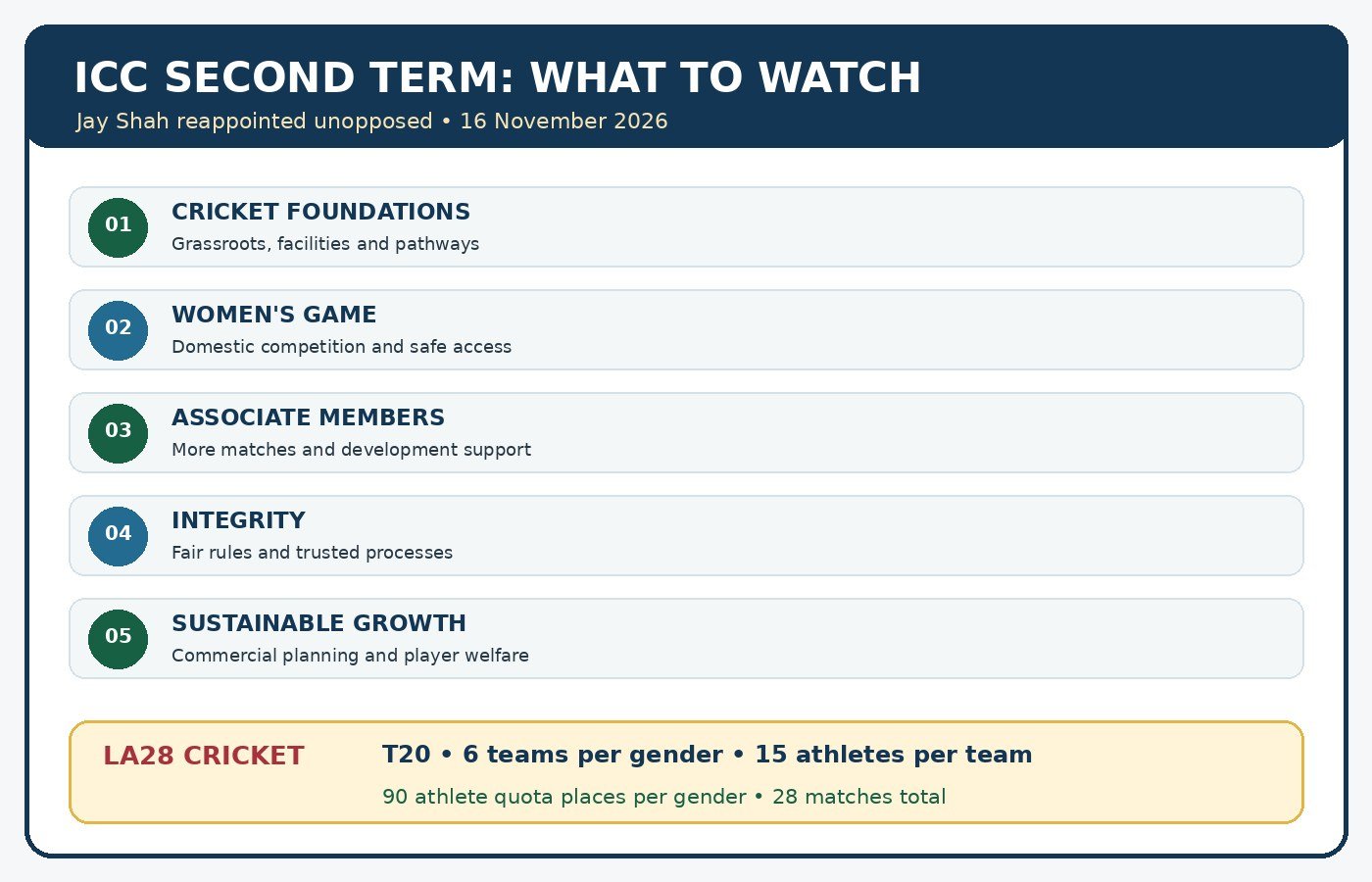
The announcement identifies several areas for continued work. These include strengthening cricket’s foundations, supporting women’s cricket, expanding opportunities for Associate Members, protecting the integrity of international cricket and developing sustainable commercial opportunities.
Shah became ICC Chair in December 2024. The second-term announcement provides continuity at the top of the organisation. It does not, by itself, confirm that every stated priority has been achieved. Delivery depends on the ICC Board, member administrations, national associations, players and competition organisers.
The Board meetings in Bali ran from 11 to 15 November 2026. The ICC’s meeting notice said discussions included proposals for future World Test Championship cycles and windows for major men’s events from 2028 to 2035. These agenda items show the wider planning context around the reappointment. They should not be mistaken for final approval of every proposal. See the ICC Board meeting notice.
What the ICC Chair Does
The ICC Chair leads the global governing body’s Board-level work. The role involves working with member representatives and supporting the organisation’s strategic direction. It does not mean the Chair alone controls every national cricket decision. Member boards remain responsible for many domestic structures, player contracts and local competitions.
Global cricket includes countries with very different resources. Some members have large professional systems and established broadcast markets. Others need support with facilities, coaching, match exposure and administration. The Chair must help build agreement across these different needs.
This is why leadership continuity matters only when it supports collective decisions. The ICC must balance major events with the long-term health of international cricket. It must also ensure that smaller members have meaningful opportunities to develop.
Five Priorities for the Next Phase
1. Strengthen cricket’s foundations
Cricket needs strong local structures. These include school and community access, qualified coaches, safe facilities, trained officials and regular competitions. National boards and local associations play a central role in this work. The ICC can support them through development programmes, technical guidance and competition pathways.
2. Support women’s cricket
Women’s cricket needs a complete pathway. High-profile international events can attract attention, but players also need domestic leagues, age-group competitions, qualified coaches and safe training environments. Fair contracts, medical support and access to quality facilities are also important.
The ICC’s independent director, Dr Ros Rivaz, said the next phase should build on the growth of women’s cricket and support players whose opportunities have been disrupted. This statement sets an expectation for continued work. Progress should be assessed through participation, competition access and player conditions.
3. Expand opportunities for Associate Members
Associate Members need regular high-quality matches and predictable development support. They may also need help with grounds, coaching, officiating, travel and administration. A wider global game requires more than occasional qualification opportunities. It needs pathways that allow teams to improve through consistent competition.
4. Protect the integrity of international cricket
Integrity includes anti-corruption education, fair disciplinary processes, consistent competition rules and strong safeguarding. Players and officials need clear reporting channels. Investigations should follow established procedures. The public should be able to trust that the rules apply consistently.
5. Develop sustainable commercial opportunities
Commercial growth can provide resources for development and player support. It should also protect the balance between international and domestic cricket. A crowded calendar can create pressure on players and reduce the space for bilateral contests. Sustainable planning must consider player workload, recovery, travel, broadcast demand and the needs of member boards.
Cricket at Los Angeles 2028
Cricket’s return to the Olympic Games is a major opportunity for the sport. It will appear at Los Angeles 2028, 128 years after its previous Olympic appearance at Paris 1900. The LA28 cricket competitions will use the T20 format for both men and women.
The International Olympic Committee’s published qualification system sets out six teams per gender. Each team can include up to 15 athletes. The system allocates 90 athlete quota places for the men’s competition and 90 for the women’s competition. The two tournaments together are scheduled to feature 28 matches.
The six-team structure includes five qualification places and one host-country quota per gender. The qualification system explains how National Olympic Committees can earn places. Teams and players should follow the current IOC and ICC qualification information rather than rely on informal predictions about which countries will qualify.
Olympic exposure may introduce cricket to viewers who do not follow the sport today. It could also encourage schools, universities and community sports bodies to create entry-level programmes. But broadcast reach alone will not create a lasting legacy. The sport needs affordable ways to play after the Games.
Read the IOC qualification-system summary and view the official LA28 cricket qualification document.
Women’s Cricket and Equal Pathways
The LA28 programme includes separate men’s and women’s T20 competitions. This gives women’s cricket a major global stage. The next challenge is to ensure that the Olympic opportunity supports more players beyond the teams that qualify.
Member boards can strengthen the pathway through school teams, local clubs, age-group tournaments and professional domestic competitions. They should provide equal access to coaching, grounds, equipment and medical support. Safeguarding policies must protect players from harassment and unsafe environments.
Women’s cricket also needs clear progression from grassroots activity to elite performance. Coaches should have suitable training. Selection criteria should be transparent. Players should understand contracts, workload expectations and available support. These practical systems help convert public interest into a stable sporting pathway.
Associate Members and Global Growth
Global growth depends on whether more countries can play meaningful cricket. Associate Members often face different challenges from full-member boards. They may have smaller budgets, fewer professional players and limited access to regular international fixtures.
Useful support can include coaching education, umpire development, ground improvement, youth competitions and predictable funding. Match exposure is especially important. Teams need opportunities to test their skills against stronger opponents and learn from competitive pressure.
The ICC should report progress in a way that members and fans can understand. Useful measures include the number of active teams, women’s participation, youth competitions, qualified coaches, facilities and international matches. A rise in social media reach alone cannot show whether cricket has become more accessible.
Integrity, Governance and Commercial Sustainability
Public trust depends on consistent rules and transparent administration. Anti-corruption programmes should educate players and officials. Reporting systems should protect people who raise concerns. Disciplinary decisions should follow clear procedures and published regulations.
Governance also includes conflicts of interest, financial accountability and fair treatment of members. Major commercial decisions should support the long-term game. They should not create unsustainable pressure on players or leave smaller members without a realistic route to compete.
The international calendar is one of the most difficult areas. Test cricket, One Day Internationals, T20 internationals and domestic leagues all require space. A balanced calendar should protect player welfare and preserve meaningful international contests. This requires consultation among the ICC, member boards, leagues and player representatives.
How to Assess the Second Term
The reappointment creates a clear opportunity to turn stated priorities into measurable results. Fans and member boards can assess progress through public evidence. The following questions provide a practical framework.
| Area | What to look for |
|---|---|
| Grassroots access | More affordable clubs, school programmes and safe facilities |
| Women’s cricket | Regular domestic competitions, fair contracts and better pathways |
| Associate Members | Predictable support and more high-quality match opportunities |
| LA28 legacy | Wider participation and accessible entry-level cricket after the Games |
| Integrity | Clear rules, protected reporting channels and consistent enforcement |
| Commercial sustainability | Transparent decisions that support the sport’s long-term health |
| Player welfare | Workload planning, medical support and safe working conditions |
These are proposed accountability measures, not official ICC targets. The ICC announcement does not provide numerical goals for each area. Future progress reports and Board decisions will be needed to assess performance.
What the Decision Means for Players and Fans
- Players: The next phase should bring clear competition pathways, fair conditions and stronger welfare systems.
- Women athletes: The Olympic platform can increase visibility, but domestic access and professional support remain essential.
- Associate nations: Development support and regular fixtures can help create stronger teams.
- Fans: LA28 may bring new audiences, while a balanced calendar can protect the value of international cricket.
- Administrators: The second term creates an expectation of transparency, cooperation and measurable delivery.
- Young players: Community clubs and schools can use wider attention to encourage safe and affordable participation.
For Indian cricket, Shah’s reappointment is a significant national milestone. However, the ICC is the global governing body. Its decisions must serve the interests of the international game and its members. A strong global system benefits cricket in India as well as in emerging cricket countries.
MASA World Editorial Insight & Community Guidance
Leadership continuity matters when it produces visible improvements. Cricket’s next phase should be judged by access, fairness, athlete welfare and the strength of grassroots systems. Young players should focus on skill, education, discipline and safe participation. Local clubs can support the game by offering equal opportunities to girls and boys and by keeping participation affordable.
The second term is an opportunity, not a guarantee. The ICC should be judged by the quality of its decisions and the outcomes members can verify. Cricket’s Olympic return will be important. Its lasting value will depend on whether more people can play the game after the global spotlight moves on.
Frequently Asked Questions
1. Has Jay Shah been reappointed as ICC Chair?
Yes. The ICC Board announced his unopposed reappointment for a second term on 16 November 2026. The decision followed a proposal by ICC directors at Board meetings in Bali.
2. How long is Jay Shah’s second term?
The ICC announcement confirms a second term but does not state its exact duration. Readers should rely on a formal ICC notice for the term dates.
3. What are the ICC’s stated priorities?
The ICC highlighted stronger foundations, women’s cricket, opportunities for Associate Members, integrity and sustainable commercial development.
4. When will cricket return to the Olympic Games?
Cricket is scheduled to return at Los Angeles 2028. The programme includes separate men’s and women’s T20 competitions with six teams per gender.
5. What will make the second term successful?
Progress should be visible in participation, women’s pathways, Associate Member opportunities, player welfare, integrity and sustainable competition planning. The ICC has not yet published numerical targets for all these areas in its reappointment announcement.
Official References
- International Cricket Council: Unopposed reappointment announcement, 16 November 2026.
- Board of Control for Cricket in India: Official response, 16 November 2026.
- ICC: Board and Committee meetings in Bali, 11–15 November 2026.
- International Olympic Committee: Cricket qualification system approved for LA28.
- LA28 official cricket qualification system.
Editorial note: The ICC and BCCI statements describe the reappointment and institutional positions. The LA28 team and athlete quotas are based on the IOC qualification system. The accountability framework in this article is MASA World’s editorial analysis, not a list of official ICC performance targets.