
Lakhpati Didi Initiative 2026: 3.76 Crore Women Enabled, Six Crore Target by 2029
Category: Govt Schemes | Updated: 19 November 2026
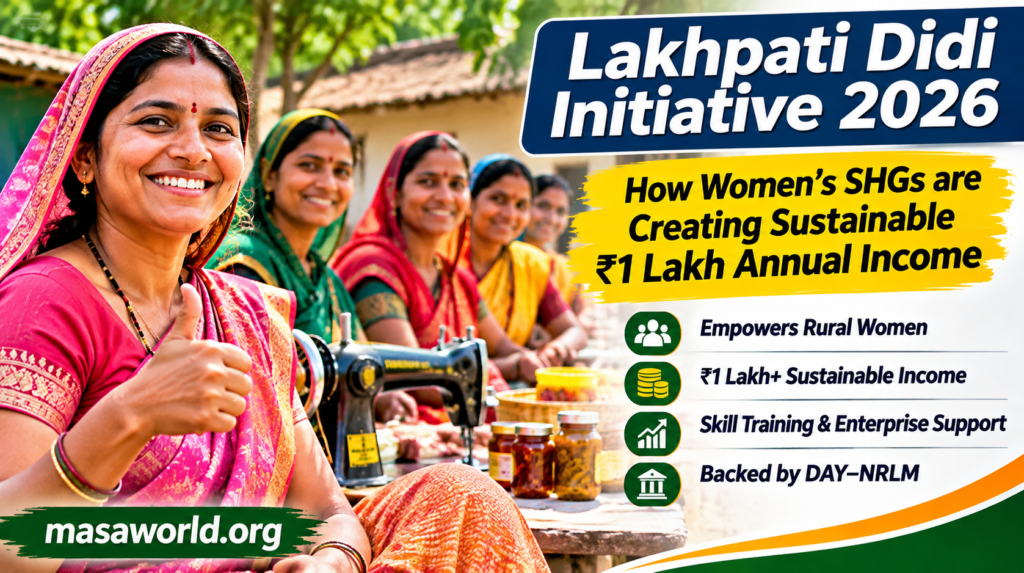
The Lakhpati Didi initiative supports rural women who build stronger household incomes through self-help groups and livelihood enterprises. The latest Ministry of Rural Development backgrounder, published by the Press Information Bureau on 15 November 2026, reports that 3.76 crore women had been enabled as Lakhpati Didis by June 2026. It also reports 5.70 crore potential Lakhpati Didis identified through the programme.
The national goal is now six crore Lakhpati Didis by March 2029. The programme does not promise every participant a fixed cash payment. It aims to help eligible Self-Help Group (SHG) members develop sustainable farm and non-farm livelihoods. The income benchmark is based on household income after expenses, not a woman’s personal salary alone.
Key facts at a glance
| Measure | Latest official information |
|---|---|
| Initiative announced | 15 August 2023 |
| Women enabled by June 2026 | 3.76 crore |
| Potential Lakhpati Didis identified | 5.70 crore |
| National target | 6 crore by March 2029 |
| Income benchmark | At least ₹1 lakh annual household income, after expenses and sustained over livelihood cycles |
| Delivery platform | DAY-NRLM and the women’s SHG network |
| SHG network as of 12 November 2026 | About 10.13 crore members across 94.40 lakh SHGs |
| Official information | Lakhpati Didi portal |
Who is a Lakhpati Didi?
A Lakhpati Didi is a woman who belongs to a Self-Help Group and whose household earns at least ₹1 lakh annually through eligible livelihood activities. The benchmark counts total household income. It does not mean that the woman must receive ₹1 lakh as an individual salary.
The income calculation considers earnings after expenses. It can include income from eligible farm and non-farm activities. The official Lakhpati Didi portal describes the benchmark as an average monthly income of ₹10,000 or more, sustained for at least four agricultural seasons and/or four business cycles. This condition matters because a single good month or one large sale does not prove a stable livelihood.
The initiative therefore focuses on reliable earnings over time. A household may combine several activities. These may include agriculture, livestock, food processing, tailoring, handicrafts, retail, local services or other viable enterprises. The activity must fit the household’s skills and local market conditions.
How the initiative developed
The government announced the Lakhpati Didi initiative on 15 August 2023. The initial goal was to enable two crore women from SHG households. In February 2024, the target increased to three crore. The government later reported that the three-crore target had been achieved ahead of schedule by December 2025.
In February 2026, the national ambition was revised to six crore Lakhpati Didis by March 2029. The 15 November 2026 PIB backgrounder reports 3.76 crore women enabled by June 2026. It also records 5.70 crore women identified as potential Lakhpati Didis.
The initiative uses the existing Deendayal Antyodaya Yojana–National Rural Livelihoods Mission (DAY-NRLM) structure. DAY-NRLM began in June 2011. It organises rural women into SHGs and supports savings, financial inclusion, livelihood development and community institutions. The Lakhpati Didi initiative builds on this network rather than creating a separate institution for every beneficiary.
How the programme works
The delivery model links women, SHGs, community institutions, trained resource persons and government livelihood missions. It aims to connect household plans with skills, finance, assets and markets. The PIB backgrounder describes a process that includes the following stages.
1. Identification of potential participants
Potential Lakhpati Didis are identified through the SHG network and the LokOS platform. Community Resource Persons (CRPs) support household discussions. They help understand existing livelihoods, income sources and possible areas for growth.
2. Household income assessment
The Digital Aajeevika Register records household livelihood, income and expenditure information. It provides a common framework for tracking progress. The purpose is to understand the household’s real earning position, rather than count sales as profit.
3. Preparation of a livelihood plan
Trained CRPs help prepare individual household business plans. These plans can identify suitable farm and non-farm activities, investment needs, skills and market opportunities. Local demand should guide the choice of activity.
4. Coordinated implementation support
Women may receive support for skills, finance, productive assets, technology and market access. The exact package depends on the livelihood plan and the support available through the state mission and local institutions. A loan is only one possible part of the plan. It is not the entire initiative.
5. Monitoring and follow-up
National and state rural livelihood missions monitor progress through the programme’s institutional and digital systems. Household income needs to remain sustainable across agricultural seasons or business cycles. This is why continuity matters more than a one-time increase.
What the latest numbers show
The 15 November 2026 PIB backgrounder provides several indicators of programme scale. Each number measures a different stage. They should not be treated as interchangeable.
| Indicator | Reported figure | What it means |
|---|---|---|
| Enabled Lakhpati Didis | 3.76 crore | Women reported as having achieved the Lakhpati Didi benchmark by June 2026 |
| Potential Lakhpati Didis | 5.70 crore | Women identified as potential participants; not all have reached the income benchmark |
| National target | 6 crore | Goal for March 2029 |
| DAY-NRLM SHG members | About 10.13 crore | Members mobilised across the wider SHG network as of 12 November 2026 |
| SHGs | 94.40 lakh | Groups reported under DAY-NRLM as of 12 November 2026 |
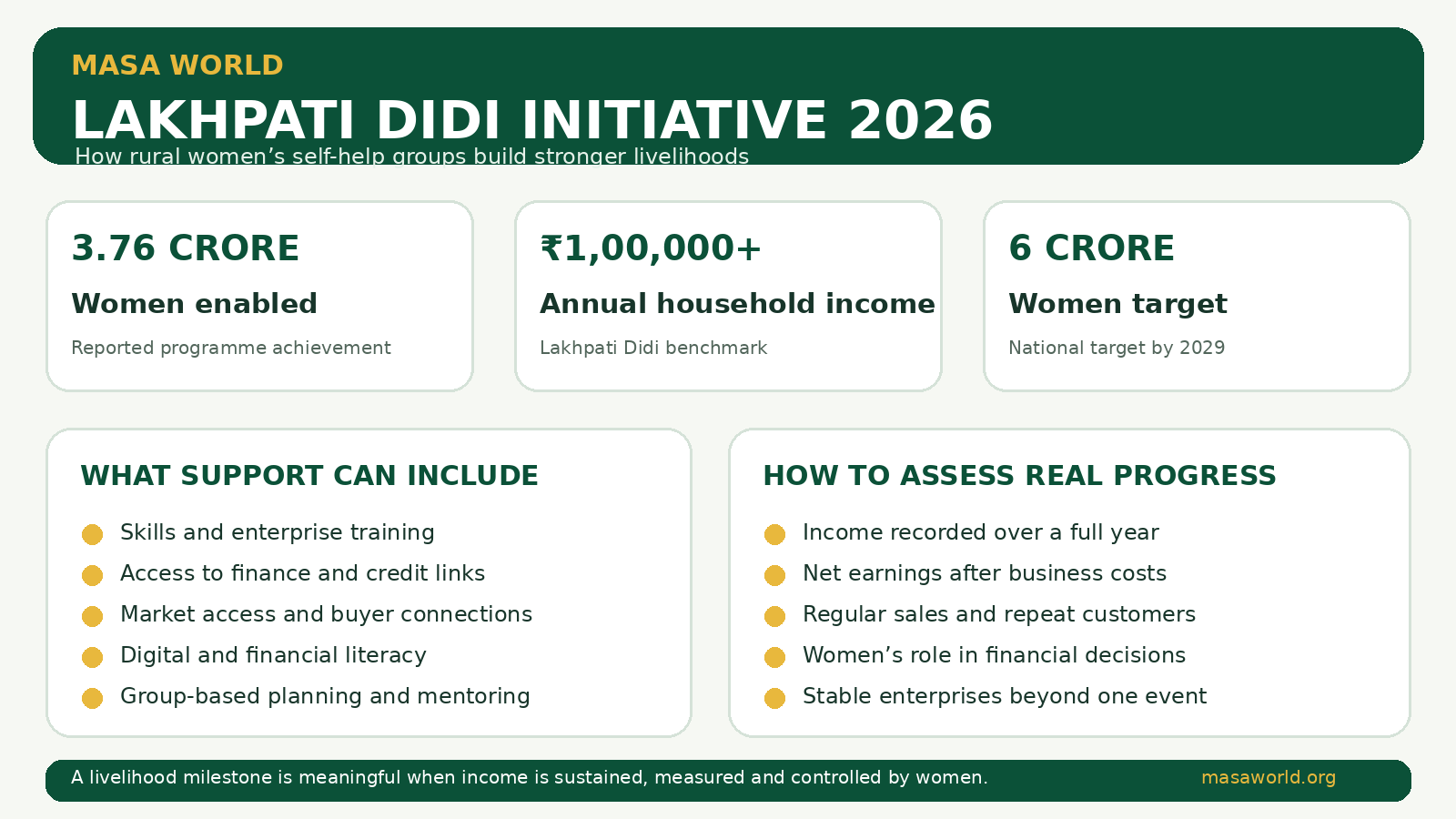
The gap between women identified as potential participants and women already enabled is important. Identification is an early programme stage. A potential participant still needs a suitable livelihood plan, implementation support and sustainable household earnings. Public reporting should keep these categories separate.
What the IIM Ahmedabad assessment found
The PIB backgrounder reports an independent IIM Ahmedabad assessment covering 6,531 respondents across 17 states and Union Territories. The assessment reported a 61% rise in average monthly household income among Lakhpati Didi households. It also reported a 61.7% increase in average monthly savings.
These are findings from the assessment sample. They should not be presented as a guaranteed result for every SHG member or every district. Results can vary with the type of enterprise, local demand, costs, access to finance, market connections and the time available to women.
The findings are useful because they look beyond the number of women enrolled. Household income and savings can show whether livelihood support is improving economic resilience. Further evaluation should also examine enterprise survival, debt levels, control over earnings and women’s participation in household decisions.
How women can seek support
The initiative is delivered through the SHG and rural livelihood mission structure. Women interested in support should begin with an authorised local institution. The precise process and available services can differ by state and district.
- Ask about SHG membership: Contact an active local Self-Help Group or its Village Organisation.
- Speak with the federation: Ask the Cluster Level Federation or authorised community representative about livelihood planning.
- Request a household assessment: Discuss current income sources, skills, assets, costs and possible opportunities.
- Prepare a business plan: Identify the customer, product or service, expected costs and likely sales before investing.
- Ask about training and support: Confirm which skill programmes, finance options, assets or market links are available locally.
- Keep written records: Record sales, expenses, loans, repayments and savings. These records help measure actual income.
- Verify the route: Confirm all assistance with the State Rural Livelihoods Mission or authorised SHG institution.
Women should not pay unofficial agents who promise guaranteed selection or a fixed government payment. The initiative is a livelihood and enterprise support framework. It is not a universal cash transfer scheme.
How to build a sustainable livelihood
A good livelihood plan starts with demand. Before buying equipment or taking a loan, a household should identify who will purchase its product or service. It should compare local prices, competitors, transport costs and seasonal demand. A business that looks profitable on paper may struggle if customers are not available.
Calculate profit, not only sales
Revenue is the money received from sales. Net income must account for materials, feed, packaging, transport, repairs, rent, labour and interest. Women should maintain a simple notebook or digital record. This makes it easier to see whether the activity is earning enough after costs.
Match credit to the business cycle
Credit can help a viable enterprise buy equipment or increase production. But repayment must match the timing of income. A seasonal activity may not generate cash every month. SHG members should understand the interest rate, instalment schedule, total repayment and consequences of delay before accepting a loan.
Build more than one route to market
Small businesses may depend on local shops, weekly markets, fairs, institutional buyers or digital platforms. A single buyer can create risk. SHG federations and producer groups may help members aggregate products, improve quality and negotiate better terms. Market links should be practical and confirmed, not assumed.
Keep control of earnings
Women’s economic participation should include a meaningful role in business decisions and control over income. Household and group discussions can help women plan savings, reinvestment and debt repayment. Financial literacy and access to bank accounts are important parts of this process.
Risks, gaps and safeguards
Enterprise income can change with weather, market prices, input costs, transport and buyer demand. Livestock activities may face disease or feed costs. Food businesses may need safe handling and packaging. Tailoring and craft businesses need regular orders. A plan should identify these risks before investment.
- Debt risk: Avoid borrowing before checking cash flow and repayment capacity.
- Market risk: Confirm likely buyers and prices before increasing production.
- Income measurement: Count income after expenses, not gross sales.
- Seasonal risk: Plan for months when farm or business income falls.
- Digital access: Provide practical support to women who cannot easily use online systems.
- Transparency: Keep clear records of assistance, loans, training and business outcomes.
Programme monitoring should measure whether enterprises remain active and whether household income is stable. It should also examine debt, savings and women’s control over earnings. Counting only the number of businesses started can hide weak sales or inactive enterprises.
Important note for Delhi residents
DAY-NRLM is the institutional platform for the Lakhpati Didi initiative. The Ministry of Rural Development has stated that DAY-NRLM is implemented across States and Union Territories except Delhi and Chandigarh. Therefore, Delhi residents should not assume that the standard DAY-NRLM SHG enrolment route is available in Delhi in the same way as participating states.
Women in Delhi should confirm any local women’s livelihood or SHG support directly with the relevant Delhi government department or authorised local institution. They should not rely on agents who claim that a national target automatically creates an individual entitlement in every location.
MASA World Editorial Insight & Community Guidance
The Lakhpati Didi initiative should be judged by stable income, not only by headline targets. Women need viable markets, useful skills, fair access to finance and control over their earnings. SHGs can help members share knowledge and reduce business risks. Before taking a loan, every household should understand its costs, buyers and repayment plan. Sustainable livelihoods grow through informed choices and strong local institutions.
Frequently Asked Questions
1. What is the Lakhpati Didi income benchmark?
The benchmark is at least ₹1 lakh in annual household income after expenses. The official portal describes sustained average monthly income of ₹10,000 or more across at least four agricultural seasons and/or four business cycles.
2. How many women had become Lakhpati Didis by June 2026?
The PIB backgrounder published on 15 November 2026 reports 3.76 crore women enabled by June 2026. It separately reports 5.70 crore women identified as potential Lakhpati Didis.
3. What is the national target for the initiative?
The government’s target is six crore Lakhpati Didis by March 2029. This is a national programme target, not a personal guarantee of income or payment.
4. Does the initiative provide a fixed cash payment to every woman?
No. It is a livelihood and enterprise support initiative delivered through DAY-NRLM and SHG institutions. Support can include planning, skills, finance, productive assets and market access, depending on local arrangements.
5. Can women in Delhi use the same DAY-NRLM route?
The Ministry of Rural Development states that DAY-NRLM is implemented in States and UTs except Delhi and Chandigarh. Delhi residents should verify local support routes with the relevant Delhi government department or authorised institution.
Official references
- Press Information Bureau, Ministry of Rural Development — “The Lakhpati Didi Initiative”, 15 November 2026.
- Official Lakhpati Didi portal — eligibility benchmark and process to become a Lakhpati Didi.
- Press Information Bureau — Action Plan under Lakhpati Didi Initiative, 28 July 2026.
- Press Information Bureau — DAY-NRLM implementation coverage, 8 August 2025.
- Deendayal Antyodaya Yojana–National Rural Livelihoods Mission, Ministry of Rural Development.
Editorial note: Programme figures in this article are attributed to the official PIB backgrounder dated 15 November 2026. The income definition is cross-checked against the official Lakhpati Didi portal. Implementation details and location coverage are based on Ministry of Rural Development and PIB information.