
Pradhan Mantri Samajik Sahayata Yojana: Five-Year Extension and New Disability Pension Rules Explained
Updated: 19 November 2026 | Category: Government Schemes
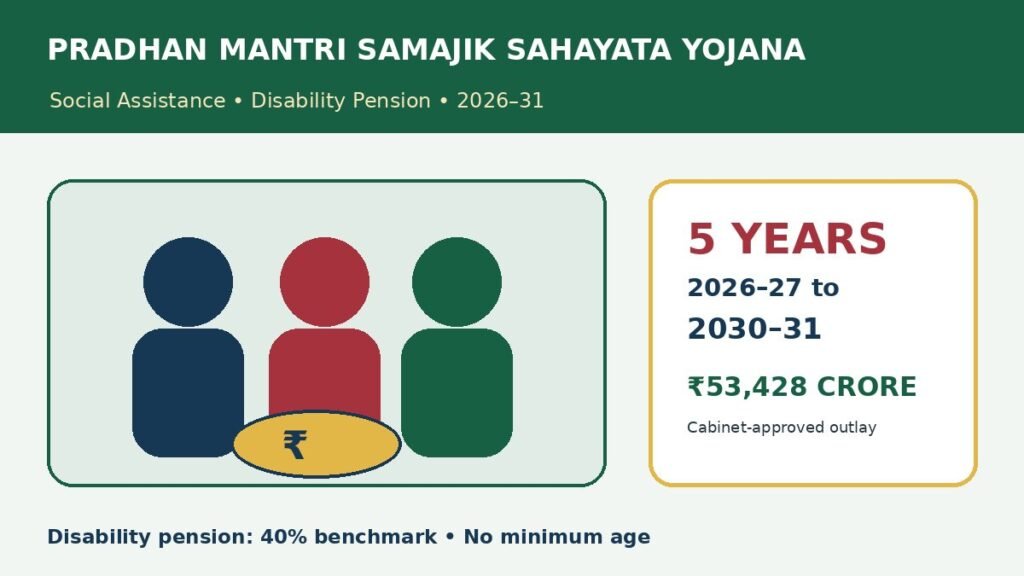
The Union Cabinet has approved a five-year continuation of the National Social Assistance Programme (NSAP). The programme will run from 2026–27 to 2030–31. Its approved outlay is ₹53,428 crore. The Cabinet has also renamed the programme as Pradhan Mantri Samajik Sahayata Yojana.
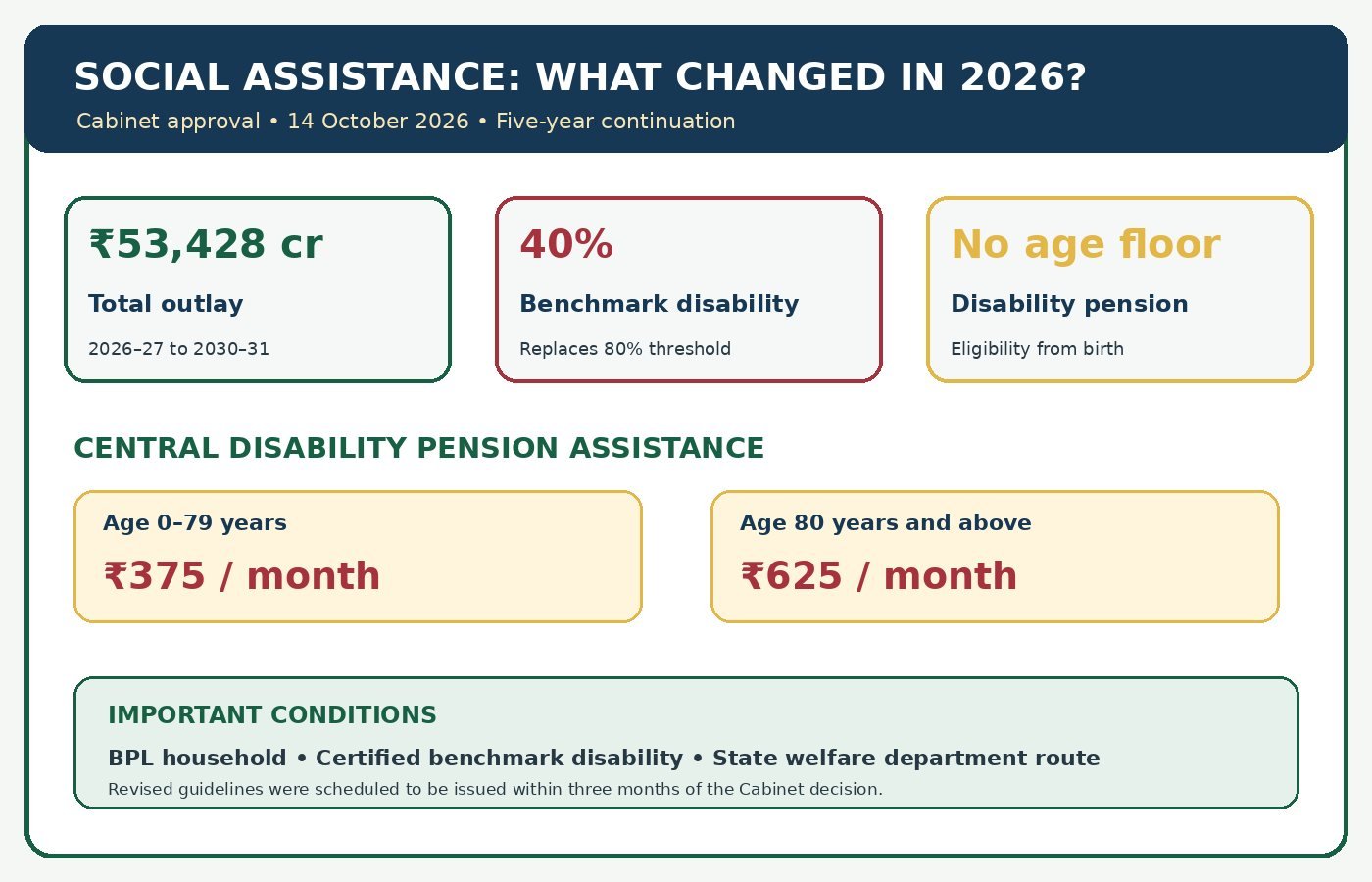
The most important eligibility change concerns the disability pension. The benchmark disability threshold has moved from 80% to 40%. The minimum age requirement of 18 years has also been removed. Eligibility can now begin from birth, subject to the other scheme conditions. These include a certified benchmark disability and a household below the poverty line (BPL).
This guide explains the Cabinet decision, the revised disability pension, the renamed sub-schemes and the application route. It also explains what applicants should verify before submitting documents. A Cabinet announcement sets the policy decision. State instructions and revised operational guidelines explain how people can apply in practice.
Table of Contents
- Executive Summary and Key Details
- What Is the National Social Assistance Programme?
- New Programme and Sub-Scheme Names
- What Changed in the Disability Pension?
- Who May Qualify Under the Revised Criteria?
- How Much Central Assistance Is Approved?
- Why State and Local Implementation Matters
- How to Check the Application Process
- Documents and Common Application Questions
- Payment Delays, Grievances and Fraud Prevention
- What the Extension Means for Social Protection
- MASA World Editorial Insight & Community Guidance
- Frequently Asked Questions
- Official References
Executive Summary and Key Details
The Cabinet approved the continuation on 14 October 2026. The Ministry of Rural Development and PIB later published an explainer on the revised programme. The official backgrounder confirms the disability threshold, age change, central assistance rates and the continuing BPL condition. Read the Cabinet decision and read the PIB backgrounder.
| Item | Approved information |
|---|---|
| Former programme name | National Social Assistance Programme (NSAP) |
| New programme name | Pradhan Mantri Samajik Sahayata Yojana |
| Continuation period | 2026–27 to 2030–31 |
| Total outlay | ₹53,428 crore |
| Cabinet approval date | 14 October 2026 |
| Disability benchmark | 40% benchmark disability, replacing 80% |
| Minimum age for disability pension | Removed; eligibility can begin from birth |
| Central disability assistance, age 0–79 | ₹375 per month |
| Central disability assistance, age 80+ | ₹625 per month |
| Key continuing condition | BPL household and certified benchmark disability |
What Is the National Social Assistance Programme?
The National Social Assistance Programme began on 15 August 1995. It provides social assistance to eligible households. Its components cover older people, widows, persons with disabilities and families that lose a primary breadwinner.
The PIB backgrounder links the programme to Article 41 of the Constitution. This provision directs the State to provide public assistance in cases such as unemployment, old age, sickness and disablement. The programme covers rural and urban areas. The backgrounder describes it as a fully funded centrally sponsored scheme with 100% central assistance for the central component.
The basic condition across the programme is that the household must be below the poverty line. State and Union Territory administrations play an important role in identifying eligible people and delivering support. Gram Panchayats and municipalities also take part in beneficiary identification. Payments are largely made through Direct Benefit Transfer (DBT).
The Cabinet decision continues the programme for five more years. It also changes the names of the programme and its four sub-schemes. The most significant eligibility and assistance changes are for the disability pension.
New Programme and Sub-Scheme Names
The Cabinet approved a new name for NSAP and each of its four components. The old-age pension, widow pension and family benefit scheme continue in their existing form. The disability pension receives revised eligibility and central assistance.
| Existing name | Approved new name |
|---|---|
| National Social Assistance Programme (NSAP) | Pradhan Mantri Samajik Sahayata Yojana |
| Indira Gandhi National Old Age Pension Scheme | Pradhan Mantri Vridhavastha Pension Yojana |
| Indira Gandhi National Widow Pension Scheme | Pradhan Mantri Vidhawa Pension Yojana |
| Indira Gandhi National Disability Pension Scheme | Pradhan Mantri Divyangjan Pension Yojana |
| National Family Benefit Scheme | Pradhan Mantri Parivar Labh Yojana |
A name change does not mean that every benefit has changed. The Cabinet specifically says that the old-age pension, widow pension and family benefit scheme continue in their existing form. The disability pension is the component with revised eligibility, coverage and central assistance.
What Changed in the Disability Pension?
The disability pension was previously known as the Indira Gandhi National Disability Pension Scheme. Under the earlier rule described by PIB, a person needed at least 80% disability and had to be at least 18 years old. The Cabinet has changed both conditions.
The benchmark is now 40%
The revised benchmark follows the Rights of Persons with Disabilities Act, 2016. Section 2(r) of the Act defines a person with benchmark disability as a person with not less than 40% of a specified disability, certified by the authorised certifying authority. The new pension threshold is therefore 40%, replacing the earlier 80% threshold.
The minimum age condition has been removed
The previous minimum age of 18 years no longer applies to the disability pension. The approved eligibility can begin from birth. This change is important for children with certified benchmark disabilities in eligible BPL households. Families should still confirm the certificate and application process with the designated authority.
Central assistance has increased
The Cabinet approved central assistance of ₹375 per month for eligible beneficiaries aged 0 to 79 years. For beneficiaries aged 80 years and above, the central assistance is ₹625 per month. These are the central assistance rates. State and Union Territory top-ups may increase the amount received by a beneficiary.
Expected coverage is higher
The PIB backgrounder says the number of beneficiaries under the disability pension is expected to increase from 8.33 lakh to 27.48 lakh. This is an official coverage estimate. It should not be read as proof that every newly eligible person has already been enrolled or has received a revised payment.
Who May Qualify Under the Revised Criteria?
The official backgrounder identifies three groups that may benefit from the decision. The household must remain below the poverty line. The applicant must also have a disability certificate that confirms benchmark disability under the applicable law.
- People with 40% to 79% certified disability: Eligible people in BPL households may now fall within the revised threshold. They were outside the earlier 80% requirement.
- Children from birth: A child with certified benchmark disability in a BPL household may qualify under the revised age rule. The earlier minimum age of 18 has been removed.
- Existing disability pension beneficiaries: Current beneficiaries are covered by the approved increase in central assistance, subject to the applicable implementation process.
Two points are essential. First, the 40% benchmark must be certified by the authorised authority. A self-declared condition is not enough. Second, the BPL household condition remains. The Cabinet decision does not remove this poverty-related eligibility requirement.
The programme’s rules and State procedures may require other records. Applicants should check the latest instructions before submitting a claim. Do not assume that a disability certificate alone guarantees approval.
How Much Central Assistance Is Approved?
| Age of eligible disability pension beneficiary | Central assistance |
|---|---|
| 0 to 79 years | ₹375 per month |
| 80 years and above | ₹625 per month |
These are the central amounts approved for the disability pension. States and Union Territories may add their own assistance. The PIB backgrounder reports that, as of September 2026, State and Union Territory top-ups ranged from ₹50 to ₹5,700 per month per beneficiary. It also reports an average monthly pension of around ₹1,100 in most States and Union Territories.
Therefore, the total amount received by a beneficiary can differ by State or Union Territory. Applicants should ask the relevant department for the current combined amount. Do not treat the central assistance figure as the final amount in every location.
The PIB backgrounder also says revised guidelines covering eligibility, beneficiary numbers and assistance rates will be issued and implemented within three months. Applicants should check the latest official guidelines and State instructions before relying on an older form or checklist.
Why State and Local Implementation Matters
The Cabinet approval establishes the national policy decision. State and Union Territory departments play a major role in identifying beneficiaries and processing records. Depending on the State, the responsible department may be social welfare, rural development, women and child development, revenue or labour.
Gram Panchayats and municipalities can help identify eligible households. Payments are largely made through DBT. This makes accurate beneficiary records and bank details important. A name mismatch or incorrect account number can delay payment.
The programme covered about 3.09 crore beneficiaries before the latest approval. The Cabinet decision places overall coverage at 3.20 crore beneficiaries across all 36 States and Union Territories. These figures relate to the overall programme, not only the disability pension.
State top-ups also create differences in the total monthly pension. The central amount provides the national assistance component. State support may add to it. Families should confirm both components with their local authority.
How to Check the Application Process
The PIB backgrounder identifies the State welfare department as the application route. It also describes the role of Gram Panchayats and municipalities in identifying beneficiaries. The exact form, portal and document process can vary by State or Union Territory.
- Contact the State or Union Territory department responsible for social assistance or social welfare.
- Ask for the latest instructions for Pradhan Mantri Divyangjan Pension Yojana.
- Confirm that the household meets the BPL condition and ask which proof is accepted.
- Check the process for obtaining or validating a benchmark disability certificate of at least 40%.
- Ask whether the State has issued the updated application form or operational guidelines.
- Prepare identity, residence, bank and other records requested by the official process.
- Submit the application through the authorised channel and obtain an acknowledgement.
- Keep the acknowledgement number and use the official grievance route if the application is delayed.
Existing beneficiaries should not submit a duplicate application without checking the State instructions. Ask whether the existing record will be updated automatically or whether a separate update request is required. The local department can confirm the process.
Documents and Common Application Questions
The final document list must come from the relevant State or Union Territory authority. Depending on the process, applicants may be asked for:
- Disability certificate showing the benchmark disability assessment.
- BPL household proof or the accepted poverty-list record.
- Identity and age documents.
- Residence details.
- Bank account information for DBT.
- Photographs or other records requested by the official form.
- Existing pension details, if the person is already a beneficiary.
Do not rely on an informal checklist if it conflicts with the latest official instructions. Ask the office to confirm accepted certificates and whether any updated form is required. If an applicant cannot travel easily, ask about accessible counters or local assistance.
Payment Delays, Grievances and Fraud Prevention
Social assistance should reach eligible people without unnecessary barriers. If a payment is delayed, first check whether the beneficiary record, bank details and required certificates are current. Then contact the responsible State or local office. Keep a copy of the application and acknowledgement.
Applicants should not pay an agent who promises guaranteed approval. Do not share bank PINs, passwords or OTPs. Government pension payments do not require a beneficiary to disclose their banking password. Submit documents only through the official channel.
Community organisations can help people understand forms and contact the right office. They should obtain consent before handling personal records. They should not keep sensitive documents without a clear reason. Respect for privacy and dignity is part of responsible assistance.
What the Extension Means for Social Protection
The five-year continuation provides a longer planning period for the programme. The ₹53,428 crore outlay covers the overall programme for 2026–27 to 2030–31. It does not mean that every beneficiary receives the same amount. Each sub-scheme has its own eligibility and assistance structure.
The disability pension revision may bring more people within the central scheme. The 40% benchmark aligns the pension threshold with the Rights of Persons with Disabilities Act, 2016. Removing the minimum age condition also recognises eligible children. The BPL condition and certification requirement remain important safeguards.
The policy’s impact will depend on implementation. Eligible families need accessible information, clear forms and reliable payment systems. Authorities should reduce delays in disability certification and beneficiary record updates. Public reporting should distinguish approved coverage estimates from the number of people who have actually received payments.
MASA World Editorial Insight & Community Guidance
Families should verify the revised disability pension criteria through the official State welfare department. Check the BPL condition, certified disability threshold and latest application instructions. Community volunteers can guide applicants, but they should never promise approval or charge unofficial fees. Protect the dignity and privacy of every beneficiary.
MASA World encourages local organisations, schools, NGOs and community leaders to share this information in accessible language. They can help families identify the correct office and prepare documents. They should also support children and adults with disabilities without stigma.
A social assistance programme succeeds when eligible people can understand their rights and receive the support approved for them. The Cabinet decision is an important policy step. The next test is clear guidance, fair processing and reliable delivery across every State and Union Territory.
Frequently Asked Questions
1. What is the new name of NSAP?
The National Social Assistance Programme is now named Pradhan Mantri Samajik Sahayata Yojana. Its four sub-schemes have also received new names.
2. How long has the programme been extended?
The Cabinet approved continuation for five years, from 2026–27 to 2030–31, with an outlay of ₹53,428 crore.
3. What is the revised disability pension threshold?
The benchmark is now 40% certified disability, replacing the earlier 80% threshold. The certificate must be issued by the authorised certifying authority.
4. Is there a minimum age for the revised disability pension?
No. The earlier minimum age of 18 has been removed. Eligibility can begin from birth, subject to the BPL household condition and other scheme requirements.
5. How much disability pension assistance is approved?
The central assistance is ₹375 per month for eligible beneficiaries aged 0–79 and ₹625 per month for those aged 80 and above. State top-ups may increase the total amount.
Official References
- PIB: Cabinet approves continuation of NSAP for five years, 14 October 2026.
- PIB Backgrounder: Pradhan Mantri Samajik Sahayata Yojana, 22 October 2026.
- Department of Rural Development — official website.
- National Social Assistance Programme — official portal.
- Department of Empowerment of Persons with Disabilities.
Editorial note: The Cabinet decision and disability pension changes are based on official PIB material dated 14 and 22 October 2026. The BPL condition, certification requirement and State welfare department route remain part of the published explainer. Applicants should follow the latest revised guidelines and State instructions when issued.