
Stand-Up India Scheme 2026: Loan, Eligibility & How to Apply
Updated: 13 November 2026
Starting a business can be difficult when a promising idea meets a shortage of capital. For women entrepreneurs and entrepreneurs from Scheduled Caste (SC) and Scheduled Tribe (ST) communities, the Government of India’s Stand-Up India Scheme is designed to improve access to institutional finance for setting up a new enterprise.
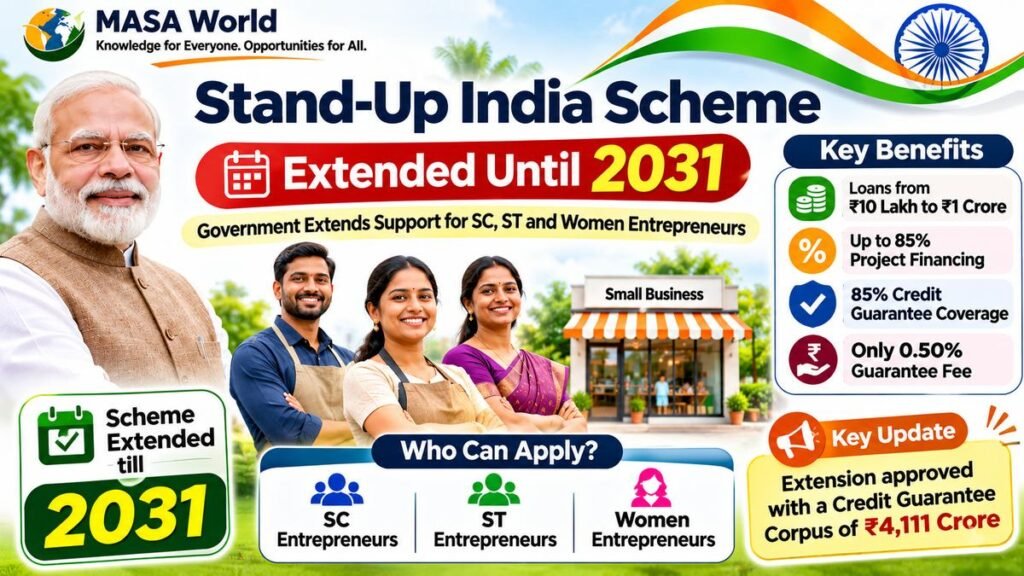
There is an important new development: on 11 November 2026, the Union Cabinet approved the continuation of the scheme for five more years, up to 31 March 2031. The extension is backed by a ₹4,111 crore Credit Guarantee Corpus and targets financial assistance for at least 2.5 lakh additional entrepreneurs. Eligible applicants can seek a term loan or a composite loan of more than ₹10 lakh and up to ₹1 crore for a greenfield enterprise, subject to bank appraisal.
This guide explains what the latest announcement means, who can apply, what the loan covers, how repayment and guarantees work, which documents to prepare, and how to approach a bank or the official portal.
Stand-Up India 2026: Key facts at a glance
- Scheme continuation: until 31 March 2031
- Loan amount: above ₹10 lakh and up to ₹1 crore
- Who can apply: eligible women and SC/ST entrepreneurs
- Project: a new greenfield enterprise
- Guarantee cover: 85% of the eligible loan amount, under applicable conditions
- Guarantee fee: standard 0.50%
1. Latest Stand-Up India Scheme update (November 2026)
The Union Cabinet approved the continuation of Stand-Up India until 31 March 2031. It also approved a ₹4,111 crore Credit Guarantee Corpus, set a target of at least 2.5 lakh additional entrepreneurs over five years and announced a standard guarantee fee of 0.50%. The extension is intended to widen access to bank finance for women, SC and ST entrepreneurs who want to establish new businesses.
- Extension: five years, through 31 March 2031.
- New outreach target: at least 2.5 lakh additional entrepreneurs.
- Loan range: above ₹10 lakh and up to ₹1 crore.
- Eligible applicants: women and SC/ST entrepreneurs.
- Project type: a new, or greenfield, enterprise.
- Eligible activities: manufacturing, services, trading and activities allied to agriculture.
- Credit guarantee support: 85% coverage of the eligible loan amount, subject to guarantee-fund conditions.
- Guarantee corpus: ₹4,111 crore approved for the continuation.
- Guarantee fee: standard fee of 0.50% under the announced framework.
The government has also reported that since the scheme began in April 2016, more than 2.75 lakh loans have been facilitated for women and SC/ST entrepreneurs. These are cumulative scheme figures, not a promise that every applicant will receive a loan. The Cabinet-approved ₹4,111 crore corpus supports the guarantee framework; it is not a pool of cash grants for individual applicants.
Important: the Cabinet’s continuation announcement confirms the scheme’s extension and broad framework. Applicants should check the latest operational circular, bank appraisal requirements and guarantee-fund terms before making financial commitments.
2. What is the Stand-Up India Scheme?
Stand-Up India was launched on 5 April 2016 to promote entrepreneurship among women and SC/ST communities. It seeks to help eligible first-time entrepreneurs establish a new business by connecting them with bank credit and support through the application process.
The scheme is delivered through scheduled commercial banks. It is a bank loan programme, not a direct cash grant or subsidy paid into an applicant’s personal account. The bank evaluates the business proposal, repayment capacity, promoter contribution, credit history and applicable lending conditions before deciding whether to sanction the loan.
3. How much loan can you get?
The scheme provides for either a term loan or a composite loan of more than ₹10 lakh and up to ₹1 crore. A composite loan can include both the term-loan requirement and working-capital requirement of the proposed business. The Union Cabinet’s November 2026 announcement expressly lists both loan forms.
Does the scheme finance the entire project cost?
The scheme framework provides for finance of up to 85% of the project cost, subject to the prescribed contribution and bank appraisal. The 85% project-cost figure describes the potential loan financing; it is not a grant and does not guarantee sanction of that percentage. Separately, the 2026 Cabinet announcement provides for credit-guarantee coverage of 85% of the loan amount. These are two different 85% figures.
The borrower is generally expected to bring a minimum contribution of 10% of the project cost. Eligible margin-money support from other government schemes may be converged, where permitted, to meet the remaining contribution requirement. The bank will confirm the amount and acceptable source of contribution for the individual proposal.
What can the composite loan cover?
- Purchase of eligible plant, machinery, tools and equipment.
- Business premises-related eligible project expenditure.
- Other approved capital expenditure required to establish the enterprise.
- Working capital needed to run the business, within the bank’s sanctioned structure.
The final eligible cost depends on the project report, quotations, business model and the bank’s appraisal.
4. Which businesses are eligible?
The scheme supports greenfield enterprises in manufacturing, services, trading and activities allied to agriculture. “Greenfield” generally means that the proposed venture is a new business in the relevant activity, rather than simply refinancing or expanding an existing business.
Examples of possible business ideas include:
- Manufacturing: food processing, garment production, packaging, furniture, fabrication or small-scale component manufacturing.
- Services: repair and maintenance, logistics, professional services, salons, digital services, healthcare-related services where appropriately licensed, or training businesses.
- Trading: a new retail or wholesale business with a viable market and documented working-capital needs.
- Agriculture-allied activities: eligible activities such as dairy, poultry, beekeeping, fisheries, food processing or other activities accepted under the applicable scheme rules.
These are illustrative examples, not a blanket approval list. Certain activities may require sector-specific licences, registrations, environmental permissions or other clearances. Confirm the activity’s eligibility with the bank before spending money.
5. Stand-Up India eligibility: who can apply?
The established scheme framework sets out the following core eligibility conditions. The bank will apply the current government and lending instructions in force when it assesses the application.
- Applicant category: the applicant must be a woman entrepreneur or belong to a Scheduled Caste or Scheduled Tribe community.
- Age: an individual applicant must be above 18 years of age.
- New enterprise: the loan must be for a greenfield project in an eligible sector.
- Non-individual entities: at least 51% of the shareholding and controlling stake should be held by a woman entrepreneur or an SC/ST entrepreneur, as applicable under the scheme. The bank will verify the ownership, control and supporting documents for the entity structure.
- Credit record: the applicant should not be in default to any bank or financial institution.
- Viable proposal: the project should demonstrate commercial feasibility and a credible ability to repay the loan.
Meeting the category and age conditions does not guarantee sanction. A bank can seek clarifications, additional security where permitted, changes to the project report or evidence of the promoter’s contribution.
6. Interest rate, repayment period and security
Interest rate
The applicable interest rate is determined by the lending bank under the scheme’s prescribed pricing framework and the bank’s current lending policy. Do not rely on an interest figure copied from an old article or an unofficial website. Ask the branch for the current rate, benchmark, spread, reset terms, processing charges and the total cost of borrowing in writing.
Repayment period
The published scheme framework provides for repayment of up to seven years, including a moratorium period of up to 18 months. The actual repayment schedule, moratorium and instalment amount are determined by the bank after assessing the project and cash-flow projections.
Is collateral-free finance guaranteed?
No applicant should assume that the loan is automatically collateral-free. The scheme’s credit-guarantee mechanism is intended to reduce the lender’s credit risk. The guarantee is issued to the lender under applicable conditions; it is not insurance that removes the borrower’s repayment obligation. The Cabinet-approved framework sets a standard guarantee fee of 0.50%. The bank will explain the primary security, any collateral requirement, guarantee coverage and applicable charges for the particular loan.
What does 85% guarantee coverage mean?
The November 2026 government announcement refers to guarantee coverage of 85% of the eligible loan amount under the guarantee arrangement. This is different from the project-financing figure of up to 85% of project cost. It does not mean the government pays 85% of the borrower’s loan, nor does it cancel the borrower’s liability if the business fails.
7. Documents to prepare before applying
The exact checklist varies by bank, applicant type, business activity and loan size. Prepare a file with the following commonly requested documents and ask the branch for its current checklist.
- Aadhaar or another accepted identity document and PAN.
- Address proof and recent photographs.
- Proof of SC/ST category, where applying under that category.
- Business constitution documents, such as proprietorship details, partnership deed, LLP agreement or company incorporation documents, as applicable.
- Ownership, shareholding and controlling-stake proof for a non-individual enterprise, including evidence that the eligible woman or SC/ST entrepreneur holds at least 51% as required.
- Business address proof and proposed premises documents, where available.
- A detailed project report with business model, market assessment, project cost, expected revenue, expenses and cash-flow projections.
- Quotations for machinery, equipment, furniture, inventory or other proposed expenditure.
- Bank statements and existing loan details, if applicable.
- Relevant licences, registrations, approvals or applications for them, depending on the business.
- Evidence of the promoter’s own contribution and any proposed eligible margin-money support.
Do not submit fabricated quotations, inflated project costs or false category or ownership documents. Incorrect information can lead to rejection and may create legal or financial consequences.
8. How to apply for a Stand-Up India loan
Step 1: Prepare a business idea and project report
Define what you will sell, who your customers are, where the business will operate, what equipment or stock you need and how the enterprise will earn revenue. Prepare realistic financial projections and a clear repayment plan.
Step 2: Check the eligibility conditions
Confirm that you meet the applicant-category requirement and that the proposed enterprise is new and falls within an eligible sector. If you are applying through a company or partnership, have the bank verify the ownership and control conditions before finalising the structure.
Step 3: Use the official Stand-Up Mitra portal
Visit Stand-Up Mitra to review the scheme information and available application support. The portal can help applicants connect with the lending process and identify support needs. Use only the official portal and verified bank contact details.
Step 4: Approach a scheduled commercial bank
You may approach a bank branch for guidance on the application and the relevant lending process. Ask which branch or officer handles Stand-Up India proposals, request the latest checklist and confirm whether the proposed activity and project cost fit the current scheme framework.
Step 5: Submit the application and supporting documents
Provide complete and consistent information. Keep copies of the application, acknowledgement, project report, quotations and documents submitted. Record the application or reference number for follow-up.
Step 6: Respond to bank queries
The bank may assess your credit history, project viability, promoter contribution, business location, licences and repayment capacity. Respond promptly and provide genuine supporting evidence. A sanction is subject to the bank’s appraisal and approval.
Step 7: Review the sanction terms before accepting
Before signing, read the sanctioned amount, interest rate, benchmark and reset terms, processing and guarantee fees, repayment schedule, moratorium, security, insurance requirements and conditions for disbursement. Ask the bank to explain any term you do not understand.
9. Stand-Up India vs Pradhan Mantri Mudra Yojana
Stand-Up India and the Pradhan Mantri Mudra Yojana (PMMY) both support access to credit for small businesses, but they serve different borrower and loan requirements.
| Feature | Stand-Up India | PM Mudra Yojana |
|---|---|---|
| Primary focus | Women and SC/ST entrepreneurs setting up a greenfield enterprise | Micro and small non-corporate, non-farm income-generating businesses |
| Loan size | Above ₹10 lakh up to ₹1 crore | Loan categories under PMMY; Tarun Plus can extend up to ₹20 lakh for eligible borrowers who have successfully repaid a previous Tarun loan, subject to current rules |
| Business stage | Greenfield enterprise | New and existing eligible micro businesses |
| Decision-maker | Participating bank after appraisal | Participating lender after appraisal |
| Grant or loan? | Loan, not a direct grant | Loan, not a direct grant |
Choose the programme based on your eligibility, project size and business stage. Do not split or restructure a project merely to fit a scheme without discussing it with the lender.
10. Common mistakes applicants should avoid
- Confusing a loan with a subsidy: the sanctioned amount must be repaid with interest under the loan agreement.
- Assuming approval is automatic: the bank independently assesses the proposal and the applicant’s repayment capacity.
- Submitting a weak project report: unexplained costs, unrealistic sales estimates and missing cash-flow calculations can weaken an application.
- Ignoring own contribution: plan the promoter contribution and verify which margin-money support, if any, can be counted.
- Assuming every existing business qualifies: Stand-Up India is designed for greenfield enterprises; confirm whether your proposal meets the current definition.
- Paying unofficial agents: use official portals and bank channels. Be cautious of anyone promising guaranteed sanction in exchange for a fee.
- Ignoring licences: food, manufacturing, transport, healthcare and other regulated activities may require approvals before operations begin.
11. Frequently asked questions (FAQs)
Has the Stand-Up India Scheme been extended?
Yes. On 11 November 2026, the Union Cabinet approved its continuation for five years, up to 31 March 2031, backed by a ₹4,111 crore Credit Guarantee Corpus and a target of at least 2.5 lakh additional entrepreneurs.
What is the maximum loan under Stand-Up India?
The scheme provides for either a term loan or a composite loan above ₹10 lakh and up to ₹1 crore for an eligible greenfield enterprise.
Can a woman entrepreneur apply?
Yes. Women entrepreneurs above 18 years of age can apply for an eligible greenfield project, subject to the bank’s appraisal and the scheme conditions.
Can an SC or ST entrepreneur apply?
Yes. An eligible SC or ST entrepreneur can apply for a greenfield enterprise, subject to the prescribed conditions and bank appraisal.
Can I use the loan to expand my existing business?
The scheme is intended for greenfield enterprises. A routine expansion or refinancing of an existing business may not qualify. Discuss the exact proposal with the bank before applying.
Is Stand-Up India a subsidy?
No. It is a bank-credit scheme. The borrower remains responsible for repayment, interest and other agreed charges.
Does the 85% guarantee mean I do not have to repay 85% of the loan?
No. Guarantee coverage protects the lender under specified conditions. It does not waive the borrower’s repayment obligation.
How long can repayment take?
The published framework provides for repayment up to seven years, including a moratorium of up to 18 months. The bank sets the actual schedule in the sanction terms.
Where can I apply?
Start with the official Stand-Up Mitra portal and contact a participating bank. Confirm current application channels and documentation directly with the lender.
Will every eligible applicant receive a loan?
No. Eligibility allows an applicant to be considered; it does not guarantee sanction. The bank assesses the proposal, credit profile, contribution and repayment capacity.
12. Official sources and useful links
- Press Information Bureau: Cabinet approves continuation of Stand-Up India Scheme (11 November 2026)
- Department of Financial Services: Stand-Up India Scheme
- Official Stand-Up Mitra portal
- Jan Samarth portal
- Press Information Bureau (PIB)
Editorial note: Scheme conditions, bank policies, portal workflows and fees can change. This article is an informational guide, not a loan sanction, legal opinion or financial recommendation. Before applying, verify the latest government notification and written terms with the participating bank.
Related MASA World Guides
- PM-KISAN 24th Instalment 2026: payment status, eligibility and e-KYC
- How to Verify Government Job Notifications in India: a safe application checklist
- Financial Literacy for Youth: budgeting, saving and smart money decisions
Before You Apply: A Quick Action Checklist
- Confirm that your proposal is a genuinely new greenfield enterprise in an eligible sector.
- Check the applicant category, age and ownership/control conditions with the lending bank.
- Prepare a realistic project report, cost quotations and cash-flow projections.
- Ask the bank to confirm the current margin contribution, guarantee fee, interest rate, security and repayment terms in writing.
- Apply only through official channels and retain the acknowledgement and application reference.
Primary government update: Read the Press Information Bureau announcement dated 11 November 2026 and the Prime Minister’s Office Cabinet release. Verify operational instructions with your bank before making financial commitments.
Knowledge for Everyone. Opportunities for All.