
Delhi Air Pollution 2026: AQI, GRAP Stage III & Safety Tips
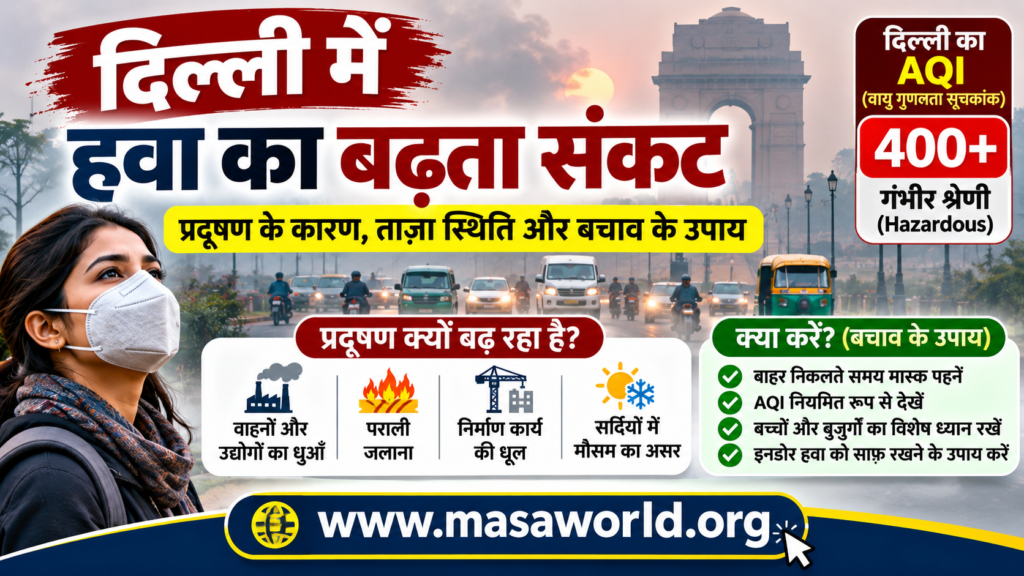
Delhi’s winter air pollution crisis is intensifying. Official monitoring data for 13 November 2026 shows several monitoring stations in the national capital recording air quality in the Severe category. The situation has renewed concerns about public health, children’s safety, outdoor work and the effectiveness of pollution-control measures.
The Commission for Air Quality Management (CAQM) invoked Stage III of the Graded Response Action Plan (GRAP) across Delhi-NCR on 6 November. Delhi schools have also been directed to offer hybrid classes up to Class 5 amid worsening air quality. Here is what the latest available information means, what is known about the causes, and how residents can reduce exposure.
Updated: 13 November 2026 | Category: Trending | Reading time: 8–10 minutes
Delhi pollution situation at a glance
| Item | Latest information |
|---|---|
| Report date | 13 November 2026 |
| Location | Delhi-NCR, India |
| Monitoring picture | Several stations in the Severe category; others in Very Poor |
| Prominent pollutants | PM2.5 and PM10, varying by station |
| Government response | GRAP Stage III invoked across Delhi-NCR on 6 November |
| School measure | Hybrid mode directed for classes up to Class 5 in Delhi |
| Main concern | Respiratory and cardiovascular health, especially for vulnerable groups |
Important data note: Station readings below are observations shown by the Delhi Air Quality Early Warning System for 00:00 IST on 13 November 2026. They are individual monitoring-station readings, not a single citywide daily average. AQI changes through the day and can differ significantly between neighbourhoods.
1. Latest AQI readings across Delhi
The official Delhi Air Quality Early Warning System showed the following selected station readings at 00:00 IST on 13 November:
| Monitoring station | AQI | Category |
|---|---|---|
| IIT Delhi | 479 | Severe |
| Chandni Chowk | 471 | Severe |
| North Campus, Delhi University | 469 | Severe |
| ITO | 460 | Severe |
| DTU | 452 | Severe |
| Burari Crossing | 447 | Severe |
| Talkatora Garden | 433 | Severe |
| Punjabi Bagh | 440 | Severe |
| JNU | 441 | Severe |
| Anand Vihar | 405 | Severe |
| Rohini | 398 | Very Poor |
| Ashok Vihar | 392 | Very Poor |
These readings show that the problem is not confined to one part of the capital. But they should not be interpreted as a live reading for every street or neighbourhood. Residents should check the latest station data for their own area before making decisions about outdoor activity.
Source: Delhi Air Quality Early Warning System (IITM).
2. What do AQI levels mean?
India’s National Air Quality Index translates measurements of several pollutants into a scale that is easier for the public to understand.
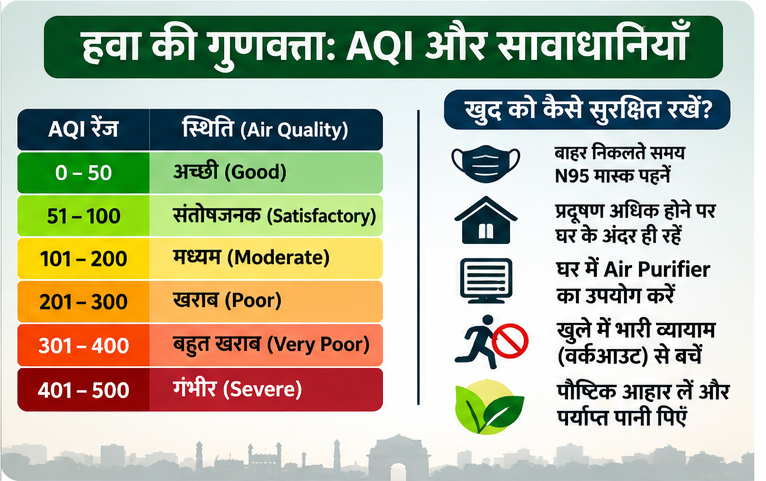
| AQI range | Category | General health interpretation |
|---|---|---|
| 0–50 | Good | Minimal health impact |
| 51–100 | Satisfactory | Minor discomfort for sensitive people |
| 101–200 | Moderate | Breathing discomfort may occur in sensitive people |
| 201–300 | Poor | Breathing discomfort with prolonged exposure |
| 301–400 | Very Poor | Increased likelihood of respiratory effects |
| 401–500 | Severe | Health impacts may affect even otherwise healthy people |
At Severe levels, the entire population may be at risk of health effects. Children, older adults, pregnant women and people with heart or lung conditions should take particular care. Healthy adults should not assume that prolonged exposure is harmless.
3. Why does Delhi experience severe air pollution?
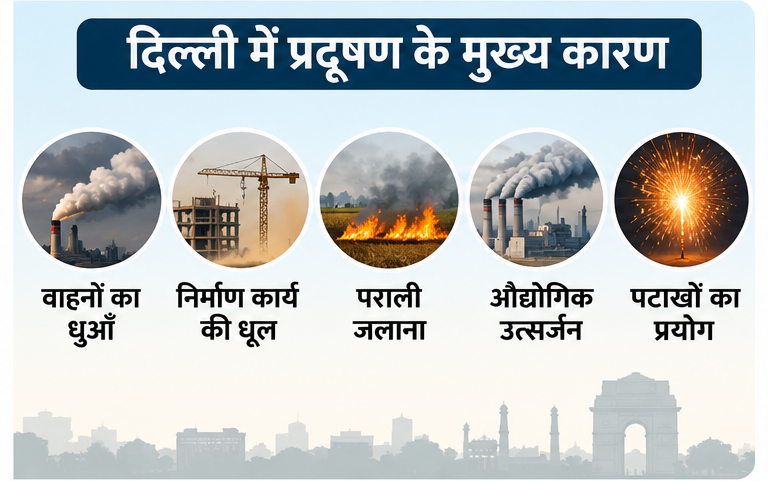
Delhi’s air pollution has no single cause. It reflects a combination of local emissions, pollution transported from surrounding areas and weather conditions that can limit the dispersion of pollutants.
Vehicle emissions
Cars, buses, trucks and two-wheelers emit pollutants through fuel combustion. Congested roads can increase exposure for commuters, pedestrians, traffic personnel and people living near busy corridors.
Construction and road dust
Construction, demolition, uncovered materials and resuspended road dust add particulate matter to the air. Site-level dust control, covered transport and effective road cleaning are important parts of prevention.
Industrial and energy emissions
Industrial processes and fuel combustion can release particulate matter and gases that contribute to pollution. Compliance monitoring and enforcement are essential.
Seasonal agricultural burning
Crop-residue burning in parts of northern India can contribute to pollution reaching the capital. It is one factor among several; it does not explain Delhi’s entire pollution burden. Local transport, dust, industry, waste burning and other sources also require sustained attention.
Winter weather
Low wind speeds, atmospheric stability and limited vertical mixing can allow pollutants to accumulate near the ground. Weather affects how quickly emissions disperse, which is why pollution levels can change even when emissions do not change immediately.
4. What is PM2.5 and why is it dangerous?
PM2.5 refers to airborne particles with a diameter of 2.5 micrometres or smaller. These fine particles can travel deep into the lungs. Exposure is associated with respiratory and cardiovascular harm, including worsening of existing conditions.
PM10 refers to particles with a diameter of 10 micrometres or smaller. Sources can include dust and construction activity as well as combustion. The pollutant driving the AQI can differ between monitoring stations and at different times.
The World Health Organization identifies particulate air pollution as a major environmental health risk. Its effects are not limited to the respiratory system; exposure is also linked with cardiovascular disease and other serious outcomes.
5. What is GRAP Stage III?
The Graded Response Action Plan (GRAP) is a framework for introducing progressively stronger pollution-control measures across Delhi-NCR as air quality deteriorates. CAQM invoked Stage III across the region on 6 November 2026.
Stage III is associated with the Severe air-quality band under the revised GRAP framework. The applicable order sets out restrictions and actions for construction and demolition activities, specified vehicle categories and other pollution sources. Measures from earlier stages continue as applicable.
What residents should know
- Construction: Specified dust-generating construction and demolition activities face restrictions under the Stage III schedule. The exact scope depends on the activity and applicable exemptions.
- Vehicles: Restrictions apply to specified older vehicle categories in Delhi and designated NCR areas. Residents should check the latest CAQM and local transport department directions before travelling.
- Schools: Delhi’s Directorate of Education has directed government and private schools to conduct classes up to Class 5 in hybrid mode, allowing online or physical attendance according to arrangements.
- Offices: The GRAP framework provides for governments to consider work-from-home arrangements and reduced physical attendance in the relevant circumstances. Follow the latest instructions issued by the competent government or employer.
Do not rely on social-media forwards for the precise scope of a restriction. Check the latest official order and local government instructions, as measures can be revised or lifted.
6. How can air pollution affect health?
Air pollution can aggravate asthma and chronic obstructive pulmonary disease (COPD), irritate airways and increase the risk of respiratory symptoms. Fine particulate exposure is also associated with cardiovascular problems, including heart disease and stroke.
Children
Children’s lungs are still developing, and they may spend more time being physically active outdoors. Families and schools should pay close attention to health advisories and hybrid-learning directions.
Older adults and people with existing conditions
Older adults and people with respiratory or cardiovascular conditions may be more vulnerable. They should follow their clinician’s advice and keep prescribed medication available.
When to seek medical help
Do not ignore persistent coughing, wheezing, unusual breathlessness or chest discomfort. Seek medical advice if symptoms occur. Severe breathing difficulty or chest pain requires urgent medical attention.
7. Practical ways to reduce exposure
- Check current AQI readings for your area before planning outdoor activities.
- Avoid strenuous outdoor exercise when air quality is Very Poor or Severe.
- Reduce unnecessary time near busy roads and traffic congestion.
- Follow school, workplace and local government advisories.
- Keep indoor spaces free from tobacco smoke, waste burning and other avoidable sources of pollution.
- Use damp mopping rather than dry sweeping to reduce indoor dust.
- If you have asthma or another diagnosed condition, follow your prescribed treatment plan and medical advice.
- Pay particular attention to children, older family members and people with heart or lung conditions.
Personal precautions can reduce exposure, but they cannot replace effective pollution control by public authorities and polluters.
8. What needs to change for lasting improvement?
Emergency restrictions can help manage severe episodes, but Delhi needs year-round action across the region.
- Improve public transport: Reliable buses, metro connectivity, safe walking routes and last-mile services can reduce dependence on private vehicles.
- Control industrial emissions: Monitor facilities, enforce standards and publish clear compliance information.
- Manage construction dust: Require effective site barriers, covered material transport and regular inspections.
- Support farmers with alternatives: Coordinate with neighbouring states and make affordable crop-residue management options accessible.
- Prevent open waste burning: Improve collection, segregation and scientific waste processing.
- Share transparent data: Make monitoring, forecasts, source studies and enforcement outcomes understandable and accessible.
- Prepare public-health services: Schools, hospitals and local authorities need plans for recurring pollution episodes.
9. MASA World editorial perspective: Clean air is a public responsibility
What does development mean if people cannot breathe clean air?
A city needs homes, roads, industries, transport and employment. But development must also protect public health and environmental quality. Air pollution should not be treated as a problem that matters only during winter. It requires year-round planning, scientific monitoring, enforcement and public participation.
Schools, youth groups, community organisations and residents can support environmental awareness, discourage open burning, report visible violations through official channels and promote responsible waste practices. Tree protection and urban green spaces matter, but planting trees cannot substitute for controlling emissions at their sources.
Clean air is not a luxury. It is a basic requirement for a healthy society.
At MASA World, we believe knowledge becomes meaningful when it helps people make informed decisions and improve their communities.
10. Frequently asked questions
What was the AQI in Delhi on 13 November 2026?
At 00:00 IST, several stations were in the Severe category. IIT Delhi recorded 479, Chandni Chowk 471 and North Campus, Delhi University 469. These are station-level observations, not the city’s daily average.
Is GRAP Stage III active in Delhi-NCR?
CAQM invoked Stage III across Delhi-NCR on 6 November 2026. Check CAQM’s latest orders for any subsequent change in status or restrictions.
Are Delhi schools closed because of pollution?
The Delhi Directorate of Education directed government and private schools to conduct classes up to Class 5 in hybrid mode. This is not the same as a blanket closure of all schools. Follow the latest notice from your school and the Directorate of Education.
Why does pollution become worse in winter?
Emissions from several sources combine with weather conditions such as low wind speeds and limited atmospheric mixing, which can allow pollutants to accumulate close to the ground.
Who is most vulnerable?
Children, older adults, pregnant women and people with existing respiratory or cardiovascular conditions are particularly vulnerable, although prolonged exposure can affect everyone.
Official sources and further reading
- Delhi Air Quality Early Warning System – IITM — monitoring-station observations and forecasts.
- Commission for Air Quality Management (CAQM) — GRAP orders and official directions.
- Central Pollution Control Board (CPCB) — National Air Quality Index and air-quality information.
- World Health Organization – Air Pollution — health evidence and guidance.
- PTI report on Delhi schools’ hybrid-mode direction, 12 November 2026.
Editorial note: This is a time-sensitive public-interest explainer. AQI readings, GRAP measures and school or workplace instructions may change. Check the official sources linked above for the latest information. This article is for general information and is not a substitute for professional medical advice.
Knowledge for Everyone. Opportunities for All.
— MASA World Team