
PM-KISAN 24th Instalment 2026: ₹18,690 Crore Released — Check Your ₹2,000 Payment, e-KYC and Eligibility

Updated: 10 November 2026
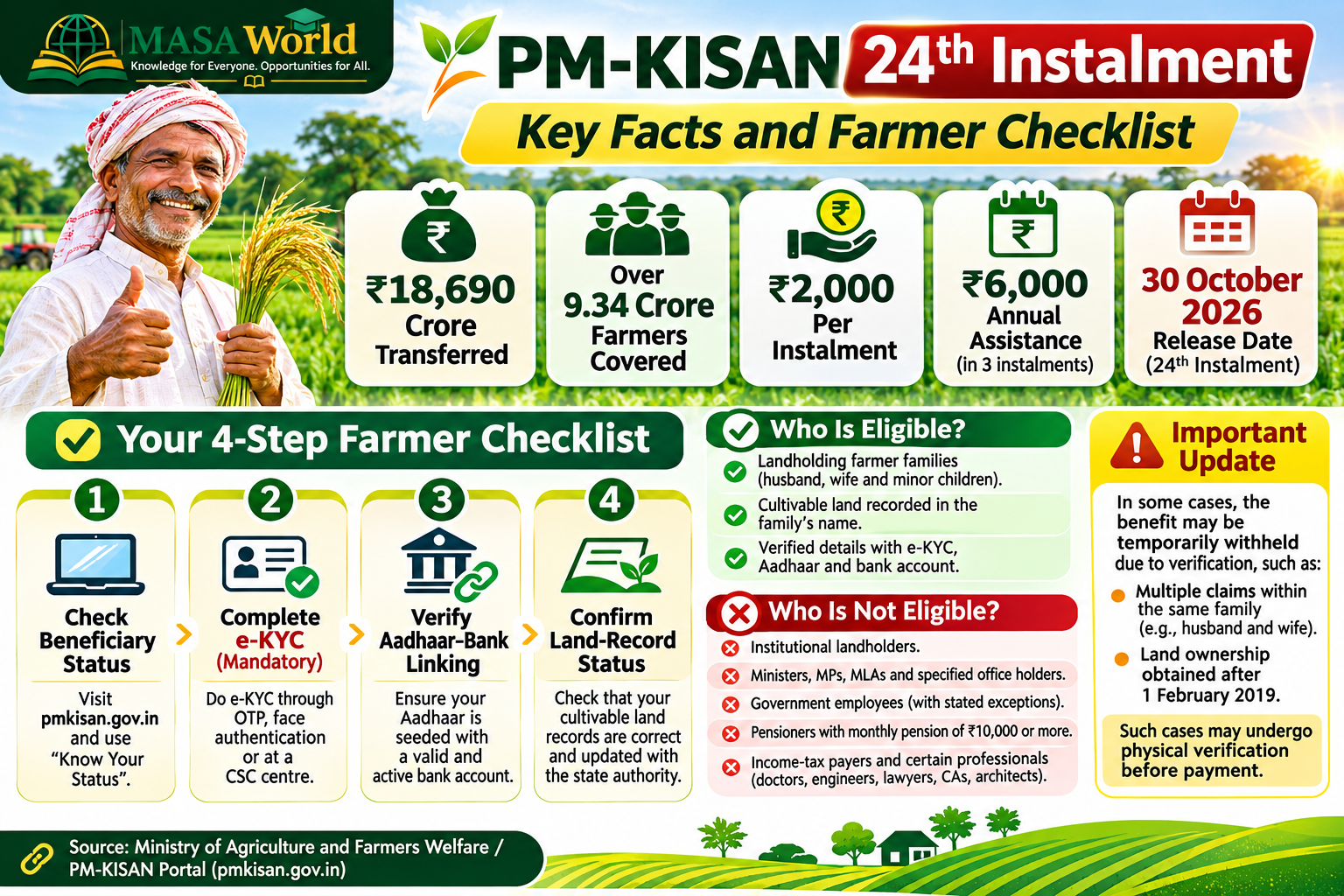
The Government of India released the 24th instalment of the Pradhan Mantri Kisan Samman Nidhi (PM-KISAN) on 30 October 2026. The official announcement reported that more than ₹18,690 crore was transferred through Direct Benefit Transfer (DBT) to over 9.34 crore eligible farmers. The instalment is ₹2,000 per eligible farmer family—not ₹2,000 for every individual member—and remains subject to eligibility and verification.
The national release figure does not mean every registered applicant has received money. The PM-KISAN portal states that e-KYC is mandatory and that certain suspected exclusion cases—including land ownership acquired after 1 February 2019 and multiple family-member claims—may have benefits temporarily withheld until physical verification. Farmers should check their individual Know Your Status record.
Executive Summary
PM-KISAN is a Central Sector scheme, fully funded by the Government of India, that provides income support to eligible landholding farmer families. It provides ₹6,000 per family per year in three equal instalments of ₹2,000. The 24th instalment was released on 30 October 2026. The official announcement reported a transfer of more than ₹18,690 crore to over 9.34 crore farmers. Cumulative disbursements have crossed ₹4.64 lakh crore.
The most useful action for a beneficiary is to check the official PM-KISAN portal. Review beneficiary status, payment details, e-KYC, land seeding and Aadhaar-linked bank information. The portal also asks farmers in suspected exclusion cases to check their status through Know Your Status or the Kisan eMitra chatbot.
PM-KISAN 24th Instalment: Key Facts
| Detail | Official information |
|---|---|
| Scheme | Pradhan Mantri Kisan Samman Nidhi |
| Instalment | 24th instalment |
| Release date | 30 October 2026 |
| Amount per instalment | ₹2,000 |
| Annual assistance | ₹6,000 |
| Farmers covered in this release | Over 9.34 crore |
| Amount transferred | More than ₹18,690 crore |
| Transfer method | Direct Benefit Transfer |
| Responsible department | Department of Agriculture and Farmers Welfare |
| Official portal | pmkisan.gov.in |
1. What Happened on 30 October 2026?
The Prime Minister released the 24th PM-KISAN instalment from Banaskantha, Gujarat. The government transferred more than ₹18,690 crore directly to over 9.34 crore eligible farmers. The payment used the DBT system, which sends government assistance to beneficiaries’ bank accounts.
The event also included two agricultural infrastructure announcements. The government dedicated 521 units developed under the Agriculture Infrastructure Fund. It also inaugurated 12 horticulture clusters to promote high-value horticultural crops. These measures address different needs. PM-KISAN provides direct income support, while infrastructure can improve storage, processing and market opportunities.
The national release does not mean every person registered on the portal has received money. Payments depend on individual eligibility, verified records and successful processing. A farmer should check the personal payment record before assuming that the instalment has arrived.
2. Understanding the PM-KISAN Scheme
PM-KISAN became operational from 1 December 2018 and was formally launched in February 2019. It is a Central Sector scheme with 100% funding from the Government of India. State and UT administrations identify and verify eligible farmer families using land records and scheme rules. The support can help meet agricultural and household expenses, including seeds, fertilisers, irrigation and other farm inputs.
The scheme provides ₹6,000 each year. The government pays this amount in three instalments of ₹2,000. The instalments relate to three four-month periods. The government announces the release dates. PM-KISAN is an income-support benefit, not a loan. Eligible beneficiaries do not repay the assistance. However, benefits received by ineligible persons may be subject to recovery under applicable rules.
The Union Cabinet approved continuation of PM-KISAN from financial year 2026–27 to 2030–31 with a total financial outlay of ₹3.15 lakh crore. The Union Budget 2026–27 also allocated ₹60,000 crore for the scheme. This provides a longer-term policy framework, but all beneficiaries must still satisfy eligibility and verification requirements.
3. Who Can Receive PM-KISAN Benefits?
PM-KISAN covers eligible landholding farmer families across India, subject to the notified exclusion categories. The scheme was extended beyond the original small-and-marginal-farmer limit to all eligible landholding farmer families irrespective of the size of their cultivable holding. Qualifying landholding must generally be recorded in the relevant State or UT land records. State and Union Territory authorities identify and verify eligible households using land and beneficiary records.
For this scheme, a farmer family generally means husband, wife and minor children. The family is treated as one beneficiary unit. The scheme does not provide a separate full benefit to every member of the same family.
- The family must meet the applicable landholding conditions.
- Land and beneficiary details must be verified by the relevant state or Union Territory.
- Required identity and bank information must be correct.
- Land seeding, Aadhaar-bank linking and e-KYC requirements must be completed.
- The applicant must not fall under an exclusion category.
A tenant, sharecropper or agricultural labourer who cultivates land owned by another person is not automatically eligible merely because they work that land. The scheme is based on qualifying landholding and recorded ownership, with limited special provisions and State-specific record handling. Such farmers should check other central and state agricultural support programmes.
4. Who Is Not Eligible?
The scheme excludes certain institutional and higher-economic-status categories. The official guidelines include institutional landholders, current and former holders of specified constitutional posts, and certain elected representatives. They also exclude serving or retired government employees in specified categories, certain pensioners receiving a monthly pension of ₹10,000 or more, income-tax payers in the last assessment year, and practising professionals such as doctors, engineers, lawyers, chartered accountants and architects.
The exclusion rules contain important exceptions. Serving or retired Multi-Tasking Staff (MTS), Class IV and Group D employees are not excluded solely on that employment category, provided the family meets all other conditions. The rules also address Non-Resident Indians (NRIs) and other specified cases. Check the current official operational guidelines before deciding eligibility.
The PM-KISAN portal currently flags suspected cases involving land ownership acquired after 1 February 2019 and cases where more than one family member receives benefits. It says benefits in such suspected cases have been temporarily withheld until physical verification is completed. This notice does not mean every farmer with a recent land change is automatically ineligible. The individual record and applicable rules must be examined.
5. How to Check Your 24th Instalment Status
Farmers can check their records on the official website. Open pmkisan.gov.in, find Farmers Corner and select Know Your Status. Enter the information requested by the portal and complete the verification process. Review the beneficiary and payment information shown on the screen.
Check these details carefully:
- Beneficiary registration status.
- e-KYC completion status.
- Land-seeding status.
- Aadhaar-bank linking information.
- Payment status and transaction details.
- Any verification or eligibility remarks.
The portal also provides beneficiary-list and other farmer services. If a family believes it has been wrongly omitted, check registration and status first, then approach the village-level revenue functionary, Block or District Agriculture Office, or State PM-KISAN nodal authority as appropriate. A previous successful instalment does not guarantee every future payment. Verification requirements can still apply.
6. Why Might a Payment Be Delayed or Held?
A national instalment announcement and an individual bank credit are not the same thing. A payment may be delayed or rejected for several reasons. Farmers should use the status shown on the official portal to identify the issue.
Incomplete e-KYC
The official portal says e-KYC is mandatory for registered beneficiaries. An incomplete verification record can prevent payment processing.
Aadhaar-bank linking problem
PM-KISAN uses Aadhaar-linked banking arrangements. Farmers should ask their bank to confirm whether Aadhaar seeding is active and whether the account can receive DBT payments.
Land records are not seeded or verified
State authorities validate land records and beneficiary details. Missing, outdated or incorrect records can affect eligibility validation. Farmers may need to approach the relevant revenue office to correct land information.
Multiple family claims or suspected exclusion
The scheme treats the husband, wife and minor children as one farmer family. Multiple claims can trigger verification. The portal also flags certain suspected cases involving recent land ownership changes. In those cases, benefits may remain temporarily withheld until physical verification is completed.
Incorrect bank details or pending state verification
An incorrect account number, IFSC or inactive account can affect payment. State and Union Territory authorities also identify and verify beneficiaries. A pending state-level record can delay the transfer. Farmers should ask for the specific reason rather than relying on rumours or unofficial agents.
7. How to Complete PM-KISAN e-KYC
e-KYC is mandatory for registered PM-KISAN farmers. The official portal identifies OTP-based and biometric options. Face-authentication is available through the PM-KISAN mobile application and the required Aadhaar Face RD application. Biometric verification is also available through Common Service Centres and authorised users.
Method 1: OTP-based e-KYC
- Open the official PM-KISAN website.
- Select the e-KYC option.
- Enter the Aadhaar number requested by the portal.
- Follow the on-screen verification instructions.
- Enter the OTP received on the Aadhaar-linked mobile number.
- Complete the process and check the updated status.
If the OTP does not arrive, check whether the mobile number is linked to Aadhaar. Use only the official website or authorised application.
Method 2: Face-authentication e-KYC
Farmers can use the official PM-KISAN mobile application with the Aadhaar Face RD application for face-authentication. Sign in using the registered mobile number, open beneficiary status or e-KYC, enter the Aadhaar details requested, provide consent and follow the face-scan instructions. Download both apps only from official app stores and verify the publisher. Download applications only from official app stores and verify the publisher.
Method 3: Biometric e-KYC at a CSC
Farmers who cannot complete OTP or face authentication may visit a Common Service Centre. Carry Aadhaar details and PM-KISAN registration information. Ask the operator to complete the authorised biometric process and confirm that the status has updated.
8. Aadhaar, Bank Accounts and Land Records
PM-KISAN uses a linked verification process. The farmer provides information, state authorities validate eligibility, and banking systems process the payment. A problem at any stage can affect the final credit.
- Aadhaar: Check that identity details are accurate and that the required authentication can be completed.
- Bank account: Confirm that the account is active, Aadhaar seeding is complete and DBT credits can be received.
- Land records: Confirm that the relevant land details are correct in state records and have been verified for PM-KISAN.
- Beneficiary data: Check that family and registration information is accurate.
When a land record is wrong, contact the State revenue department or local land-record office. For Aadhaar seeding or DBT mapping, ask the bank to verify Aadhaar seeding and the NPCI mapper status. For an incorrect or inactive account, contact the bank. For scheme-level eligibility remarks, contact the agriculture office or PM-KISAN helpdesk. The institution responsible for the record is usually the correct place to request a correction.
9. What Should Farmers Do if Money Has Not Arrived?
Do not immediately assume that registration has been cancelled. First identify the reason shown in the official status record. Then take the following steps.
- Step 1 — Check Know Your Status: Review the payment record, beneficiary status and any verification remarks.
- Step 2 — Complete e-KYC: If the portal shows e-KYC as incomplete, use an official OTP, face-authentication or biometric method.
- Step 3 — Contact the bank: Ask whether Aadhaar seeding is active, the account is operational and DBT credits can be received.
- Step 4 — Contact the agriculture office: If the issue concerns land or eligibility, ask the district or state agriculture office for the exact reason and correction process.
- Step 5 — Raise an official grievance: Use the PM-KISAN portal’s helpdesk or the government’s grievance redressal channel where appropriate.
- Step 6 — Keep evidence: Save the complaint reference number and copies of relevant records. Follow up through the official channel.
Never pay an unofficial agent to release a pending instalment. Government officials and genuine service providers should not ask for your banking PIN, OTP or internet banking password. Do not share these details with callers or unknown websites.
10. Economic Impact and Limitations of PM-KISAN
PM-KISAN provides direct financial assistance to eligible farmer families. A ₹2,000 instalment can help meet part of a household’s agricultural or essential expenses. It may support the purchase of seeds, fertilisers or small farm inputs. It can also provide limited support between crop payments.
The scheme’s scale is significant. The 24th instalment transferred more than ₹18,690 crore to over 9.34 crore farmers. Cumulative disbursements crossed ₹4.64 lakh crore. These figures show the reach of the programme. They do not, by themselves, prove a specific increase in farm income, crop yield or household welfare.
The annual assistance is limited compared with the full cost of cultivation. Farmers also need irrigation, crop insurance, storage, fair market access, agricultural research and reliable extension services. Tenant farmers and agricultural workers may not qualify under the normal landholding-based rules. Digital verification can also create difficulty for people with limited connectivity or inaccurate records.
The scheme works best alongside wider agricultural support. Transparent verification, timely grievance handling and accessible local assistance are important. Genuine farmers should have a clear way to correct errors and understand why a payment has been held.
11. Important Eligibility Clarifications Farmers Often Miss
There is no current general two-hectare ceiling
Older PM-KISAN material described support for small and marginal farmers owning up to two hectares. The scheme was subsequently extended to all eligible landholding farmer families irrespective of the size of their landholding, subject to exclusions. Therefore, owning more than two hectares does not by itself disqualify a family under the expanded framework. Other exclusion rules still apply.
The 1 February 2019 landholding cut-off needs careful interpretation
The operational guidelines use 1 February 2019 as the cut-off date for determining qualifying landholding, with a specific exception for transfer of ownership through succession following the death of the landowner. A purchase, gift or other transfer after the cut-off does not automatically create eligibility for the new owner. The current portal flags suspected post-cut-off land-acquisition cases for physical verification. This is a verification alert, not a substitute for a case-specific decision: check the individual record and applicable succession exception with the State authority.
Joint landholding and the family definition
The scheme treats husband, wife and minor children as one farmer family. Where land is jointly held or family members have separate parcels, State authorities apply the scheme’s land-record and beneficiary-identification rules. A family should not file multiple claims simply because several relatives appear in a land record. If more than one family member receives instalments, the portal may flag the case for verification.
Special land-record arrangements
The operational guidelines provide special handling for certain North-Eastern States and Jharkhand because of differences in land ownership and record systems. Local State and UT authorities determine which supporting documents or verification route applies. Farmers in these regions should follow their State nodal department’s instructions rather than assume the standard land-record workflow is identical everywhere.
12. PM-KISAN Payment Troubleshooting: Match the Status to the Next Step
| What the portal or bank shows | What to check next | Where to go |
|---|---|---|
| e-KYC pending / not completed | Complete OTP, face or biometric e-KYC; revisit status to confirm it updated. | PM-KISAN portal, official app or authorised CSC |
| Land seeding pending | Check whether land details are correct and State verification is complete. | Revenue / land-record office and Agriculture Office |
| Aadhaar-bank seeding or DBT mapping issue | Ask the bank to verify Aadhaar seeding and NPCI mapper status for the account intended to receive DBT. | Bank branch |
| Bank account invalid, closed or details mismatch | Correct account details through the authorised process and confirm the account is active. | Bank and PM-KISAN record-correction channel |
| Eligibility / physical verification pending | Ask for the exact reason and documents required; do not pay an agent. | Village / Block / District Agriculture Office or State nodal officer |
| Payment marked processed but not visible | Check the bank statement and transaction details; ask the bank to trace the DBT credit. | Bank branch, then official PM-KISAN grievance channel if unresolved |
Keep a note of the status message, date checked, registration number and complaint reference. Do not post Aadhaar numbers, bank account details or OTPs publicly or send them to unknown people on social media.
13. Kisan eMitra and Official Grievance Support
The PM-KISAN portal identifies Kisan eMitra as an AI-based chatbot that can help beneficiaries find information about scheme status and common queries. Use it through the official PM-KISAN website or official application. Treat it as an information and navigation aid: corrections to land records, bank mapping or eligibility still need to be made by the responsible authority.
Farmers can submit a query through the official PM-KISAN Grievance Query Form. The form asks for a temporary or registration number, captcha and a description of the issue. It also provides a way to view grievance details. Use the temporary ID where a new registration is pending approval. For a broader unresolved public-service grievance, use CPGRAMS and retain the acknowledgement number.
When submitting a grievance, describe the issue clearly: instalment number, date, portal status message, action already taken and the office contacted. Attach only documents requested by the official portal. Never share passwords, OTPs, debit-card PINs or full banking credentials.
14. What PM-KISAN Does—and Does Not—Provide
| PM-KISAN provides | PM-KISAN does not provide |
|---|---|
| ₹6,000 annual income support to each eligible farmer family, paid in three instalments. | ₹6,000 per month or ₹2,000 to every family member. |
| Direct transfer to the beneficiary’s bank account after verification. | An automatic payment to every person who cultivates land as a tenant or labourer. |
| Support that may help meet part of farm-input and household expenses. | A loan, crop-insurance policy, guaranteed crop price or reimbursement of all cultivation costs. |
| A national scheme with eligibility and exclusion rules. | Automatic eligibility where land, identity, bank or family records are incorrect or unverified. |
The distinction matters when families plan their finances. PM-KISAN is one component of farmer support. It does not replace crop insurance, irrigation, credit, storage, market access, extension services or State-level agricultural programmes.
15. MASA World Editorial Insight & Community Guidance
Government schemes create value when eligible people can understand, access and use them.
PM-KISAN is an important example of direct financial assistance. Its success should be measured not only by the amount announced. It should also be measured by timely payments, accurate records and accessible grievance support.
MASA World recommends five practical priorities:
- Awareness: Help farmers understand eligibility and official scheme rules.
- Digital inclusion: Support older farmers and people with limited digital skills.
- Record accuracy: Encourage families to correct land and bank details through authorised institutions.
- Transparency: Ask authorities to explain payment delays and verification decisions clearly.
- Protection: Educate beneficiaries about fake websites, fraudulent calls and requests for OTPs.
NGOs, community organisations, schools and local volunteers can help farmers access reliable information. They should never promise guaranteed approval or demand unofficial payments. Public awareness should make government services easier to use, not create new barriers.
16. Frequently Asked Questions
1. Has the 24th PM-KISAN instalment been released?
Yes. The Government of India released the 24th instalment on 30 October 2026. More than ₹18,690 crore was transferred to over 9.34 crore eligible farmers.
2. How much money does a farmer receive under PM-KISAN?
An eligible farmer family receives ₹6,000 per year. The amount is paid in three instalments of ₹2,000 each.
3. How can I check my PM-KISAN payment status?
Visit pmkisan.gov.in, open Farmers Corner and select Know Your Status. Follow the portal’s instructions to review beneficiary and payment information.
4. Is e-KYC compulsory for PM-KISAN?
Yes. The official portal says e-KYC is mandatory for registered beneficiaries. Farmers can use available OTP, face-authentication or biometric methods.
5. Why has my PM-KISAN payment not arrived?
Possible reasons include incomplete e-KYC, missing Aadhaar-bank linking, land-record problems, incorrect bank details or pending eligibility verification. Check the official status and contact the relevant bank or government office.
6. Is the scheme limited to farmers with two hectares or less?
No. The scheme was extended to all eligible landholding farmer families irrespective of landholding size, subject to the exclusion rules. The old two-hectare limit should not be treated as the current general ceiling.
7. Can a tenant farmer receive PM-KISAN?
Not automatically. The scheme is based on eligible landholding farmer families and qualifying land records. A tenant or sharecropper whose name is not recorded as the qualifying landholder may not qualify under the standard rules.
8. What if land was inherited after 1 February 2019?
The operational guidelines provide an exception for transfer through succession following the death of the landowner. Other post-cut-off transfers are treated differently. Ask the State revenue or agriculture authority to verify the specific case.
9. How do I complete e-KYC if my Aadhaar-linked mobile number is unavailable?
Check the currently available biometric or face-authentication options through the official PM-KISAN app or an authorised CSC. Do not use an unofficial agent or share OTPs and passwords.
10. Where can I complain about a pending or incorrect payment?
Use the official PM-KISAN Grievance Query Form. Keep the registration number, status details and grievance acknowledgement for follow-up.
11. Does a successful previous instalment guarantee the next one?
No. Beneficiary records and eligibility may be checked again. Keep e-KYC, land details and bank/DBT information accurate and review the latest Know Your Status record.
12. Is PM-KISAN a loan that must be repaid?
No. It is income support, not a loan. However, payments made to ineligible beneficiaries or obtained through incorrect declarations may be recovered under applicable rules.
17. Official References and Research Sources
- Department of Agriculture and Farmers Welfare — PM-KISAN Official Portal: instalment notice, e-KYC, Know Your Status and beneficiary services.
- Press Information Bureau — 24th Instalment of PM-KISAN: transfer figures, annual assistance and cumulative disbursement.
- Press Information Bureau — Release of the 24th Instalment: confirmation of the 30 October 2026 transfer and associated agricultural initiatives.
- Press Information Bureau — Verification Under PM-KISAN: land seeding, Aadhaar-bank linking and e-KYC requirements.
- Press Information Bureau — Cabinet Approval for Continuation of PM-KISAN: continuation from 2026–27 to 2030–31 and approved financial outlay.
- PM-KISAN Revised Operational Guidelines: eligibility, exclusions, family definition and landholding cut-off.
- PM-KISAN Grievance Query Form: official complaint registration and status.
- PM-KISAN – Modes and Processes of e-KYC: OTP, biometric and face-authentication instructions.
Editorial transparency: Research cutoff 10 November 2026. This article distinguishes confirmed national release figures from individual beneficiary outcomes. A national instalment release does not guarantee payment to every registered applicant. Individual eligibility and verification requirements continue to apply.