
COP31 2026: World Climate Summit Opens as WMO Warns of Record Heat, Rising Seas and Growing Risks
Updated: 10 November 2026
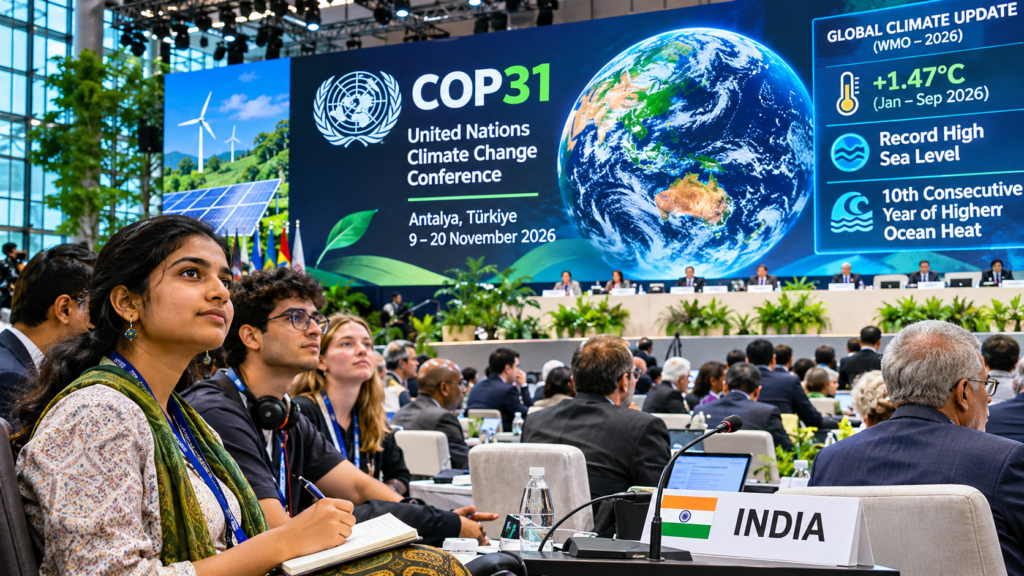
The 31st United Nations Climate Change Conference (COP31) opened in Antalya, Türkiye, on 9 November 2026 and is scheduled to run until 20 November. On its opening day, the World Meteorological Organization (WMO) released its State of the Climate Update for COP31. It reports that 2026 is among the four warmest years on record, global ocean heat and mean sea level are at record highs, and El Niño has intensified since August. The developing El Niño is expected to raise the risk of extreme heat, drought and heavy rainfall well into 2027.
These developments make COP31 more than a diplomatic meeting. They connect climate policy with food systems, public health, jobs, water security, energy affordability and household costs. For India, the central questions include predictable climate finance, adaptation, technology access, equity and a transition that protects development needs and workers.
COP31 at a Glance
| Item | Details |
|---|---|
| Conference | 31st Conference of the Parties (COP31) |
| Dates | 9–20 November 2026 |
| Host city and country | Antalya, Türkiye |
| Framework | United Nations Framework Convention on Climate Change (UNFCCC) |
| Latest science update | WMO State of the Climate Update 2026, released 9 November |
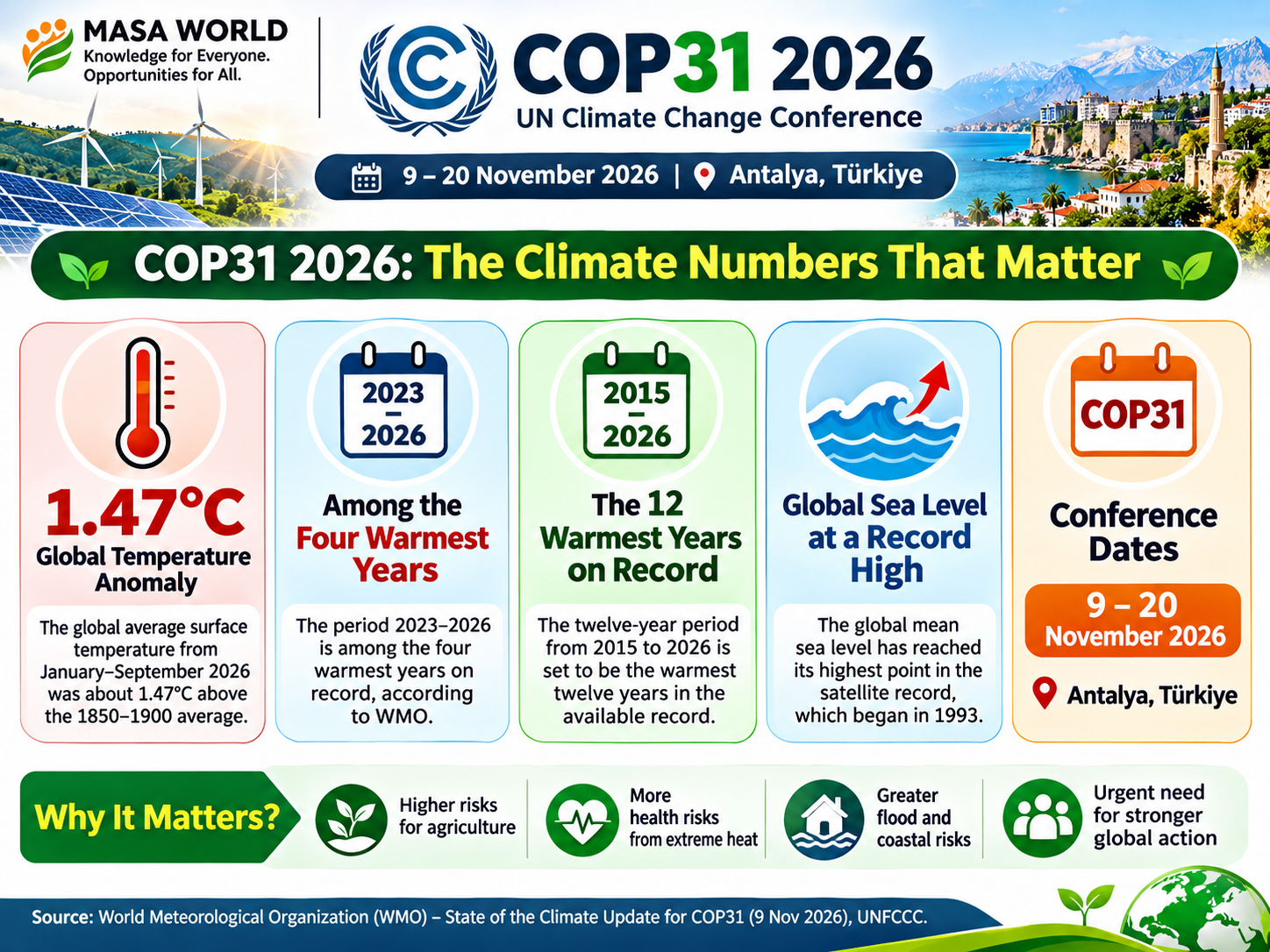
| Global temperature indicator | About 1.47°C above the 1850–1900 average for January–September 2026 |
| India’s stated priorities | Predictable climate finance, adaptation and mitigation outcomes, technology transfer and just transition |
| Reporting status | Summit ongoing as of 10 November 2026 |
1. Why COP31 Matters Now
COP is the annual meeting of countries that are parties to the UNFCCC. Governments use it to review climate action, negotiate shared decisions and strengthen cooperation. The Paris Agreement, adopted in 2015, is a central part of this process. It aims to hold the rise in global average temperature well below 2°C and pursue efforts to limit it to 1.5°C above pre-industrial levels.
COP31 takes place during a period of unusually high global temperatures and growing climate impacts. The WMO’s latest update gives negotiators a clear scientific warning. The question is no longer whether climate risks matter. The question is how quickly governments can reduce emissions, protect people and fund practical solutions.
The conference also highlights a major gap between promises and delivery. Countries need stronger plans, reliable data, trained workers and investment. Communities need measures that protect homes, livelihoods, health and essential services.
2. What the WMO Report Says: Five Important Signals
The WMO released its State of the Climate Update for COP31 on 9 November. The global temperature figure uses data from January to September 2026; other indicators use their stated data cut-offs. The report is a scientific update, not a forecast of the final annual temperature or a claim that every region experienced the same conditions.
2.1 2026 is among the four warmest years on record
The WMO says 2023–2026 are set to be the four warmest years in the observational record. The global average surface temperature for January to September 2026 was about 1.47°C above the 1850–1900 pre-industrial average. This is a nine-month estimate, not the final annual figure. It should not be confused with the long-term warming level used to assess the Paris Agreement temperature goals.
2.2 The recent twelve-year period is exceptionally warm
The WMO reports that 2015–2026 are set to be the warmest twelve-year period on record. A twelve-year sequence of exceptional warmth is evidence of a sustained global trend; it is not simply a statement about one unusually hot season.
2.3 Ocean heat remains at a record level
Oceans absorb much of the excess heat trapped by greenhouse gases. Preliminary data through July 2026 point to a tenth consecutive year of record ocean heat content. Warmer oceans affect marine ecosystems, coral reefs, fisheries and weather patterns. Coastal communities can face added pressure on food sources and livelihoods.
2.4 Global mean sea level is at a satellite-era record
The WMO says global mean sea level reached its highest point in the satellite record, which began in 1993. Sea-level rise reflects several processes, including ocean warming and the addition of water from melting land ice. It increases the baseline risk of coastal flooding, erosion and saltwater intrusion, and can worsen storm-surge impacts on ports, roads, homes and freshwater systems.
2.5 Extreme weather carries a high human and economic cost
Heat, drought, heavy rainfall and storms can damage homes, crops, transport and public services. The effects can continue after the event. Families may lose income, schools may close and local authorities may face large recovery costs. Reliable observations and early warnings help people prepare and reduce avoidable harm.
3. El Niño and the Risks into 2027
El Niño is a naturally occurring climate pattern associated with warmer-than-average sea-surface temperatures in the central and eastern equatorial Pacific. It influences atmospheric circulation and can shift the probability of weather patterns around the world. The WMO says El Niño intensified from August 2026 and is expected to increase the risk of extreme heat, drought and heavy rainfall well into 2027. It does not mean every location will experience all these hazards.
Its effects are not identical in every country. El Niño can be associated with a higher risk of weaker Indian summer monsoon rainfall, but it does not determine the monsoon on its own. Indian Ocean conditions, regional weather systems and other factors also influence rainfall. People should follow forecasts and advisories from the India Meteorological Department (IMD), rather than treating a global outlook as a local prediction.
Long-term human-driven warming and natural climate variability are different processes. They can still interact. A strong El Niño can add heat to a planet that is already warmer because of greenhouse gas emissions.
4. The Major Issues on the COP31 Agenda
Climate finance
Countries need money to reduce emissions and prepare for climate impacts. Developing countries argue that finance must be accessible, predictable and affordable. The form of support matters. Grants and concessional finance can reduce debt pressure compared with loans on less favourable terms.
Adaptation and resilience
Adaptation means preparing people, services and infrastructure for climate impacts. It includes heat action plans, flood protection, water security, resilient agriculture and stronger health systems. Local risk information is essential. A coastal town, a dry farming district and a dense city need different solutions.
Emissions reduction
Mitigation means reducing greenhouse gas emissions or increasing their removal. Electricity, transport, buildings, industry, agriculture and land use all matter. Cleaner power, efficient equipment, public transport and better industrial processes can reduce emissions. Policies must also consider affordability and reliable energy access.
Just transition and workers
A shift to cleaner energy can create new jobs. It can also affect workers and communities that depend on high-emission industries. A just transition includes training, worker protection, social dialogue and support for affected regions. New opportunities should be accessible to women, young people and lower-income communities.
Technology and early-warning systems
Satellites, weather stations, forecasting tools and public warning systems help governments prepare. Renewable energy, storage, efficient buildings and climate-smart agriculture can support the transition. Technology works best when countries can afford it, maintain it and train people to use it.
5. India’s Priorities and Position
India has major development needs and significant exposure to climate risks. Agriculture, coastal settlements, cities and outdoor workers can all be affected by heat, water stress and extreme rainfall. India therefore argues that climate action must recognise different national circumstances and development priorities.
On 3 November 2026, Union Environment Minister Bhupender Yadav outlined India’s priorities: predictable climate finance, party-driven mitigation and adaptation outcomes, technology transfer and just transition. On 10 November, India’s opening statement at COP31 reaffirmed climate multilateralism, equity and Common But Differentiated Responsibilities and Respective Capabilities (CBDR-RC). India emphasised that public finance from developed countries remains central to supporting developing-country climate action, particularly adaptation. It also aligned itself with statements by G77 and China, LMDC and BASIC.
Predictable and accessible finance
India wants finance that developing countries can plan around and access on suitable terms. It argues that support should not create unsustainable debt burdens. Finance must reach projects that deliver measurable results for people and the environment.
Adaptation and nationally determined action
India supports adaptation as a core part of climate action. It also stresses that countries should be able to choose pathways suited to their national conditions. This includes poverty reduction, energy access, infrastructure and employment.
Technology transfer and a fair transition
Access to technology can help developing countries improve energy systems, climate monitoring and resilience. India also stresses that workers and communities must be considered as energy systems change. These priorities connect international negotiations with domestic development.
6. How Climate Risks Affect Daily Life
Farmers and food systems
Farmers depend on suitable temperatures, water and seasonal information. Heat and rainfall changes can affect crop growth, sowing and irrigation costs. Useful responses include soil conservation, efficient irrigation, crop diversification, local forecasts and access to agricultural advice. No single crop or technology is suitable for every region.
Children, students and schools
Extreme heat can affect health, concentration and outdoor activity. Schools can improve drinking-water access, ventilation and shade. They should follow local heat advisories and adjust outdoor sports when conditions become unsafe. Preparedness should include children with disabilities and students who travel long distances.
Outdoor and daily-wage workers
Construction workers, delivery workers, street vendors and agricultural labourers can face high heat exposure. Employers and authorities should provide drinking water, shaded rest areas, suitable breaks, heat-risk information and emergency support. Work schedules may need adjustment during severe heat, following local guidance.
Women and vulnerable households
Climate impacts can increase the time and effort needed to secure water, food and household income. Older people, persons with disabilities and low-income families may face additional barriers during emergencies. Local plans should identify these needs before a crisis occurs.
Cities and coastal settlements
Cities need drainage, safe public spaces, tree cover, water management and resilient buildings. Coastal areas need risk mapping, suitable land-use planning and protection for essential infrastructure. Local authorities should use scientific risk assessments before approving major development.
7. Climate Finance: The Difficult Question
Climate finance supports mitigation and adaptation. It can come from national budgets, development banks, dedicated climate funds and private investment. Each source has different conditions and risks. Public support is especially important where projects protect vulnerable communities but do not generate commercial returns.
Developing countries argue that wealthier nations should provide stronger support, reflecting their responsibilities and capacity. They also raise concerns about loans that add to public debt. Donors and recipient governments must make funding transparent, track results and prevent misuse.
Useful outcomes should be visible in communities: safer homes, better water systems, resilient crops, reliable clean energy, stronger hospitals and effective warning systems. The amount announced is only one measure. Access, quality and real-world impact matter too.
8. Green Skills, Technology and Future Jobs
The transition can create demand for skilled workers. Potential areas include solar installation, wind operations, battery maintenance, electric mobility, energy audits, environmental monitoring, sustainable construction and climate data services. These are career areas, not guaranteed vacancies. Students should check course quality, practical training and employer demand before paying for a programme.
Artificial intelligence can support weather forecasting, flood modelling, energy planning and satellite analysis. It also uses electricity and computing resources. Its environmental value depends on efficient systems, responsible energy use and whether it solves a real problem. Technology should support qualified experts, not replace official warnings or scientific review.
9. What Communities and Young People Can Do
- Learn from reliable sources: Follow the WMO, UNFCCC, IMD and relevant public authorities. Check dates and local relevance.
- Conserve water: Repair leaks, use water carefully and support responsible rainwater harvesting where suitable.
- Reduce waste: Separate waste, avoid unnecessary single-use materials and support safe recycling systems.
- Protect local ecosystems: Care for existing trees, wetlands and water bodies. Choose native species and plan for long-term maintenance when planting.
- Prepare for heat and floods: Know local warning channels, emergency contacts and safe routes.
- Build useful skills: Explore recognised training in energy, water, environment, disaster response and climate technology.
- Make sport climate-aware: Coaches and organisers should consider heat, hydration, shade and official weather advice when planning outdoor sessions.
Community action does not replace government responsibility. It can strengthen public programmes and help residents identify local needs. Projects should set clear goals, involve the people affected and report results honestly.
10. What to Watch Before the Summit Closes
COP31 is scheduled to run until 20 November 2026. As of 10 November, negotiations are still under way. Final decisions must not be treated as confirmed before they are formally adopted.
- Finance: Will countries agree on practical steps that improve access to predictable and affordable climate finance?
- Adaptation: Will support reach communities facing heat, drought, floods and coastal risks?
- Implementation: Will countries strengthen delivery of existing commitments?
- Technology: Will cooperation improve access to tools, expertise and early-warning systems?
- Fair transition: Will worker protection and skills development receive meaningful attention?
- Accountability: Will outcomes include clear responsibilities, reporting and follow-up?
The value of COP31 will depend on what happens after delegates leave Antalya. Governments must translate decisions into policy, budgets and local programmes. Public institutions should report progress in ways that citizens can understand.
11. COP31 Thematic Programme: What Is Being Discussed?
The COP31 Presidency has organised thematic days to connect negotiations with practical action. The schedule covers food and health, energy and transport, waste, cities, finance, youth, science, oceans, social development and implementation. These are programme themes and events; they should not be mistaken for final negotiated decisions.
| Date | Presidency thematic focus |
|---|---|
| 9 November | Food, Agriculture and Health |
| 10 November | Energy and Transport |
| 11 November | Zero Waste and World Leaders Summit – Day 1 |
| 12 November | Resilient Cities and Built Environment; World Leaders Summit – Day 2 |
| 13 November | Finance and Trade |
| 14 November | Children, Youth, Education and Skills |
| 16 November | Science, Industry and Technology |
| 17 November | Ocean, Seas, Nature and Land Use |
| 18 November | Human and Social Development |
| 19 November | İmece: Enhancing Implementation |
| 20 November | Final negotiations |
The schedule may be updated by the Presidency. Readers should consult the official COP31 thematic days programme and UNFCCC conference portal for current meeting times and documents.
12. What India Said in Its COP31 Opening Statement on 10 November
India’s opening statement, delivered by the Secretary of the Ministry of Environment, Forest and Climate Change, reiterated support for climate multilateralism and a fair outcome grounded in equity and Common But Differentiated Responsibilities and Respective Capabilities (CBDR-RC). India described the UNFCCC and Paris Agreement as inclusive forums in which every country should have a voice. It also referred to the COP31 Presidency’s emphasis on dialogue, consensus and action.
On finance, India highlighted Article 9.1 of the Paris Agreement and said public finance from developed countries remains central to enabling climate action in developing countries. India also stressed adaptation, just transition and the development needs of the Global South. These are India’s stated negotiating positions; the final COP31 decision text has not yet been adopted as of this article’s update date.
Why it matters: The debate is not only about how much money is announced. It is also about who provides it, whether it is predictable and accessible, whether it adds to debt, and whether it reaches communities facing the greatest risks.
13. What Would a Meaningful COP31 Outcome Look Like?
A useful summit outcome should be judged by implementation, not headlines alone. The following tests can help readers assess the final decisions once they are formally published.
- Finance: Clear pathways for predictable, accessible and affordable support, with transparent reporting on sources and delivery.
- Adaptation: Practical support for heat-health plans, resilient agriculture, water security, coastal protection and disaster preparedness.
- Mitigation: Stronger implementation of national climate plans, with transparent progress tracking and attention to energy access.
- Technology: Better access to climate information, early-warning systems, clean-energy technology and local capacity to maintain them.
- Just transition: Skills, social protection and meaningful participation for workers and communities affected by economic change.
- Accountability: Clear responsibilities, timelines and public reporting so commitments can be checked after the summit.
These are assessment criteria, not a prediction of what negotiators will agree. The final text and Presidency announcements should be checked before reporting any outcome as adopted.
14. MASA World Editorial Insight & Community Guidance
Climate change is not only an environmental issue. It is also an issue of education, equality, public health and economic opportunity.
MASA World believes that climate awareness must lead to practical, inclusive action. Governments need to protect people and deliver transparent programmes. Educational institutions should build climate literacy. Employers should protect workers. NGOs and community groups can help people understand risks and take part in local solutions.
We recommend five priorities:
- Education: Make reliable environmental knowledge available to students and communities.
- Youth development: Connect young people with green skills, science and responsible innovation.
- Community participation: Support local water conservation, waste management and ecosystem protection.
- Health and fitness: Make sports and outdoor programmes safer during extreme weather.
- Accountability: Ask public programmes to publish clear goals, spending information and measured outcomes.
A sustainable future requires cooperation among governments, businesses, schools, NGOs and citizens. Climate solutions must include people from every economic background. Knowledge for Everyone. Opportunities for All.
15. Frequently Asked Questions
1. What is COP31 and why is it important?
COP31 is the 31st meeting of countries under the UN climate convention. It is important because governments use it to negotiate climate action, finance, adaptation and cooperation.
2. Where and when is COP31 taking place?
COP31 is taking place in Antalya, Türkiye, from 9 to 20 November 2026. The summit is ongoing as of 10 November.
3. What did the WMO report about global temperatures in 2026?
The WMO said that January–September 2026 was about 1.47°C above the 1850–1900 average. It also said 2023–2026 are the four warmest years on record.
4. What are India’s main priorities at COP31?
India has highlighted predictable climate finance, adaptation and mitigation outcomes, technology transfer and just transition. It also stresses practical solutions that reflect national circumstances and development needs.
5. How can ordinary people contribute to climate action?
People can conserve water, reduce waste, protect local ecosystems and follow official weather warnings. Communities can also support climate education, preparedness and responsible local projects.
6. What is the WMO’s 1.47°C figure for 2026?
It is the estimated global average surface-temperature anomaly for January to September 2026 compared with the 1850–1900 pre-industrial average. It is not the final full-year figure or a measurement for every country.
7. Does El Niño mean India will definitely have a weak monsoon?
No. El Niño can increase the probability of certain monsoon outcomes, but India’s seasonal rainfall also depends on the Indian Ocean, regional weather systems and other factors. Follow official IMD forecasts rather than treating El Niño as a definite local prediction.
8. What are India’s main priorities at COP31?
India has highlighted predictable climate finance, adaptation, party-driven mitigation outcomes, technology transfer, equity and just transition. Its 10 November opening statement also stressed climate multilateralism and CBDR-RC.
9. Has COP31 reached its final agreement?
As of 10 November 2026, the conference is still in progress and is scheduled to close on 20 November. Do not treat proposals, speeches or draft texts as final decisions until they are formally adopted.
10. Where can I follow official COP31 updates?
Use the UNFCCC COP31 portal, the WMO COP31 page and official Presidency announcements for schedules, documents and adopted outcomes.
16. Official References and Research Sources
- World Meteorological Organization: State of the Climate Update for COP31 (9 November 2026)
- WMO: State of the climate in 2026 gives new meaning to phrase “off the charts” (9 November 2026)
- PIB: India’s COP31 priorities (3 November 2026)
- PIB: India’s opening statement at COP31 (10 November 2026)
- COP31 Presidency: Thematic Days Programme
- UNFCCC Global Climate Action: COP31 Action Agenda priorities
- United Nations: COP31 to take place 9–20 November 2026 in Antalya
- UNFCCC: COP31 conference portal
- WMO: Activities and live updates during COP31
- UN Climate Change: Opening remarks on climate and health at COP31 (9 November 2026)
Editorial transparency: Research cutoff 10 November 2026. COP31 is ongoing. This article distinguishes published scientific findings from expected risks and pending negotiation outcomes. It is for education and public information, not a substitute for official weather, health or emergency advice.